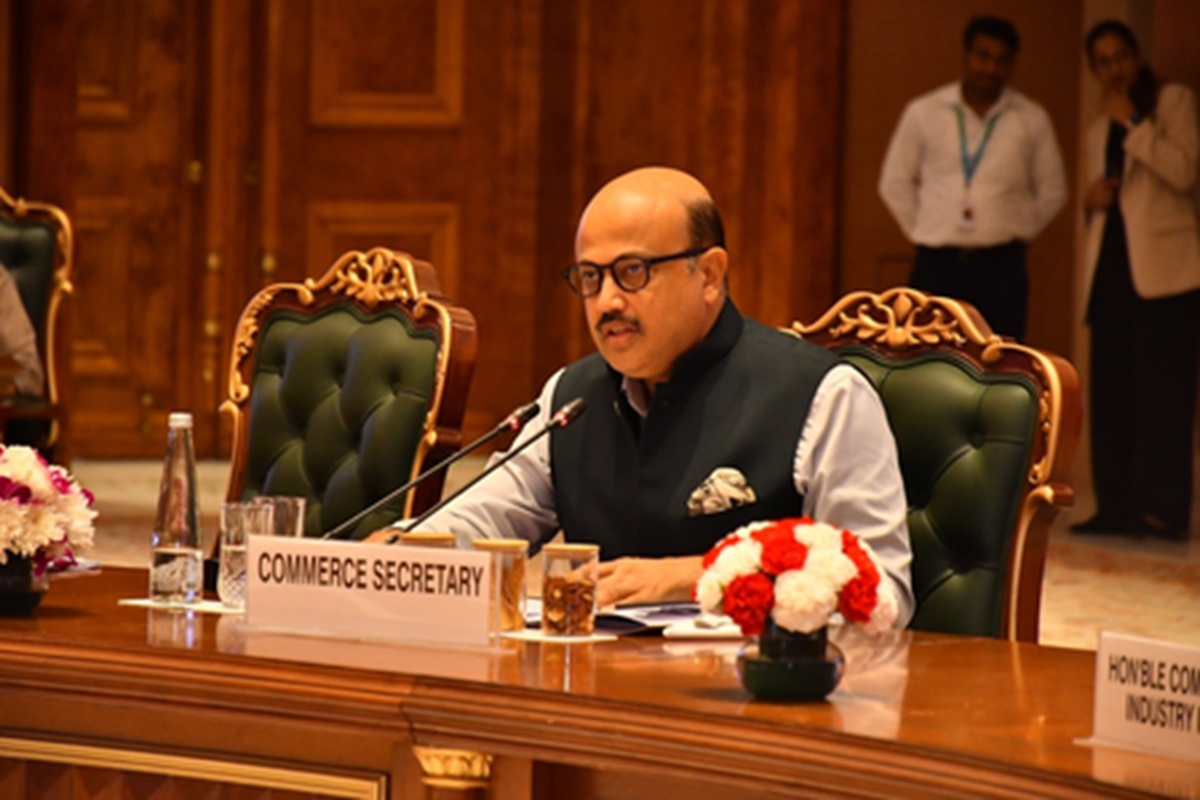
Commerce Secretary Rajesh Aggarwal on Wednesday said India should expand into global markets using its fintech capabilities, especially the experience of Unified Payments Interface (UPI) and digital public infrastructure (DPI).
Speaking at the Global Fintech Fest held in Mumbai, Aggarwal said that India has a huge opportunity to expand its digital payments and financial technology services, especially in the countries of the Global South.
He said that the fintech services market is growing rapidly globally and if India achieves even just 10 percent share in this trade, the country's fintech services exports can increase from the current $8 billion to $60 to $80 billion.
Rajesh Aggarwal said, “Global trade in the field of fintech services is growing rapidly. If we achieve even 10 per cent contribution in this, it can be a journey to reach exports of $ 60-80 billion from $ 8 billion.”
He said that India is already working towards taking its digital public infrastructure model to other countries. For this purpose, India has so far signed Memorandum of Understanding (MoU) for DPI cooperation with about 23 countries.
Additionally, the government is also working towards interconnecting payment systems with many countries, especially those that have large populations of Indian expatriates.
“We have signed agreements with about 23 countries for DPI cooperation. We also discuss coordination of payment systems in whatever free trade agreements we negotiate, especially with countries where people of Indian origin are present in large numbers,” Agarwal said.
He further said that technology can play an important role in reducing the cost of financial services. Digital payment systems and India's fintech capabilities can be expanded globally, especially to make remittances, credit distribution and payment services more affordable and accessible.
The Commerce Secretary also emphasized the role of Free Trade Agreements (FTAs) in the growth of the FinTech sector. He said India strives to remove barriers related to financial regulation, telecommunications, cross-border data flows, Artificial Intelligence (AI), investment and movement of professionals during various trade agreements, so as to create a more conducive environment for the FinTech sector.
“When we negotiate FTAs, we will strive to reduce barriers to financial regulation, telecommunications, data flows, AI, investments and movement of professionals to boost the fintech economy,” he said.
Aggarwal said that services trade is an important part of FTA negotiations, under which financial services are also given special attention. India strives to ensure that along with foreign banks getting opportunities in India, Indian banks and financial institutions can also expand into other countries.
He said, “In the last four to five years, India has signed nine free trade agreements, the size of the combined economy of the countries under its ambit is about $ 60 trillion.”