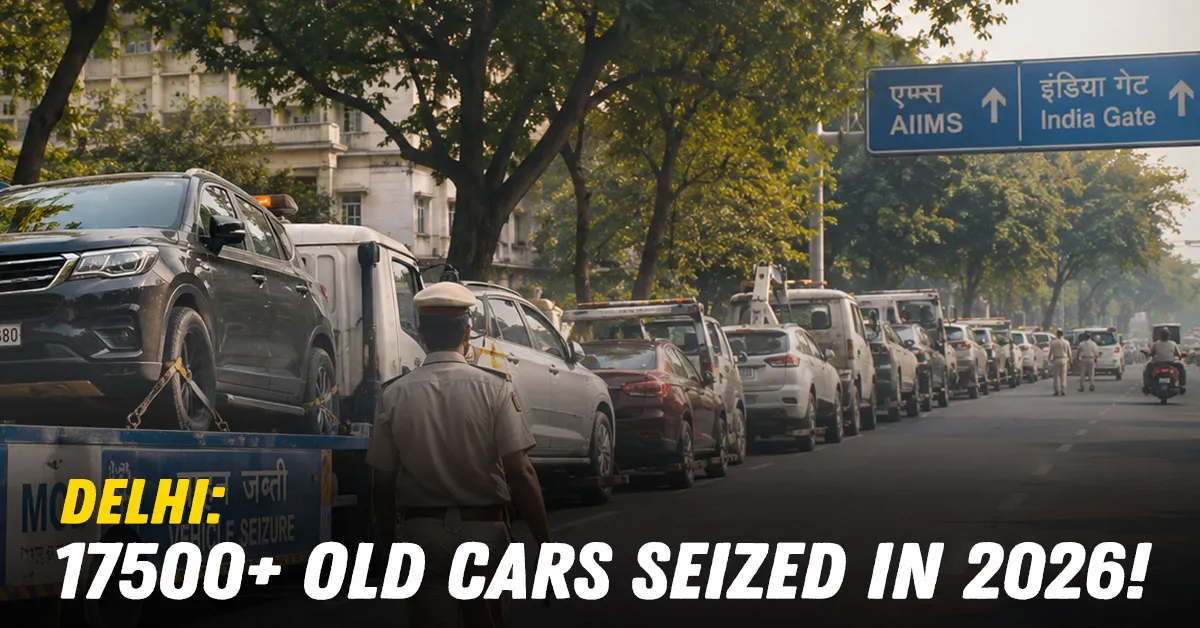
Delhi Traffic Police has impounded 17,506 end-of-life vehicles in 2026 as part of its drive against older vehicles. The operation is part of an effort to reduce air pollution and improve road safety. However, there is an important distinction for motorists: the age of a vehicle alone does not always justify its seizure under the latest Supreme Court directions.
The police figures cover 9,916 vehicles seized in the Eastern, Central and Northern traffic ranges, and another 7,590 in the Western, New Delhi and Southern ranges. They are cumulative enforcement figures, not the number of vehicles seized on a single day.
Delhi has long restricted diesel vehicles older than 10 years and petrol vehicles older than 15 years. These age limits came from earlier court and tribunal orders and led to large numbers of old vehicles being taken off the roads. Owners have often complained that a well-maintained car can become ineligible even when it passes a Pollution Under Control test.
The legal position is now more specific. On 17 December 2025, the Supreme Court modified an earlier order and said that no coercive action should be taken against owners of BS-IV and newer vehicles merely because their diesel vehicles have crossed 10 years or their petrol vehicles have crossed 15 years. Vehicles meeting BS-III or older emission standards do not have that protection. Other violations can still invite action under applicable rules.
This matters because the headline number of 17,506 vehicles does not come with a breakdown by emission standard, fuel type, or the reasons recorded in individual seizure notices.
The traffic police also organised a five-day awareness campaign between 12 and 16 November. Residents, market associations and residential welfare associations were told about end-of-life vehicle rules, authorised scrapping facilities and the problems caused by abandoned vehicles. One police update said 240 end-of-life vehicles were impounded during the campaign in Zone I.
Police have urged owners to use government-authorised vehicle scrapping facilities rather than selling old vehicles to unauthorised scrap dealers. An authorised scrapper offers a clearer record of disposal, which is useful when a vehicle is deregistered and the owner wants to avoid future disputes over its identity or use.

Removing a heavily polluting vehicle can help. Older engines may emit more particulate matter and nitrogen oxides than newer ones, especially when emission-control components are worn out or missing. Keeping such vehicles off the road is therefore a legitimate part of pollution control.
But 17,506 seizures cannot be converted into a claim about how much Delhi’s PM2.5 level has fallen. The number tells us about enforcement activity, not its measured effect. A meaningful assessment would need information about the vehicles’ emissions, how often they were driven and what portion of the city’s overall pollution came from them.
Delhi’s air quality is affected by many sources, including construction and road dust, industry, burning of waste, regional pollution and traffic. Even within the transport sector, stopping an old car is only one measure. Congested roads, idling traffic, poorly maintained commercial vehicles and weak compliance checks also matter.
Owners of older petrol and diesel cars should first check their vehicle’s Bharat Stage emission category, registration record and the latest applicable transport directions. A BS-IV or newer vehicle cannot be targeted solely for crossing the specified age threshold under the Supreme Court’s December 2025 protection. Owners should still keep their registration and pollution documents valid and comply with any separate traffic or seasonal restrictions.
Anyone planning to dispose of a vehicle should check that the facility is authorised and obtain the relevant paperwork. If the authorities impound a vehicle, the owner should ask for the written grounds rather than assume the action is automatically justified by age.