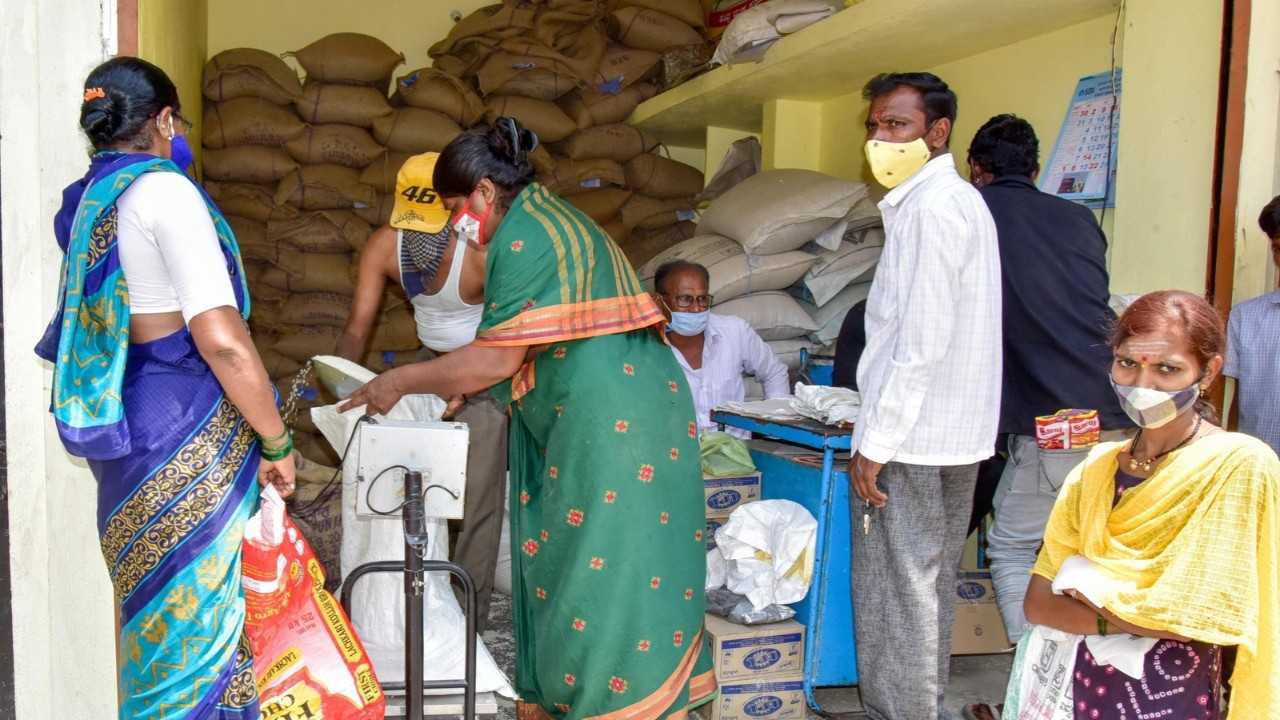
Every month about 3.27 crore people in the country are taking ration from some other shop instead of their fixed ration shop. Releasing this information on November 12, 2026, the Food and Public Distribution Department has described it as a major achievement of the 'One Nation One Ration Card' (ONORC) scheme. According to government data, since the launch of the scheme in August 2019, more than 233 crore portability transactions have been registered across all 36 states and union territories of the country. Through this, more than 614 lakh metric tonnes of grains have been distributed.
At first glance these figures seem very impressive but there is a big catch behind them. The 3.27 crore transactions taking place every month does not at all mean that so many migrant laborers are going to other states and taking ration. Actually, two types of transactions are involved in this total figure. The first is 'inter-state' i.e. a person holding a ration card of Bihar should take ration in Delhi and the second is 'intra-state' i.e. a person should take ration from a dealer other than a ration dealer in his own state. Looking at both the figures together, the picture of the actual benefits being received by migrant laborers becomes blurred.
Also read: Amritpal's grandmother passes away, gets one day bail, will have to return to jail again
What changed till now?
To understand this difference, the research of IIM Ahmedabad researchers Chinmay Tumbe and Rahul Kumar Jha, published in the journal 'Urbanization' in May 2024, can be seen. That research revealed that despite the launch of the scheme, it was being used mainly within the state. At that time, more than 2 crore transactions were taking place every month within the state. Whereas in other states the figure of taking ration was less than 5 lakh every month.
However, subsequent government data shows an increase in interstate portability. According to the government reply presented in the Lok Sabha on March 25, 2026, there has been an increase of about 18.9 percent in the transactions related to taking ration in other states. While in the year 2024 there were about 74.75 lakh inter-state transactions, in 2025 this number will increase to about 88.85 lakh. But here also it is important to understand that 88.85 lakh transactions do not mean 88.85 lakh different labourers. If the same laborer takes ration in another state for twelve months of the year, then he is counted twelve times in this figure.
Questions on real count and migration
This is where the biggest question arises, how many different migrant workers have used this facility? This question was also raised in the Rajya Sabha on March 17, 2026, but the government disclosed the state-wise transactions of five years but did not disclose the separate number of unique beneficiaries. Apart from this, just by looking at the total transactions state-wise, it is difficult to guess from which states the workers are taking ration.
For this, it is necessary to have the linked data of 'home state' i.e. where the ration card is and 'cell state' i.e. where the ration was taken, so that the truth of major migrant states like Bihar to Delhi, UP to Haryana or Odisha to Gujarat can be revealed. However, inter-state transactions are available separately in the data updated till October 15, 2026 on the government's Open Government Data platform (data.gov.in). The ministry also monitors these through two separate portals 'Annavitaran' (within the state) and 'IM-PDS' (interstate), but the data of repeated ration intake of the same person is still not public.
Who is being left out of the scope of the scheme?
Another major limitation of the ONORC scheme is that its benefit can be availed only by those people who have an eligible ration card made under the National Food Security Act (NFSA), 2013. Under the rules, one member of the family can collect his/her share of ration through Aadhaar biometric at any shop having e-PoS machine in another state, while the rest of the family can collect the ration in their village or home state. There is no need to make a new card for this. But what about those millions of migrant laborers in the country who do not have ration cards or who are not included in the NFSA list? Such workers are left out of this entire system.
Also read: 'My phone is being tapped', Rahul Gandhi's allegation on Prime Minister Narendra Modi
Many questions are yet to be answered to know the real success of the scheme at the ground level. For example, how many workers' transactions get stuck due to Aadhaar authentication failure, network problem, malfunction of e-POS machine or non-availability of food grains at the shop and how many workers are not even aware of this facility. Unless a clear account of the large number of transactions as well as the actual beneficiaries and the deprived workers is revealed, it is difficult to say how much portability of ration has strengthened the food security of migrant workers.