
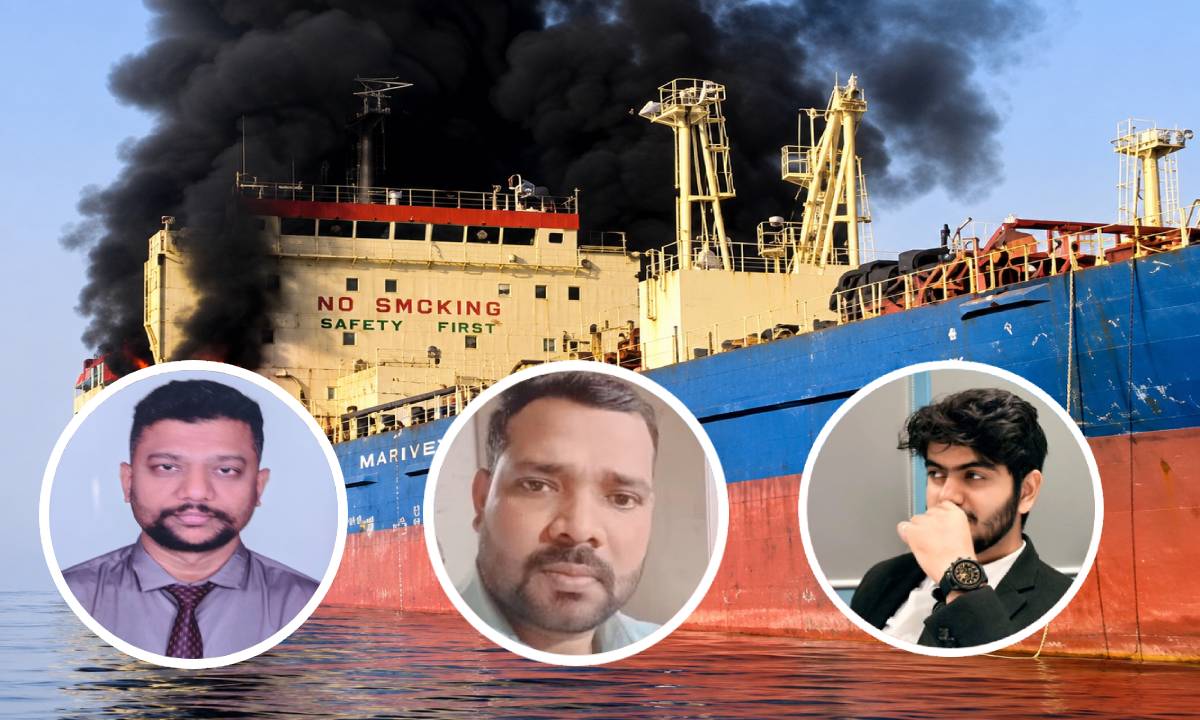
Did the ship ignore the warnings, what options did America have other than firing the missile?

Indian Sailor Killed: Amid growing tension between America and Iran, three Indian sailors have died in US military action near the coast of Oman. The Indian government has lodged a strong protest with America on this incident and has made it clear that such attacks should stop. On Thursday (11 June 2026), India publicly acknowledged for the first time that the US Navy targeted three merchant ships with Indian crew in the last four days, resulting in the loss of three Indian citizens’ lives.
After this attack, deck cadet Aditya Sharma, engine fitter Shivanand Chaurasia and chief engineer Patanala Suresh went missing. Later Indian officials confirmed the death of all three.
Among those who lost their lives in the American attack was 23-year-old Aditya Sharma, a resident of Hadita village in Galod area of Hamirpur district of Himachal Pradesh. Aditya had joined the maritime service just six months ago and was working as a deck cadet. He was among the 24 Indian crew members aboard the Palau-flagged oil tanker MT Setebelo.
What did the father of the person who lost his life say?
Aditya Sharma’s father Rajesh Sharma told Indian Express that he used to talk to his son almost every day. He said that during a WhatsApp call on Sunday, Aditya had told that his ship had received warnings from the US Navy at least twice in the last two weeks. Despite this, the ship was moving towards the Strait of Hormuz.
According to Rajesh Sharma, Aditya was worried about the situation at that time. He had told that on the same day another ship present in the vicinity of his ship was attacked. However, Aditya had assured the family by saying that all the crew members on board the ship had been rescued safely. After that conversation, the family was hopeful that everything would be fine, but after a few days this sad news came.
What did America say?
The US says the action on MT Setebelo was a “precision military strike”. According to US officials, the ship was operating under the Palau flag and its crew had disobeyed repeated instructions.
Washington alleged that the ship was violating US military sanctions imposed on Iranian ports. America has imposed this blockade since April to limit Iran’s sources of income and to put pressure on Tehran.
What did the Indian government say?
After the incident, the Indian government gave a strong reaction. The government summoned a senior American diplomat and lodged its protest. Foreign Ministry spokesperson Randhir Jaiswal said in a press briefing, “Such attacks must stop. We appeal to restore peace and stability in the region as soon as possible through dialogue and diplomacy.”
The Indian government has also said that it is closely monitoring the activities of all ships with Indian crew and Indian sailors present in the Gulf region. The government is constantly reviewing the situation and is alert about the safety of Indian citizens present in the area.
What options did America have?
Manoj Yadav, General Secretary of Indian Sailors Organization, has also raised questions on this action. He said, “I am confident that the US Navy knew how many Indians and other foreign nationals were present on the ship. If the ship had not followed instructions, it could have been seized, but a missile attack was not necessary.”
What do the laws say?
- International Humanitarian Law (Law of Armed Conflict)
If there is an armed conflict going on in an area, armed forces have to distinguish between civilian and military targets. Only attacks on targets used for military purposes can be considered legitimate. Targeting civilian ships may raise serious legal questions. However, these appear to be only paper laws and there is no information available about any action being taken against anyone.
- geneva convention
The protection of civilians and non-combatants must be ensured in accordance with the principles of the Geneva Conventions. Principles like proportionality and caution also apply in the sea.
- Rules of Naval Blockade
Under international law, a country can impose a maritime blockade under certain circumstances. But even during the enforcement of the blockade, there are rules regarding the behavior of civilian ships and the use of force. If a vessel does not comply with orders, it may be stopped, searched or seized. But in such circumstances, the use of lethal force is considered a last resort and its legality depends on the circumstances.

Comments are closed.