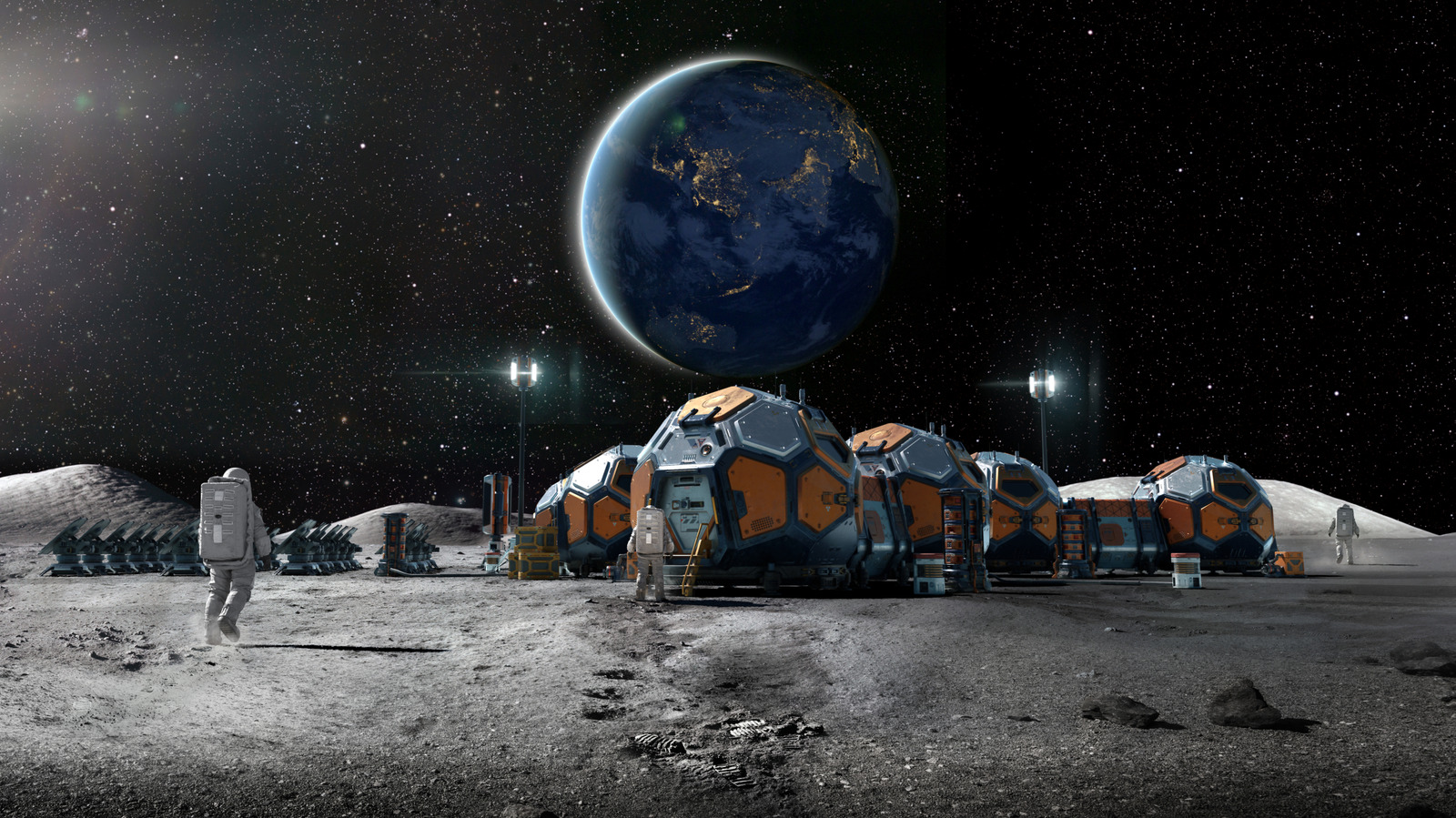
Establishing a permanent base on the Moon is one of humanity’s goals in order to eventually reach Mars and other celestial bodies in the Solar System. Having a base on the Moon would make future spaceflights easier, as fuel could be mined from the regolith, which is the Moon’s uppermost layer consisting of dust, rock, and mineral fragments covering the surface and the layers beneath. Regolith also contains water ice, oxygen, and other elements that could be used to fuel future rockets, but it also presents an opportunity for building.
Transporting construction materials from the Earth to the Moon is an expensive and challenging process, so many scientists and engineers have proposed using what’s there as building materials. Instead of pouring concrete and putting up frames made of timber or steel, regolith could be scooped up, processed, and made into large bricks, as one study from the University of Arkansas demonstrated. Researchers at the university published a paper in August 2026 in the journal NPJ Advanced Manufacturing called “Additive manufacturing of lunar regolith for reconfigurable building blocks toward lunar habitation.”
The paper outlines the process of transforming loose, non-homogeneous regolith into LEGO-like bricks. It details how 3D printing in the form of laser powder bed fusion could take the regolith’s fine, powder-like substance, pack it into a form, and hit it with a laser to fuse the powder into a single object. The process is called sintering, and it’s one of the leading concepts being explored for potential lunar base construction, which is something the U.S. government is paying $1 million for, as NASA is returning to the Moon after more than half a century.
No binders on the Moon — no problem
What’s impressive about this latest study is that it doesn’t require the use of binders to form the bricks. The concept of producing construction materials from regolith isn’t new; other researchers have conducted similar studies, but they required binders to properly form the bricks. Binders, which are liquid, glue-like substances, would have to be shipped from the Earth to the Moon, but the new process avoids this entirely. Cole McCallum, the first author on the paper, told the Arkansas News“There’s nothing else it’s binding to. The regolith powder is binding to itself.”
That’s an important step towards potentially 3D printing materials out of regolith, and while the blocks the researchers made were small, they proved the process’ potential. Still, while the process works without binders on material that’s a close approximation of regolith, the resulting bricks are porous and weaker than those printed with binders. McCallum added, “These structures we’re making can be self-supported. But I would be hesitant to say our process could be used for something that’s supporting other loads at this moment yet.”
There are other factors to take into consideration, including the Moon’s weaker gravity and almost complete lack of atmosphere, so further research and experimentation is needed. Should these issues and others prove surmountable in producing larger, stronger objects from regolith without requiring binders, astronauts and robots could one day construct entire buildings composed of LEGO-like bricks printed on-site. This would eliminate costly travel between the Earth and Moon, offer a permanent option in lunar base construction, and take humanity one step closer to the stars.