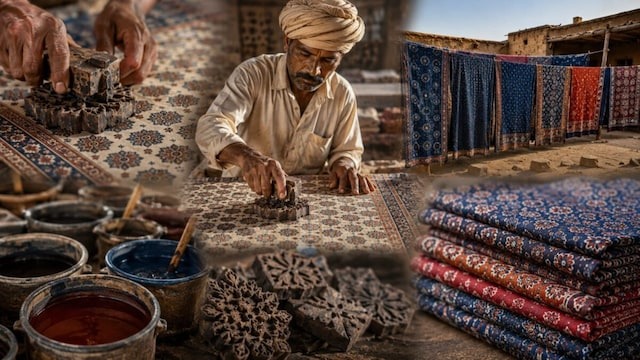
Whenever we talk about the textile history and traditional handicrafts of the world, some such arts come to the fore which, after traveling through centuries, still retain their shine. One such unique and miraculous art of printing is 'Ajrakh Print', whose history is not today but is about four thousand years old. Evidence and remains of this ancient art come directly from the archaeological excavation sites of the Indus Valley Civilization. If we turn the pages of history, we come to know that during the historical excavation of Mohenjodaro, a statue was found on which the shawl or sheet lying on its shoulders had Trefoil designs and geometric patterns engraved on it, which exactly matches today's modern Ajrakh print. From this it becomes clear that this art had already established its deep roots in the world of textile weaving and dyeing since the early stages of human civilization. This journey, which started from the Sindh region, covered a path of centuries and crossed the border to reach the desert areas of Kutch and Rajasthan of India, where the artisans kept it alive with their hard work and devotion. How this unique art got the name 'Ajrakh' and what is the interesting folk tale behind it. There are many interesting stories and historical beliefs associated with the origin of the word 'Ajrakh' and its naming. According to a popular belief, the word 'Ajrak' means 'blue' in Arabic language, because indigo plays the most important role in this entire printing and dyeing process. Another local legend also says that when an artisan of this art prepared this intricate and beautiful cloth for the first time and showed it to his king or master, after seeing it he said 'keep it today', which means take care of this wonderful art and keep it today itself. With the passage of time this name became famous as 'Ajrakh'. This art is not just a simple printing done on clothes, but it is a practice that has been going on for generations in which the desert soil, the chemical properties of water, natural herbs and the skill of the artisans' fingers mix together in such a way that the cloth is made as soon as you see it. The art crossed the border and reached the desert of Rajasthan and the Ajrakh print of Barmer. This art, which is related to Indus Valley and Sindh province of Pakistan, crossed the border with time and reached Kutch of Gujarat in India and Barmer district situated on the western end of Rajasthan. In Balotra and surrounding areas of Barmer, the people of Khatri community cherished this art in such a way that today it has created its own identity in the whole world by the name of 'Ajrakh Print of Barmer'. Despite the lack of water and scorching heat in this hot and dry desert area of Rajasthan, the artisans kept this printing alive with their hard work. Since natural colors are used in this printing, the natural nature of soil and water here makes these colors more solid and bright. Even though political walls have been drawn on both sides of the border, this ancient cultural heritage of Ajrakh still presents a beautiful and living example of the shared history and love of art between the two countries. A very complex process of sixteen steps, which makes unique use of elements of nature. Creating an Ajrakh print is not an easy task, rather it is a very long, difficult and patience-testing process going through sixteen steps. No artificial or chemical colors are used in this entire printing, rather the entire process is completely eco-friendly and natural. First of all, raw cloth (cotton or silk) is mixed with camel dung, castor oil and soda and kept soaked in water for several days so that the fibers of the cloth become soft and can absorb the color well. After this the cloth is dyed in myrobalan solution. Intricate hand-carved wooden blocks are used to carve the designs. After repeatedly printing on the cloth, it is dipped again and again in a solution of iron rust, alum, mith and natural indigo and red dyes. After each color is applied, the cloth has to go through a long process of drying and washing in the sun, which takes several weeks. The glory of Ajrakh in the world of modern fashion and the challenge of saving this heritage. In today's modern and mechanical era, where everything is prepared in factories in seconds, the value and importance of hand-made Ajrakh print has increased even more. Today, big fashion designers and connoisseurs of traditional clothes in India and abroad are giving preference to sarees, kurtas, dupattas and shawls made of Ajrakh print in their winter and summer collections. The smell of natural colors and its unique geometric designing is also attracting the modern youth. However, this magnificent heritage still faces some big challenges. Learning and practicing this art requires a lot of physical effort, patience and time, due to which the youth of the new generation are moving away from this traditional profession. Apart from this, cheap synthetic and fake 'Ajrakh' prints available in the market also harm the business of genuine artisans. What is needed is that this four thousand year old Thati should get government protection and in true sense, those skilled artisans should get their rights and fair prices who are sitting in the desert sun and cherish this art in their breath.