
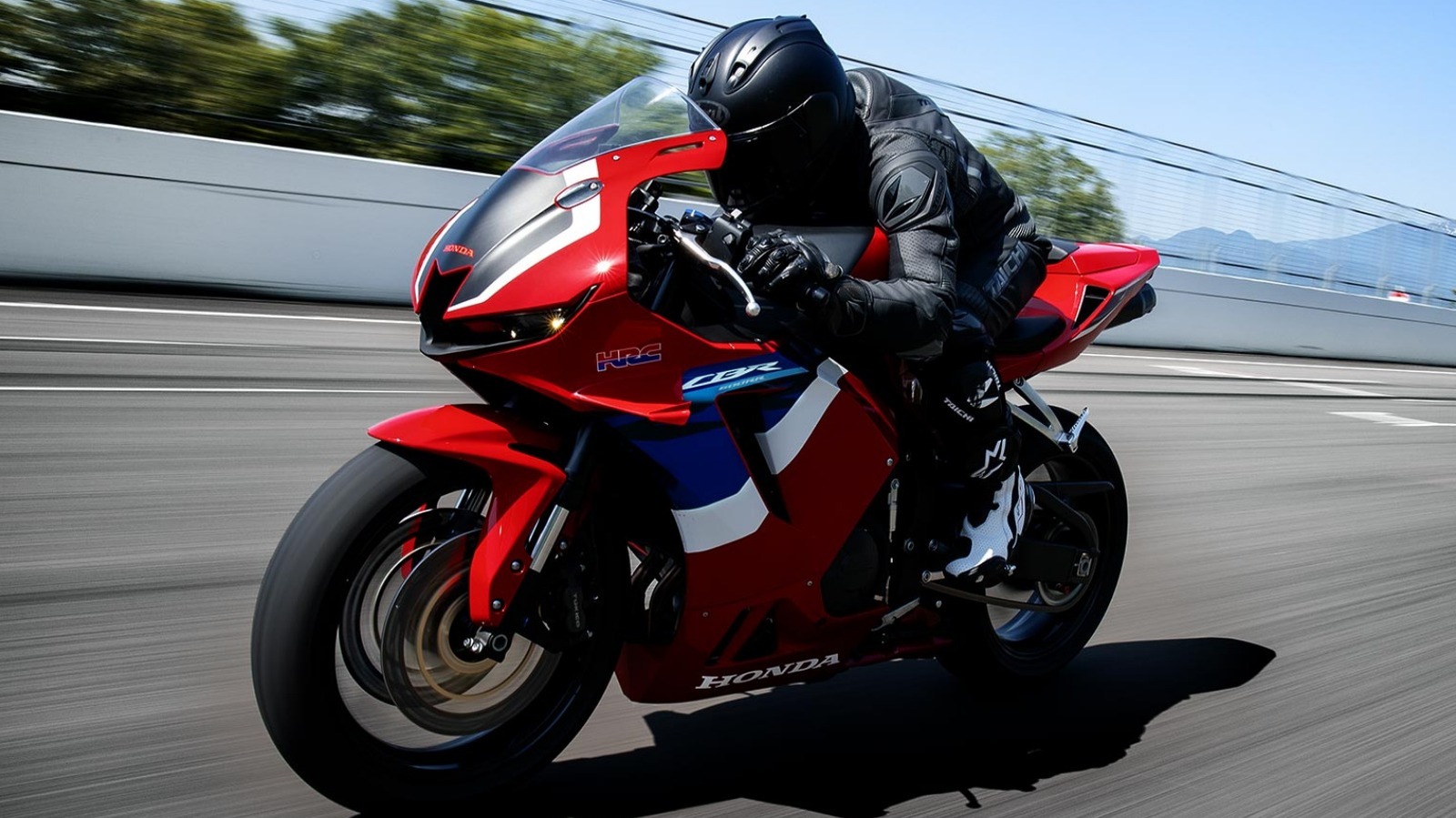

When looking at motorcycle engines, one of the first things to note is the engine’s displacement, as this usually has a strong correlation with the bike’s overall weight and power output. But that isn’t the only factor worth considering. It’s also worth taking a look at the number and orientation of the engine’s pistons.
Most of the motorcycles being made these days use either a parallel-twin or an inline triple-cylinder engine. These are affordable to manufacture and offer a unique blend of power and efficiency. Then there are the inline-four motorcycle engines, which are also sometimes called ‘screamers.’ These became very popular starting in the late ’60s, with that popularity seeming to peak in the mid-2010s. It’s only recently that these have started to slow down in production, and we have begun seeing fewer and fewer of them coming out each year. Many riders still consider these bikes highly desirable for their high-RPM power, smooth balance, and racetrack competence, but there’s no denying they’re slowly slipping out of vogue.
There are a few reasons why you’re seeing fewer inline-four engines coming out than before, and it isn’t just because they’re more expensive to make. There are several other disadvantages that might make them less appealing to the rider. You can still find a fair few affordable inline-4 motorcycles being made even now, but you might want to stop and consider the drawbacks before seeking one out.
1. Inline-fours typically have less low-to-mid-range torque
Most of the arguments in favor of the inline-four engine model primarily cite performance. The bikes that use them are known for delivering a large amount of power smoothly during acceleration, pushing the bike harder at higher speeds. That said, performance isn’t exactly a zero-sum game. While it’s true that inline-four engines are well known for their ability to output incredible amounts of horsepower at high RPMs (which is one of the reasons they are still so popular at the racetrack), this comes at a slight cost.
Inline-fours produce slightly less low-to-mid-range torque than some other engine types. This means riders often discover that they have a little less get-up-and-go when accelerating from a stop than if they were riding a bike with something like a parallel twin in its chassis. This makes them less than ideal for a daily driver, especially for those living in cities with plenty of traffic lights.
So, what qualifies as performance can vary depending on the type of bike and how it’s being ridden. An ultra-lightweight sport bike might have no trouble getting up to speed using an inline-four, while a heavy cruiser might struggle. Likewise, those who primarily ride in urban areas might prefer a bit more low-end torque, while those who prefer to push the red line at the track might prefer something with more power at higher speeds. This makes the inline-four a less practical choice for those seeking a commuter who aren’t looking to get any speeding tickets on the highway.
2. Inline-fours can be wider and heavier
Motorcycles that use inline-four engines are exceptionally well balanced. This is because the pistons move in pairs along a single plane, so there’s always one in the up position and one in the down position on each side, creating a smooth counterbalance. That said, they aren’t exactly petite.
It’s true that the pistons themselves are generally smaller in an inline-four than they are in a two- or three-cylinder motorcycle, but there are more of them, which means that they still end up having more parts and taking up more space overall. That means the casing has to be bigger, which means more metal, which means more weight. That alone can cause a ripple of other issues, such as lowering fuel efficiency and making the bikes feel a little more intimidating to smaller or less confident riders who want something light.
What’s more, the vast majority of modern inline-four engines are mounted transversely. As a result, the straight row of four cylinders is mounted perpendicular to the bike’s frame, not parallel. This effectively makes the engine wider, with each side protruding farther from the centerline than you might get in a two- or three-cylinder engine. That, in turn, means the bike needs a wider frame to accommodate it. This is another factor that might be detrimental to smaller riders, as it can be difficult for them to comfortably place their feet flat on the ground when stopped if they need to straddle a significantly wider seat.
3. Inline-fours drive up price tags
Inline-four engines are complex machines that are meticulously engineered for smooth acceleration and raw horsepower. Four smaller pistons being attached to the crankshaft in a row create a constant state of balance within each revolution as the bike is consistently receiving power. This is how these engines can accelerate with minimal thumping, and it’s also why they produce that signature screaming exhaust sound. Getting this to work properly requires that all four cylinders be perfectly balanced to prevent them from ever falling out of sync, but that complexity comes at a cost.
We’ve already mentioned that inline-four engines are being used less because they are more expensive to manufacture than parallel twins and some other design styles, but it isn’t actually the manufacturers who swallow that cost. The 2026 Kawasaki Ninja 650, for instance, has a 649cc parallel-twin engine and retails for $7,599. Compare that to the 2026 Honda CBR650R, which runs on a 649cc inline-four. Both are Japanese sport bikes with the same displacement as well as comparable designs and features, but the Honda starts at $9,199. Then take a look at the supersports. The 2026 Kawasaki Ninja ZX6R has a 636cc inline-four engine and retails for $11,599. But despite having a lower displacement, it costs more than the $9,399 2026 Yamaha YZF-R7, which runs on a 689cc parallel-twin. Perhaps one of the most extreme examples might be within Kawasaki’s own line. The 2026 Ninja 500 has a 451cc parallel-twin and starts at $5,799 for the ABS model. The 2026 Ninja ZX-4RR has a 399cc inline-four cylinder engine and costs $9,999.
4. Inline-fours have higher maintenance costs
While we’ve discussed the fact that manufacturing costs drive up the prices of the bikes that run on inline-fours, you also might find that you’re spending a lot more at the mechanic than you were on your last motorcycle. The very intricacy of the inline-four’s design that makes it such a powerhouse can also drive up maintenance costs.
Part of this is simple math. More cylinders mean more parts that require maintenance (twice as many valves), so your mechanic will need to spend twice as long checking the cylinders simply because there are twice as many. This also means more expendable parts like spark plugs and gaskets, but this is only a small part of it. The bigger issue is the effort required to get inside the engine. The inline-four sitting horizontally across the motorcycle’s frame means that it isn’t easy to access from the outside. Mechanics will often need to remove the fairings and tank from the bike just to get to it, which can drive up labor costs quite a bit.
Then there’s the additional complexities of the design. A routine valve adjustment, for instance, might cost between $300 and $600 for an inline-four engine, which usually requires a shim-under-bucket style valve adjustment. That would only run you between $150 and $400 on a V-twin that uses a screw and locknut valve adjustment system. Some of them even use a hydraulic lift valve adjustment system that is self-adjusting and doesn’t need to be serviced at all unless it breaks.
5. Inline-fours are less fuel-efficient
Fuel efficiency wasn’t as big of a consideration for a lot of riders back in the inline-four’s heyday, but it’s definitely become a major factor in how people choose their motorcycles now. Unfortunately, inline-fours sacrifice a fair amount of fuel efficiency in favor of high-RPM power. This might not be that big a deal for the kinds of riders who only use their motorcycles at the track, but it’s definitely something to think about if you’re planning on riding one of these bikes for your daily commute.
Take a look at some of the most fuel-efficient motorcycles on the market, and you’ll quickly find that all of them, except of course for the electric and hybrid models, are powered by one- or two-cylinder engines. Of course, fuel efficiency can be affected by other factors, such as overall weight, gearbox type, chain drive, throttle control, tire pressure, modifications, cargo, and the rider’s weight. There are a few examples of inline-four bikes that are more fuel efficient than you might think, like the Kawasaki Z900, which can get up to 49 MPG. As a rule, however, inline-four bikes are consistently less fuel-efficient than most other engine types and often get city miles closer to those of an SUV than an economy vehicle. Even Honda, which is exceptionally well known for efficiency, can only offer about 40 MPG on its inline-four CBR600RR, while its parallel-twin CBR500R boasts over 65 MPG. Even the larger parallel-twin Kawasaki Ninja 650 is able to hit over 51 MPG.
How we listed these disadvantages
Inline-four engines are immensely popular, and they certainly have a lot of great things going for them. However, there are certain weaknesses that riders who are thinking about getting one should be aware of. There is a wide variety of inline-four engines that have been released over the years, and they are attached to an even wider variety of motorcycles. As such, it is difficult to make any universal claims about design or performance that won’t be disproven by at least one exception. That said, there are certain general rules of thumb that one can apply to the vast majority of them when looking at these weaknesses.
By taking a look at several different professional reviews, motorcycle forums, mechanic forums, and the raw stats of many of the inline-four motorcycles that are on the market today, we have rooted out five key weaknesses that appear to apply to most of them. Once we had our list of weaknesses, we sought to corroborate these claims by verifying them against specs, price comparisons, and reports from trusted sources. We then explained these weaknesses, breaking down why they are tied to the design and how they can serve as a detriment to the rider. In this way, we hope to arm prospective buyers with as much information as possible when weighing the pros and cons of a purchase.

Comments are closed.