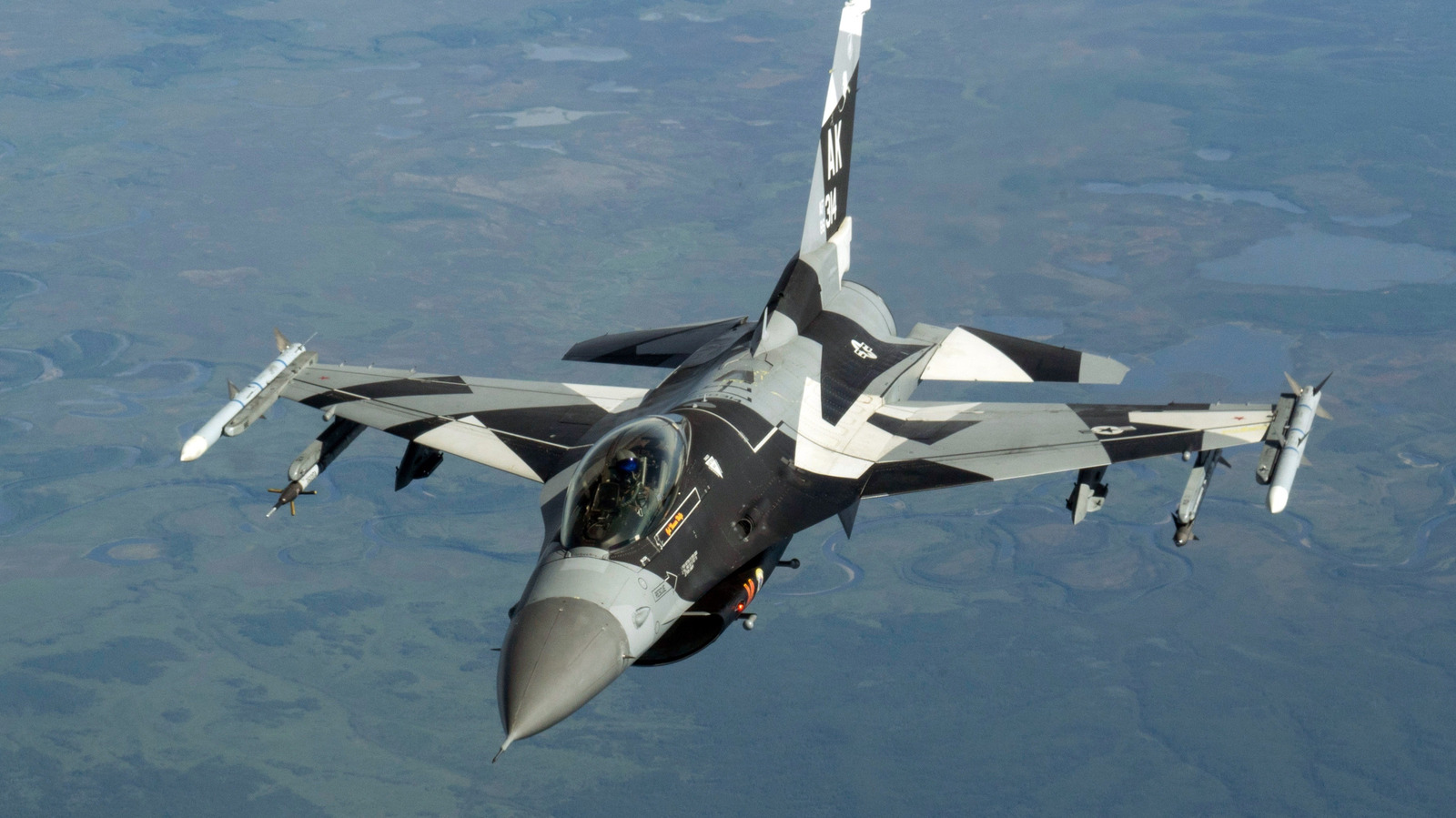
The F-16 might be aging by some standards, but it’s still one of the fastest machines in today’s skies. The F-16A took its first flight in 1976, and the jet first entered service with the US Air Force in 1979. While it may not have the service length of iconic Boeing planes like the B-52 bomber, the F-16 exists in a world where sheer performance can be the difference between life and death. Of course, F-16 fighters have evolved over their 50 years of service, a point that has helped them remain relevant in modern combat.
The jet was originally designed as a lightweight, low-cost, single-engine fighter, with an emphasis on agility more than sheer speed. Over the course of its career, it has proved itself to be versatile as well as capable. It has been used for air-to-air combat roles, strike missions, suppression of enemy air defenses, and close air support.
But what fighter jets are quicker than the F-16? First, we need to set the benchmark. Over the decades, the jet has been produced in several variants. And, although the F-16 has used different engines over its lifetime — including Pratt & Whitney and General Electric offerings — the USAF’s reported top speed remains unchanged. The official figure for the F-16 is Mach 2.0 or about 1,500 mph.
This set a high benchmark, so let’s have a look at five planes that didn’t just reach this but soared past it.
The F-15E Strike Eagle
It seems fitting that the first plane on the list is another US jet fighter with its own long heritage. The F-15A first flew in 1972 and entered operational service in 1976. The jet is powered by two Pratt & Whitney F100-PW-220 or 229 engines that can produce up to 29,000 pounds of thrust per engine. Essentially, this is the same engine type fitted into many F-16 variants, although the F-16 is a single-engine jet.
Powered by those two engines, the F-15E is substantially quicker than the F-16 and can hit a top speed of over Mach 2.5 or about 1,875 miles per hour. To help visualize this, we can consider how fast a fighter jet can fly across the United States – depending on the plane, it’s easily between one and a half to two hours, whereas a typical commercial flight can take as many as six. The F-15E Strike Eagle is another versatile fighter; although its primary function is described as being an air-to-ground attack aircraft, it can also be used in air-to-air missions (although earlier versions were primarily used in air-to-air roles).
The F-15E’s speed is a great attribute given its current role. This is an aircraft that can travel deep into enemy airspace, deliver a devastating blow to ground targets, and still be able to battle its way home. Unlike the F-16, this is a jet that delivers more on raw power than agility, and with a maximum range with external tanks of 2,400 miles, it’s a jet that’s built for sustained combat. Recent upgrades have also made the F-15 a lot better at fighting drones, helping to modernize the airframe.
F-14 Tomcat
For the next jet fighter on the list, we have to take to the seas and have a look at the legendary F-14 Tomcat. The carrier-based fighter has a listed top speed of Mach 2.34, which equates to 1,734 mph. Not bad for a jet that entered service before both the F-16 and F-15. The F-14 Tomcat was retired from US Navy service in 2006 when it was replaced by the slower top-speed F/A-18 Super Hornet. Incidentally, the “Maverick Act” could see the F-14 Tomcat flying again, as the bill calls for three surplus airframes to be transferred to the US Space and Rocket Center (USSRC) in Huntsville, Alabama for restoration purposes.
Of course, the name Maverick is well associated with the Tomcat, as it’s the fighter featured in the “Top Gun” movies starring Tom Cruise. However, the jet was more than a mere movie star — it can trace its operational history back to the Vietnam War, when the fighter was used to support the evacuation of Saigon in April 1975. Although the jet didn’t participate in any air-to-air combat during the operations, it did fire its first shots in anger at North Vietnamese troops.
While the F-14 went on to have a thirty-year-plus career and was involved in both Gulf Wars, as well as seeing action in Libya and Afghanistan, U.S. Navy F-14s only shot down five enemy planes. While this is largely down to the role the fighter was asked to play, we can get an idea of just how potent the air-to-air potential of the Tomcat by looking at another country flying the F-14 — Iran. During the Iran/Iraq war in the 1980s, it’s believed that Iranian F-14s accounted for around 150 kills in air-to-air combat.
MiG-31 Foxhound
The MiG-31 Foxhound is not a jet fighter known for its agility or air-to-air combat roles. Rather, it’s intended as a supersonic interceptor. Powered by two Soloviev D-30F6 afterburning turbofan engines, the Foxhound has an astounding maximum speed of Mach 2.83 — or just shy of 2,100 mph, if you prefer.
The MiG-31 was introduced to replace the MiG-25 Foxbat, although there are key differences between the Foxbat and the Foxhound. The former was another fast but ultimately flawed Soviet-era jet fighter. The Foxhound was the then Soviet Union’s first fourth-generation fighter; it wasn’t just fast, it also had other advanced features that had the West worried. Among these was a phased array radar that allowed the fighter to track multiple targets across various directions and altitudes. In the case of the Foxhound, the radar allowed for up to 10 targets to be tracked simultaneously. To put this in some context, the MiG-31 entered service in 1981, and the first American fighters with a similar system were F-15Cs that were retrofitted with Raytheon scanned array radars, a project that wasn’t complete until December 2000.
Since its introduction, the jet has been produced in several variants. This includes the MiG-31D, of which two prototypes were developed as an anti-satellite weapons platform. Another notable variant is the MiG-31BM; this can track up to 24 targets simultaneously and has air-to-ship, air-to-ground, and anti-radar capabilities.
Dassault Mirage 2000
While its top speed might not match that of the Foxhound, the Dassault Mirage 2000 can reach Mach 2.2 (1,630 mph), slotting it in between the F-15 and the F-16. The French fighter first entered service with the French Air Force in 1984 and was exported to various other countries, among them India, Peru, and Brazil. The Mirage is a fourth-generation fighter that could perform a range of front-line roles including air superiority, nuclear weapons delivery, and interception.
Much like the F-16, the Mirage was primarily designed to be a cost-effective and lightweight jet that could compete with Soviet Union fighters like the MiG-29. The similar design briefs behind the F-16 and the Mirage saw both jets take on a single-engine design. In the case of the Mirage, the fighter is powered by a SNECMA M53-P2, which can produce 22,031 pounds of thrust with afterburners and a still pretty hefty 14,388 pounds of thrust when cruising.
The Mirage is perhaps best known for its distinctive delta-wing configuration, an attribute shared with the Eurofighter Typhoon, which also boasts an impressive top speed. In the case of the Mirage 2000, the use of a delta wing is something that Dassault Aviation — the jet’s manufacturer — has been using in designs since the original Mirage I took to the air in 1955. However, the Mirage 2000 uses unstable aerodynamics and computerized fly-by-wire systems to get improved performance from the delta wing configuration.
Sukhoi Su-27 Flanker
Returning to Russia, we end the list with a look at another fourth-generation Soviet-era fighter — the Sukhoi Su-27 Flanker. This is a twin-engine jet fighter that was designed to counter American jets like the F-14 Tomcat and the F-15 Eagle. Powered by two Saturn AL-31F afterburning turbofan engines, the Flanker is capable of reaching speeds of about Mach 2.35, or 1,742 mph. The jet first flew in 1977 and entered operational service in 1985.
In some ways, the Flanker was more than a match for its American counterparts. When pitted against the F-15 Eagle, for instance, the Flanker displayed superior low-speed maneuverability. However, at higher speeds, the F-15 still retained an edge. The American jet was also faster than the Flanker, although the Russian fighter has a better climb rate and thrust-to-weight ratio.
As with most planes of this vintage, there have been many variants of the Flanker introduced over the years. This includes the single-seater Su-27S Flanker-B, the first production version of the fighter. One interesting variant is the P-42, a stripped-down, re-engined version that was designed specifically to set climb time records. And, as it turned out, it was something that it was very good at. In a two-year spell from 1986 to 1988, the jet broke 27 records, some of which had previously been held by the F-15 Streak Eagle, a modified F-15A that itself set eight world records for climb time in 1975. While the standard Su-27 Flanker may not boast the records of the P-42, it’s still fast enough to rank among the fastest Russian and Soviet jets.