SUVs are some of the most popular vehicles in the United States. Among the 25 best-selling vehicles in 2026 so far, 13 of them are SUVs, and pickup trucks take up another six spots. Clearly, American automobile buyers are interested in space. Whether it’s because they have a family that needs to be transported around or just want to avoid the feeling of being cramped into a rolling metal box, a roomy interior is a must-have for many. Consequently, you don’t see a ton of traditional sedans on that best-selling list, even if they have other perks like possibly being more fuel efficient or less expensive.
While you’re likely to get more space with some of those larger cars, do not discount that there are sedans with plenty of space inside that you may not recognize just by seeing the car from the outside. Sure, there are plenty of small cars that require you to get creative with how you utilize the space, but with many sedans, there could be a good deal of front and/or rear seat legroom or quite a bit of headroom for those on the taller side. Here, we’re going to look at six different sedans on the market that have interior spaces that are on par with many of the larger vehicles out there. These are going to cover sedans from both mass-market and luxury automotive brands that are all readily available to show that this kind of space is available to anyone, no matter their budget.
Hyundai Elantra
If there’s one vehicle type where people often need to find clever ways to maximize interior space, it’s compact cars. They’re designed to be small, which is why many buyers avoid them. Meanwhile, the 2026 Hyundai Elantra is here to give folks some decent room in a small package. For the front seats, an Elantra offers 42.3 inches of legroom. For the rear seats, which are the ones that typically get cramped, you still can get 38 inches of room.
These legroom measurements hold for all six of the Elantra’s trims. These trims also have uniform shoulder and hip room measurements. The front seats get 56.5 inches of shoulder room and 53.4 inches for the hips, and in the back, they’re 55.6 inches and 50.5 inches, respectively. The same, however, can’t be said for other space measurements. When it comes to headroom, the lower tiered SE and SEL Sport actually offer more headroom for the front seats than the top four tiers. You can expect 40.6 inches there, whereas the upper tiers manage 38.7 inches. All six do get you 37.3 inches of headroom for the rear seats though.
For comparison, Hyundai’s smallest SUV is the 2026 Venue. The Elantra beats out every single interior space measurement when compared to the SUV. Sometimes, that margin is significant. For rear legroom, the Elantra has nearly four more inches of space than the Venue. A 2026 Hyundai Elantra starts at $22,825 (plus a $1,295 freight fee), so you’re getting quite a lot of space for a very good price.
Honda Accord
While it may be difficult to find good interior space in a compact car, the world of mid-size vehicles has a bit more to offer. This makes sense because they’re a bit larger on the whole, but that doesn’t necessarily mean that extra size is utilized for more room inside. Well, with the 2026 Honda Accord, you do get that added space.
Arguably the most impressive extra space is the Accord’s rear legroom. Across all six available trims, you can get 40.8 inches of rear legroom, which is paired with 42.3 inches of legroom for the front seats. Both shoulder room and hip room are quite ample as well. The front seats get 57.9 inches of shoulder room and 55.4 inches of hip room for every trim. As for the back seats, you still get 56.5 inches of shoulder room and 55.4 inches of hip room.
These measurements are quite comparable to the Honda CR-V crossover SUV. More often than not, a 2027 model will provide more or less room in a given space within an inch, or even a half-inch. For instance, the CR-V’s max headroom is 40 inches for front seats of the base LX trim. An Accord LX’s front seats only get 39.5 inches, dropping to 37.5 inches for the other five trims. Considering the Honda Accord starts at $28,395 (plus a $1,195 destination and handling fee), which is $3,125 less than a CR-V, maybe it’s worth giving up that half-inch of headroom.
Let's go K5
For some, rear legroom is the great arbiter of a car’s interior space, but not everybody has people in those rear seats frequently. Others may just want to have ample legroom in the front seats so that the driver and a passenger can feel comfortable while on the road. For a mid-size sedan that really delivers on this front, look no further than the 2027 Kia K5.
Those in the front seat of this car are able to enjoy a whopping 46.1 inches of legroom for all three trims. In U.S. News and World Report’s ranking of roomy sedans, no other model clears the K5 when it comes to front row legroom, be it a mass-market or luxury brand. Even large Honda vehicles don’t beat it. The large Kia Telluride SUV’s front row only gets 41.4 inches of legroom. The Kia Carnival MPV minivan, a vehicle specifically designed for a lot of space, gets just 41.1 inches of front legroom. These larger vehicles certainly beat out the K5’s fairly average 35.2 inches of rear legroom, but that front row leg space is very nice, especially for taller drivers worried about being in a sedan.
The K5 offers plenty of other room as well. Those in the front get 58 inches of shoulder room and 56.6 inches of hip room. Those in the back are also treated to 56.6 inches of hip room, along with 56.1 inches of shoulder room. The Kia K5 doesn’t have exceptional rear leg space, but the space is pretty exceptional everywhere else. Starting at $27,690 (plus a $1,245 destination fee), it’s not a bad deal either.
BMW 7 Series
Certain people consider having ample interior space in a car a luxury, so it makes sense that luxury brands provide this kind of space in their sedans. Rear legroom is particularly important for these very high-end vehicles, since there’s a chance the owner might be in the back seat while the car is operated by a driver. One brand that produces a sedan with very good rear legroom is BMW with its 7 Series 740 sedan.
Sitting in the back seat of one of these cars means enjoying 43.3 inches of legroom. The 7 Series’ rear legroom is actually more spacious than in the front seats, which is 41.2 inches. That’s still a very respectable number for the front, but the back’s clearly where BMW sees that space must go. Where the front does outshine the back is with shoulder room. The front seats get 61 inches of shoulder room, which is quite a lot. The rear seats still get plenty though with 56.3 inches. Headroom in the 740 sedan isn’t extraordinary — giving the front seats 39.8 inches and the back 38.6 inches — but for most people, that’s plenty.
Beyond the space, the BMW’s interior is quite high-tech, so it’s no surprise the 7 Series retails at a premium. The starting price is a massive $99,800 (plus a $1,150 destination fee) for the base model and an xDrive version starts at $102,800 (plus that same $1,150 fee). These are very high prices, but if you’re someone looking to enjoy the rear seats of a BMW 7 Series while someone else regularly drives you, price probably isn’t an issue.
Mercedes-Benz S-Class
Few brands scream luxury more than Mercedes-Benz. The company produces a great deal of executive cars for wealthy owners, and for those who want a sedan with a lot of interior space to enjoy, then a great option for them would be the Mercedes-Benz S-Class sedan. The class of car comes as either the S 500 or the S 580, but the measurements of the cars’ spacious interiors are exactly the same.
Let’s start with the legroom. In the front seats, you’re looking at 41.3 inches of space, which is perfectly good. However, in the rear seats, that legroom measurement goes up to 43.9 inches. That’s the kind of space that just about anyone sitting in the back seat of a car can enjoy. The S-Class sedans also offer a great deal of headroom for the front and back seats too, giving them 42.1 and 39.4 inches of headroom respectively. This is definitely the most headroom for a vehicle on this list. Shoulder room is also quite good with 59.7 inches of space for the front seats and 59 inches for the rear.
As you’d expect, these Mercedes-Benz S-Class sedans can be quite expensive machines. A new 2027 S 500 model has a starting price of $112,550 (plus a $1,450 destination fee). An S 580 model is even more expensive, starting at $134,600 (plus the same $1,450 destination fee). Of course, Mercedes-Benz is offering more than just interior space with these luxury sedans, but the cost of that kind of room, particularly the rear legroom, is going to be high.
Audi A8/S8
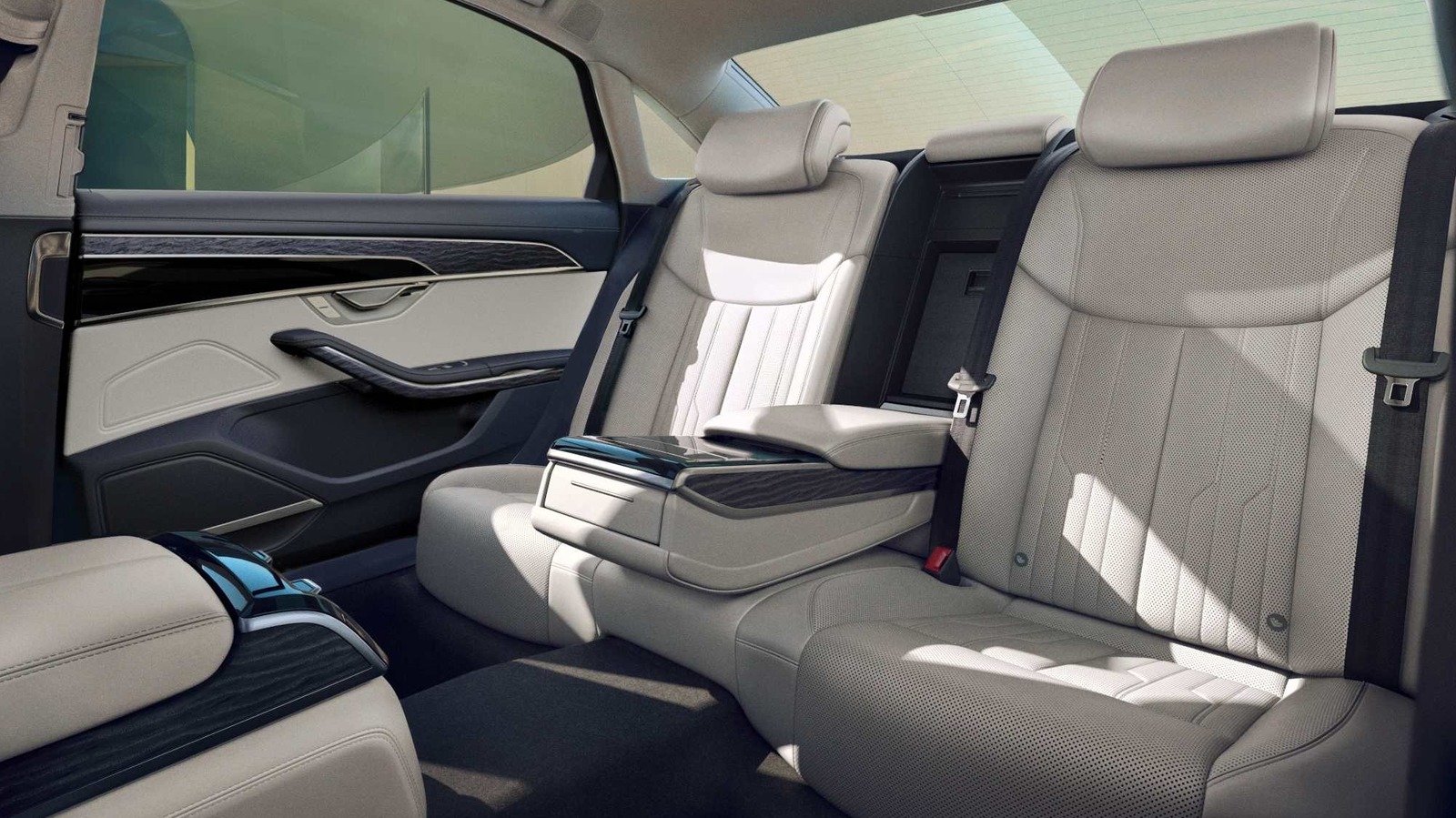
If rear legroom is truly all you care about and money isn’t an issue, then you really aren’t going to find a much better sedan option out there than the 2027 Audi A8 or the more expensive S8. Both of these models offer the most rear legroom of any sedan on this list, giving those passengers an incredible 44.3 inches of space. Those in the front row aren’t left behind either, as they can still enjoy 41.5 inches of legroom.
The rear shoulder room of the Audi is already pretty impressive at 57.6 inches, but if you’re going to have three passengers back there, you’re always going to be dealing with the shoulder widths of your fellow occupants. However, you could actually remove that scenario entirely with this sedan. The Audi S8 offers an optional package that costs $4,200 that will that transform the car from a five-passenger vehicle to a four-passenger one, giving the rear seats a permanent center console rather than a middle seat. All of a sudden, the idea of bumping shoulders with another person becomes a lot less likely. Notably, the front seats also get ample shoulder room with 59.1 inches.
A 2027 Audi A8 starts at $95,100 (plus a $1,395 destination charge). The S8 significantly jumps up in price, starting at $130,000 (plus the same $1,395 destination charge). Add on that four-seat package option, and it’s even more money. The Audi sedan isn’t cheap, but it gets you all the space you need.