
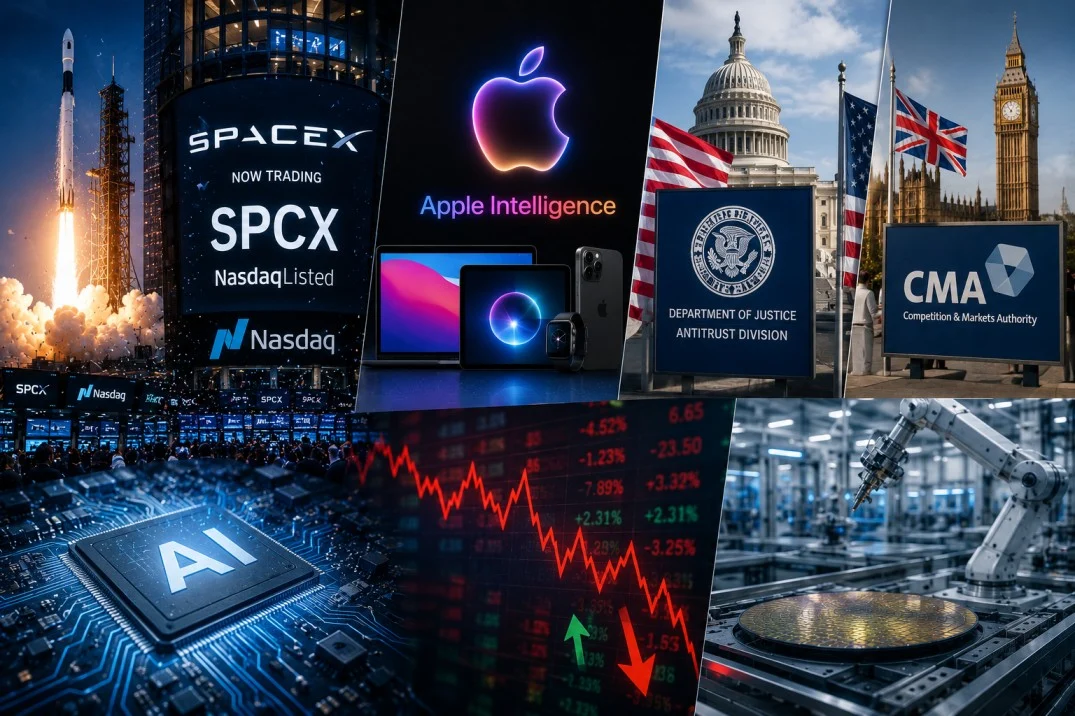

Technology news often moves in cycles. One week investors focus on artificial intelligence, the next they are talking about smartphones, regulation or semiconductor shortages. Yet every so often a single week offers a broader picture of where the industry is heading. SpaceX completed a stock market debut that immediately entered the record books. Apple attempted to reset the conversation around its AI ambitions. Governments in Washington and London signalled a stronger willingness to intervene in technology markets. Meanwhile, chipmakers and investors were reminded that enthusiasm for AI can create sharp swings in market sentiment.
Taken together, the week’s developments highlighted a technology industry that is no longer defined only by product launches or software updates. Politics, regulation, national security and financial markets now play a far larger role in determining how technology companies grow and compete.
SpaceX’s Record-Breaking IPO
The event that attracted the most attention came from Elon Musk’s SpaceX. After years of speculation about when the private aerospace company would enter public markets, the firm completed what became the largest initial public offering in history. Investor demand reached levels rarely seen for a public listing, pushing the company’s valuation above the two trillion dollar mark during its market debut.
The listing was about more than stock market records. SpaceX has spent years building a business that stretches across rocket launches, satellite communications and space exploration. Starlink has become one of the largest satellite internet services in the world, while the company’s reusable rocket programme has reshaped launch economics.
The IPO also had a direct effect on Musk’s personal fortune. The rise in SpaceX’s valuation, combined with his holdings in Tesla, xAI and X, pushed estimates of his wealth above one trillion dollars. That figure immediately became a topic of debate across financial markets and social media, where supporters viewed it as the result of entrepreneurial risk-taking and critics pointed to concerns about wealth concentration.
Apple WWDC 2026: Major Siri AI Overhaul and Apple Intelligence Upgrades
While investors focused on SpaceX, Apple spent the week trying to answer questions about its place in the artificial intelligence race. At its annual Worldwide Developers Conference, the company introduced a rebuilt version of Siri and presented a broader collection of AI functions under its Apple Intelligence banner.
For years, Siri had been viewed as lagging behind newer conversational AI systems. Apple’s answer was to rebuild the assistant with stronger conversational abilities, improved understanding of user context and deeper connections with applications across its devices.
The company also introduced AI-powered photo editing, writing assistance and organisation functions throughout its software products. Rather than presenting AI as a standalone chatbot, Apple argued that these capabilities should operate throughout everyday device use.
Investor reaction remained cautious. Apple faces pressure from competitors that entered the generative AI market earlier, and expectations ahead of the event were high. The announcements showed that the company intends to make artificial intelligence a central part of future software development, but the market response suggested many investors are still waiting to see how quickly those plans translate into broader user adoption.
Anthropic Suspends Top AI Models (Fable 5/Mythos 5) After US Government Order
The week also demonstrated how closely artificial intelligence is becoming linked to national security policy. Anthropic, one of the leading AI developers in the United States, suspended access to some of its most advanced models following a reported directive connected to export controls.
The restrictions highlighted a growing reality for AI companies. As models become more capable, governments are paying closer attention to who can access them and under what conditions. What began as a competition between technology firms increasingly overlaps with geopolitical concerns involving the United States, China and other major powers.
Questions about access to advanced computing systems, semiconductor supplies and AI software are now being treated in many capitals as matters that affect national interests. That development has introduced a layer of uncertainty for companies operating across international markets.
UK Government Announces Social Media Restrictions/Ban for Under-16s
Government involvement in technology extended well beyond artificial intelligence. In Britain, the government announced plans aimed at limiting access by under-16s to certain social media services. The proposal would impose tighter controls on activities such as messaging with strangers, disappearing messages and livestreaming.
Supporters argue that stronger safeguards are needed as concerns grow over online harms affecting younger users. Critics question whether such measures can be effectively enforced and whether restrictions might create new privacy concerns. The debate mirrors discussions taking place in several countries where policymakers are examining the relationship between social media use and youth wellbeing.
AI Chip Market Volatility and Rebound Amid Broader Tech Selloff
Financial markets provided another reminder that enthusiasm for artificial intelligence remains powerful but far from predictable. Semiconductor stocks experienced sharp swings during the week as investors weighed concerns about interest rates and valuation levels against continuing demand for AI computing capacity.
Large technology companies continue to spend heavily on data centres, advanced processors and computing hardware needed to train and operate AI systems. That spending has helped fuel demand for chips produced by companies such as Nvidia and Taiwan Semiconductor Manufacturing Company.
Even so, market movements during the week showed that investors are becoming more selective. High expectations leave little room for disappointment, and even strong earnings forecasts can sometimes struggle to satisfy markets when valuations have already climbed sharply.
ByteDance in Talks for Chinese AI Chips; Global Supply Chain Shifts
Another important development came from China, where reports indicated that ByteDance was seeking alternative sources of AI chips through domestic suppliers. The discussions reflect a wider effort among Chinese technology firms to reduce reliance on foreign semiconductor providers following years of export restrictions imposed by Washington.
The search for domestic alternatives is reshaping supply chains and influencing investment decisions throughout the technology industry. Companies increasingly face pressure to secure computing resources while also navigating political considerations that did not play the same role a decade ago.
Throughout the week, one theme connected nearly every major story. Artificial intelligence remained the centre of attention, whether through Apple’s software plans, Anthropic’s restrictions, semiconductor demand or investment activity across technology markets.
At the same time, the conversation around AI is becoming more complex. The discussion now includes regulation, labour markets, national security, competition policy and public trust. Technology companies are still racing to build more capable systems, but they are doing so under closer scrutiny from governments, investors and the public.
The events of the week offered a snapshot of an industry entering a new phase. The technology world is still producing new products and attracting large amounts of capital, yet the forces shaping its future increasingly extend far outside company headquarters. Decisions made in government offices, financial markets and regulatory agencies now carry almost as much weight as those made in engineering teams.
That reality was visible throughout the week. Whether the subject was a record-breaking IPO, a rebuilt virtual assistant, export controls or social media restrictions, the message was similar. Technology remains one of the most influential forces in the world economy, but it no longer operates on its own terms.

Comments are closed.