
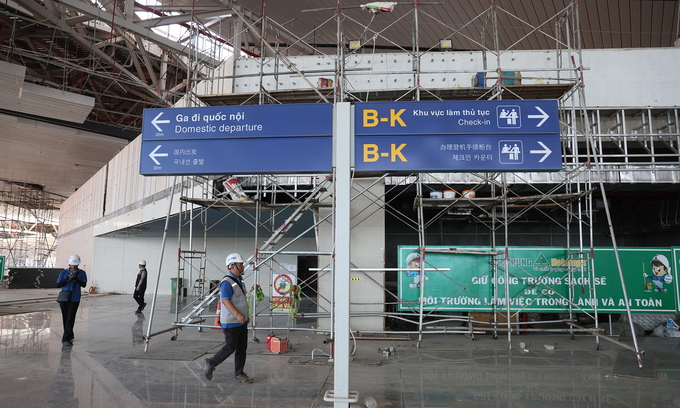

The Airports Corporation of Vietnam (ACV) announced Monday that for nearly three weeks since the start of the campaign, the average workforce directly involved in construction has been more than 7,300, an increase of 4.5% from June 1.
The contractors are using the additional personnel to speed up work on key packages like the passenger terminal, internal airport road network, and the second runway, it said.
Some contractors have also deployed hundreds of military personnel for the construction.
Work under Component 3, the main one and which includes the terminal, runway and airfield, has thus far cost VND65.6 trillion (US$2.49 billion), or 76% of the contract value.
Workers are seen at the construction site of Long Thanh airport, Dong Nai City, May 2026. Photo by Read/Phuoc Tuan |
Major construction packages alone have reached more than VND56 trillion, or nearly 68% of contract value, up more than 3 percentage points since early June.
For the airport’s internal transport and infrastructure package, it is closely monitoring all construction activities and coordinating them with other packages to keep the work on schedule.
As of Monday, early VND6.9 trillion worth of work has been completed in Package 4.8 for the internal transport and aviation infrastructure systems, 62% of the contract value.
As the peak rainy season begins, the ACV warned that weather conditions could affect outdoor construction work, transportation of materials and equipment, and overall project execution.
But contingency plans are in place and schedules have been tweaked to cope with the conditions.
During a site inspection last week, leaders from the Ministry of Construction urged the ACV, contractors, and others to mobilize more military personnel to assist with landscaping, site cleanup, and grass planting for the airport’s finishing stage now underway.
Vietnam’s largest airport is being built on 5,000 hectares at a cost of VND336.63 trillion (US$12.8 billion). After the first phase, it will have a capacity of 25 million passengers and 1.2 million tons of cargo annually.
It is scheduled to begin trial operations in September and commercial operations later this year.
Comments are closed.