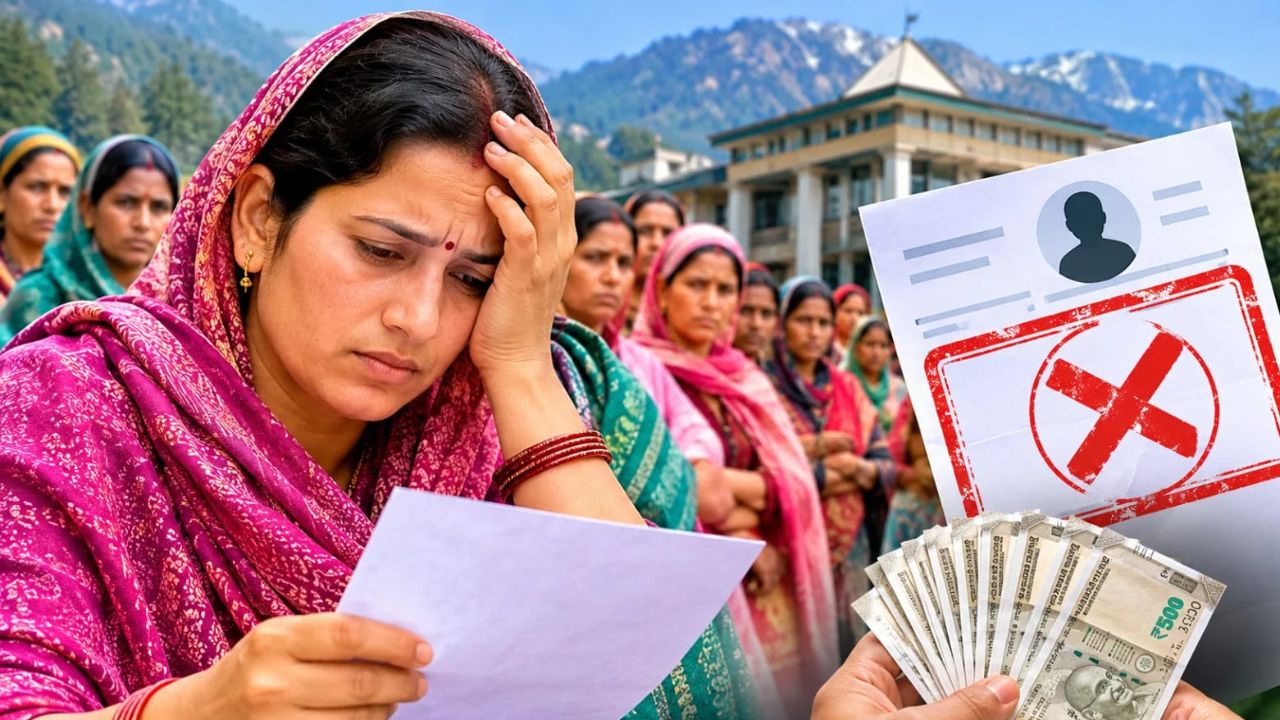
The figures of Indira Gandhi Pyari Behna Sukh-Samman Nidhi Yojana, started with the aim of economically empowering women in Himachal Pradesh, are raising a big question before the government. About 93 percent of the women who applied in the hope of getting financial assistance of Rs 1500 every month were disappointed. Out of more than 8.25 lakh applications received under the scheme in the last three years, 7.69 lakh applications have been rejected. This means that a large part of the women who applied could not fulfill the eligibility for government assistance.
These figures, revealed in the winter session of the Assembly, highlight the huge gap between the actual beneficiaries of the scheme and the women who applied. The situation is that out of 8,25,446 applications, only 51,853 have been approved, while 4,408 applications are still pending. In such a situation, the question is arising that why such a large number of women were left out of the scope of the scheme? Social Justice and Empowerment Minister Dr. Dhaniram Shandil put this information in the House in written reply to the question asked by Paonta Sahib MLA Sukhram Chaudhary on Saturday. According to the government, these figures are till November 1, 2026.
The income limit of Rs 2 lakh blocked the way for help.
The biggest reason for rejection of applications under the scheme is the prescribed limit on the annual income of the family. The government has fixed the annual family income for eligibility at Rs 2 lakh. Due to this condition a large number of applications fell out of the scope of eligibility. Under the scheme, there is a provision to give Rs 1500 every month to eligible women. In this context, this assistance amounts to Rs 18 thousand annually. For financially weak women, this amount can be helpful in household expenses, children's education and daily needs. But most of the women who applied could not get its benefit. An important question here is whether the actual economic conditions of the women of the state were adequately assessed while deciding the eligibility conditions of the scheme? Especially in rural areas where the income of the families is not regular and many women fulfill the financial responsibilities of the family through agriculture, animal husbandry and small jobs.
Also read: Ruckus in Himachal over new districts, MLAs face to face over dividing Kangra
Most applications rejected in Kangra
If we look at the district wise figures, Kangra district is at the forefront in terms of rejection of applications. Here 1,75,544 applications were received for the scheme, out of which 1,59,068 were rejected, while 15,670 were approved. The situation is almost similar in Mandi district also. Here out of 1,23,125 applications, 1,19,938 applications were rejected. Similarly, 79,536 applications were rejected in Shimla, 73,399 in Una and 72,229 in Sirmaur. In Solan district, out of 51,837 applications, 51,246 were rejected. Applications of 49,786 women in Hamirpur and 44,994 women in Bilaspur were rejected. In Chamba also 56,048 applications were rejected. It is clear from these figures that the number of women applying for the scheme was very large, but the proportion of women getting approval was very low.
Approval figures differ in tribal areas
On the other hand, the data from tribal and remote areas shows a somewhat different picture. In Pangi, out of 3,228 applications, 1,926 have been approved. In Kaza, 814 out of 1,054 applications were approved, while in Dodra Kwar, 509 out of 835 women were found eligible for the scheme. However, some applications are still pending in these areas also. Maximum 2,158 applications are pending in Kinnaur. 1,192 applications in Pangi, 215 in Dodra Kwar, 806 in Kangra and 28 in Kaza are awaiting final decision.
The government has clarified that the benefits of the scheme will be given to the remaining eligible women in a phased manner as per the rules. However, no definite timeline has been revealed for disposal of pending applications and providing assistance to eligible women. In such a situation, thousands of women are still waiting to see whether their application will be approved or not.
Questions raised on the reach and eligibility of the scheme
The success of any welfare scheme of the government is measured not only by its budget or announced economic assistance, but also by how many needy people its benefits are reaching. In the case of the Pyari Behna Scheme, the gap of over 8.25 lakh applications and just 51,853 accepted applications gives rise to debate as to how broad the eligibility criteria of the scheme are and whether a large number of needy women have been left out. The figures revealed in the Assembly now pose a double challenge to the government. On one hand, there is a responsibility to provide assistance to the eligible women, while on the other hand, it is also important to answer the questions arising regarding the eligibility process and the reasons for rejection of such a large number of applications.
Also read: 47 pharmaceutical companies fail repeatedly, production banned; Question on Himachal's pharmaceutical industry