We may receive a commission on purchases made from links.
A landscaping service can be great if you’ve got the money, but some of us actually like working in the yard. Even if it’s laborious, it can be a great excuse to take in fresh air, burn off some calories, get our hands dirty, and reconnect with the state of our own property. However, doing your own landscaping yard work often requires all of the equipment, not just a mower and some clippers.
A tool shed can hold some of the more frequently used things, but bigger equipment, like wood chippers or tow-behind tools, will be a challenge. There’s also cost to consider, especially if that’s part of why you’re taking care of business yourself in the first place. That’s where renting comes in — it’s typically cheaper than buying, and there’s worrying about long-term storage or maintenance. In the case of tools you only need at the start or end of the season, it’s especially practical.
Renting tools is not some outside-the-box life hack, either — it’s common practice. That’s why there are plenty of tools you can rent from Home Depot and other home improvement retailers in the first place. Based on these grounds, these lawn tools and machines are some we think make more sense to rent.
Cultivators and tillers
One of the first things you need to do when starting a new lawn or garden is prepare the ground. A cultivator helps chop up and loosen soil, making it easier to plant and mix in compost. Sometimes, heavier-duty prep is needed, though. Tillers are typically larger and more powerful, with stronger tines to really dig in and break up the ground, useful for harder and more compact soil or for larger properties.
Because tillers are bigger and more powerful, they’re typically more expensive. You’ll also need them less often. Once you’ve tilled your yard, a smaller cultivator will be fine for regular maintenance work. Because of that, it’s more practical to rent a tiller (though a cultivator is also arguably equipment that makes more sense to rent from Lowe’s than buy).
Once such product is a 13-hp Hydraulic Tiller that can be towed behind a truck or SUV. The gas-powered machine can be pulled as quickly as 45 mph and has a 20-inch tilling width, with tines spinning at 260 rpm. A 4-hour rental from Lowe’s will run you around $150, while a monthly rental costs $2,150.
Sure, you could also just buy a tiller — the Honda FG110 25cc 9-inch Tiller costs $489 to own, for example. However, while it uses a Honda engine like the 13-hp Hydraulic, it’s considerably smaller and it needs to be pushed around manually.
Post drivers
A post driver or pounder is typically needed when building a fence, though there are other reasons to drive T-posts, U-posts, and similar structures into the ground. For instance, I used T-posts to set up a mesh trellis around my backyard garden. I ended up buying a manual post driver on Amazon because I didn’t feel like heading out to Home Depot to rent one and back to return it. It was reasonably priced — less than $40 — but I kind of regret it.
For one thing, it only took me about a half hour to install my posts, and I likely won’t move them for a while. Now I have this bulky, heavy, post driver taking up space in my very small backyard. I traded an hour or two of inconvenient travel for the constant aggravation of having to move the driver around to make room for and get to other yard tools. Driving posts also ended up being more work than I really wanted to do. It takes a lot of manual effort to use a tool like this, especially with poor leverage.
Had I used a powered post driver, such as the gas-powered one Lowe’s rents for $66I would’ve finished my work in minutes, without breaking a sweat. Maybe it would’ve been overkill for me, but you’d definitely want a powered post driver if you’re erecting more than a handful of posts. Putting a fence around your entire property takes dozens, if not more.
Aerators
Cultivators and tillers are great for making your soil easy to work with, but you don’t want to damage your lawn after things are planted either. Aerators allow you to dig tiny holes into the ground without overturning the whole area and disturbing what’s already there. That way you can plant more seeds, get your water and fertilizer deeper and closer to roots, and — if you’ve got more clay-heavy ground — help regulate moisture.
Making lots of little tiny holes can be incredibly tedious, and in a large yard you’ll probably want to use a larger aerator. There are models you can attach to tractors and the like to tow, as well as those you can drive yourself, like a riding mower. For these larger aerators, it typically makes more sense to rent one for the day rather than buy one and have a whole extra vehicle taking up valuable real estate in your tool shed or garage.
Renting a 36-inch Tow-Behind Aerator from Lowe’s can cost you less than $50, giving you a machine powerful enough to be used on golf courses by professional landscapers. The AerStorm Aerator with Drop Seeder can turn for easy maneuverability and moves up to 7 mph, allowing it to cover around 2 acres per hour. It can be rented from Lowe’s for $240 per day, or half that if you just need it for a few hours. Of course, you’ll need to supply your own ½-ton truck to tow it from the store — or rent one of thoseas well.
Dethatchers
Hybrid tools that combine more than one type of lawn tool with another for the sake of convenience aren’t uncommmon. For example, Ryobi makes a battery-powered Dethatcher/Aerator. However, one of the things you should know about the Ryobi 18V Dethatcher/Aerator before you buy one is that some find it lacking in both power and its ability to handle dethatching. That can be an issue, because the only reason you’ll want to dethatch in the first place is because the layer of dead grass and other organics (thatch) covering your lawn is getting too thick.
A thin layer is usually a good thing for your property, acting as mulch by regulating soil moisture and temperature. When thatch gets too thick, it smothers your lawn and blocks sunlight and nutrients. Hence, it’s very important that the dethatcher you end up using is strong enough to actually clear the material.
Instead of a combo tool, your best bet is likely a dedicated thatcher (and a dedicated aerator). Two tools can double the cost or more, which is why renting is a smart choice — especially if you don’t need the equipment all that often. Arco offers a professional-grade Ryan Turf Dethatcher/Power Rake for $100 per weekend, or $50 for four hours. Yes, this one is also a combo tool — but unlike an aerator, a power rake is essentially just a more powerful dethatcher, meaning you can handle different thicknesses of thatch equally well.
Chippers, grinders, and splitters
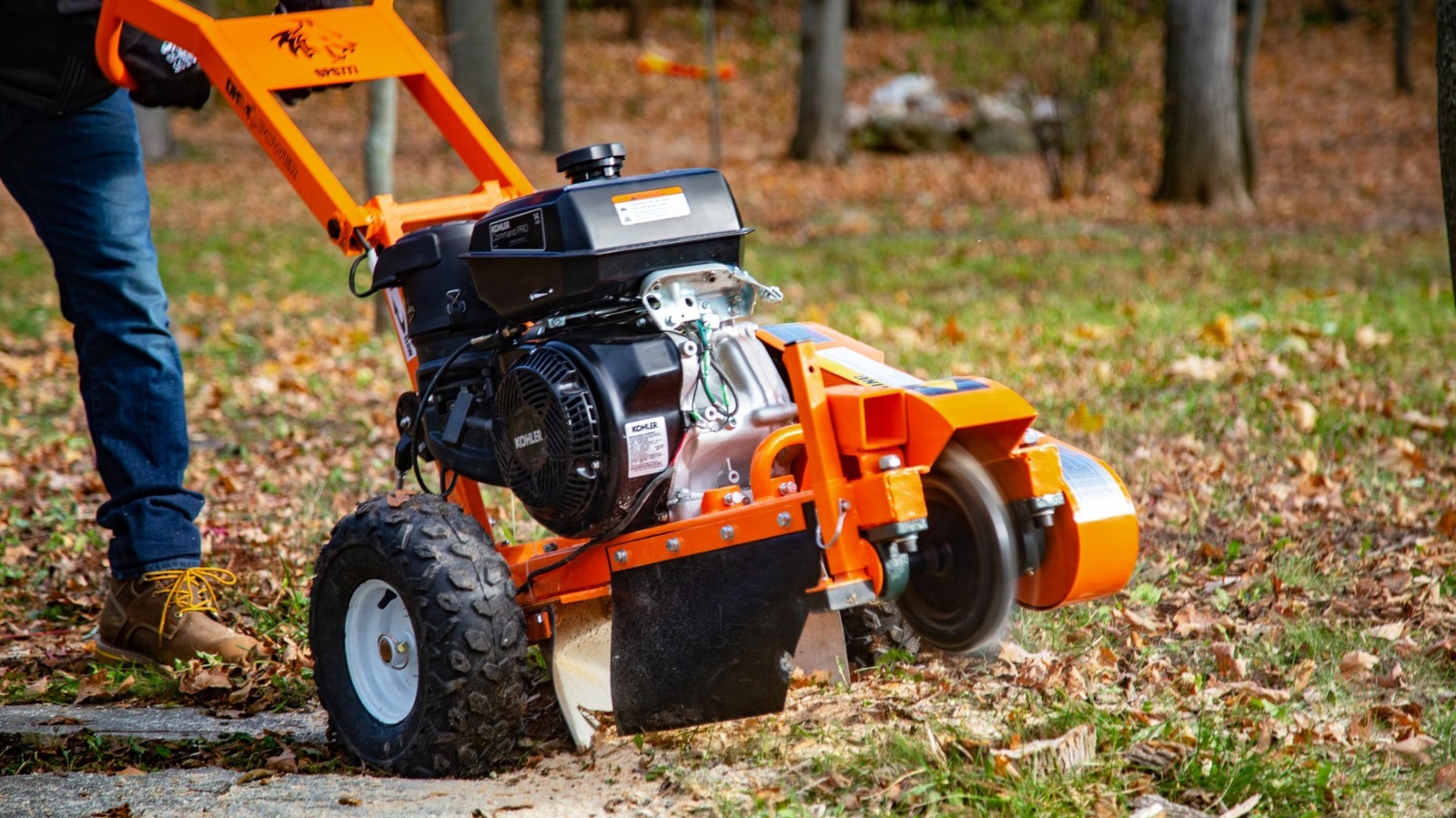
Unless you’re a professional landscaper, you’re almost always going to want to rent the equipment needed for removing trees from your property. These are big machines that require a lot of power, and they can cost a pretty penny. Besides, how often are you removing tree trunks and stumps from your yard, anyway?
Home Depot offers various wood chippers and stump grinders for rent — the retailer can even deliver them straight to your property so you don’t need to worry about towing or hauling them with a truck. The chippers range from a modest 4-inch model to a heavy-duty Vermeer 12-inch BC1000XL that can be hitched and towed. With a machine that large, you can handle most if not all the brush and branches you need to clear, though it’ll cost you over $500 per day and nearly $4,000 for a month.
Similarly, Home Depot offers a compact stump grinder, a 32-inch stump grinder, and a Mama Bear grinder that those needing something in between will find just right. The latter has a 13-horsepower Honda GX390 engine and rents for $189 per day, which is $130 less than the more powerful 31-hp Barreto E30SGB grinder that offers a 14-inch grind depth. In addition to chippers and grinders, you can also rent a 25-inch Log Splitter from Home Depot that delivers 20 tons of force and rents for $133 per day or approximately $1,600 per month.
Methodology
The lawn tools and equipment selected for this list were chosen because they can be useful for residential property owners, and not just professional landscapers. When searching available rentals from retailers like Lowe’s and Home Depot, we excluded tools that would typically see use as often as a lawn mower or string trimmer, which can make more sense to buy.
Other reasons include the cost of buying and maintaining the machines compared to renting them short-term and the size of the equipment. It doesn’t make much sense to keep large, bulky machines in your garage or toolshed that you don’t plan on using more than a few times a year, if not less. It’s also relatively easy to find places that rent each of the items on this list.