
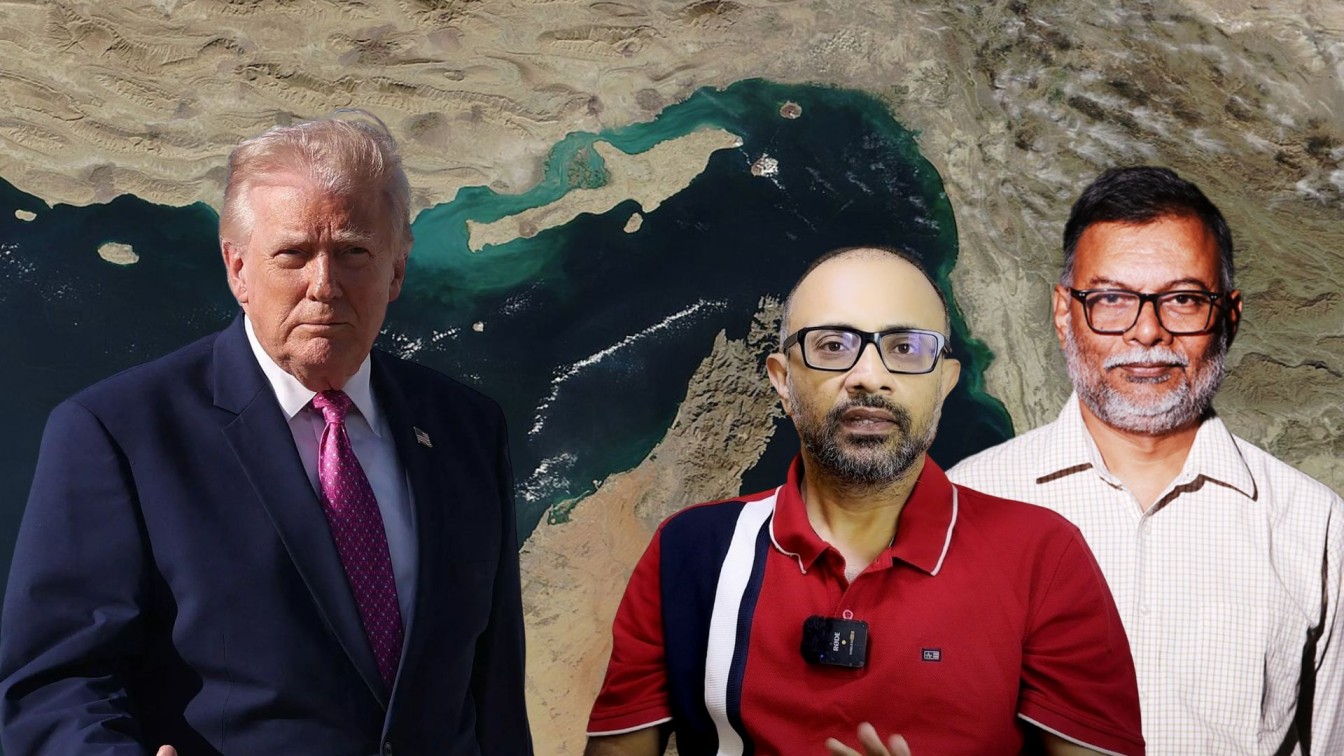

As America’s blockade of the Strait of Hormuz took effect on Monday (April 13) after marathon peace negotiations between the US and Iranian officials in Islamabad, Pakistan, failed, an apprehensive international community was thinking what’s next.
Also read: Trump vs Pope Leo XIV: How often have Washington and the Vatican warred?
The Federal spoke with Consulting Editor KS Dakshina Murthy, also a geopolitical expert, to understand what Washington’s new position means and what unabated tensions between the US and Iran could mean for the global economy and regional stability.
“The US blockade of the Strait of Hormuz is illegal, unilateral, and risks pushing the world to a dangerous flashpoint,” said Murthy, describing the latest escalation by Trump as a desperate and high-stakes gamble.
Here are some excerpts from the interview:
How do you see the US blockade of the Strait of Hormuz impacting its interests and Trump’s larger strategy?
A complicated war is getting even more complicated. That is the sum and substance of this situation. The US and Israel started striking Iran with missiles and drones on February 28. It was an unprovoked start to a war that has now gone on for 45 days.
Now, about half an hour ago, Trump began enforcing a blockade of the Strait of Hormuz. What does this mean? Iran retaliated in a way that the US and Israel did not expect. Instead of responding linearly, Iran targeted US interests across West Asia and internationalised the conflict.
Also read: The war and ceasefire are Trump’s, but Iran owns the Hormuz agenda
This created global pressure, including within the US, to halt the strikes. Trump demanded that Iran give up its nuclear and ballistic missile programmes—demands that directly affect Iran’s sovereignty. But Tehran refused.
Both the US and Iran are trapped in an ego-driven standoff, pushing the world to the brink.
Trump is now trying to turn the tables. By blocking Hormuz, he wants even Iran’s friends—especially China—to feel the pressure and force Iran to concede. It is a risky and uncertain strategy.
Is China an indirect target of this move by the US?
Trump is trying to replicate what he did in Venezuela, where he successfully blocked oil supplies and gained leverage. But China is not Venezuela.
China is perhaps the only country capable of challenging the US. It depends heavily on Iran and the Strait of Hormuz for energy supplies. It will not remain silent.
In fact, China has been working behind the scenes to bring about a ceasefire, possibly influencing countries such as Pakistan, Turkey, Egypt, and Saudi Arabia. Trump’s move is less about confronting China directly and more about using pressure on China to influence Iran.
Also read: Iran war: ‘There are clear red flags in ceasefire deal’
But this is a huge gamble. Any miscalculation could escalate the situation dramatically.
Does the US have the logistical and diplomatic backing to sustain such a blockade?
Let’s look at legality first. The war itself is illegal—there is no international legal backing for the US-Israel strikes on Iran.
The blockade is also illegal. Such an action requires a UN Security Council resolution, which the US does not have. The US president is acting unilaterally under the pretext of “freedom of navigation”.
Even the US’s key allies are distancing themselves. British Prime Minister Keir Starmer has clearly stated that the UK will not be involved in the Strait of Hormuz adventure. Other European nations are likely to follow.
This shows Trump’s increasing isolation and the confusion in the US strategy.
Is Trump now stuck in a war he cannot easily end?
He can end the war, but it would come at a significant loss of face. Trump is not someone who accepts defeat easily.
At the same time, Iran cannot back down either. Its nuclear programme is a matter of national pride and political survival. If it concedes, the government could face serious internal backlash.
So both sides are trapped in an ego-driven standoff, pushing the world to the brink.
What does this crisis mean for India, especially in terms of energy and diplomacy?
India has relationships with all sides—China, the US, and Iran. It could have played a significant mediating role.
Unfortunately, Indian policymakers did not take that route, and countries like Pakistan stepped in instead. However, Pakistan’s role is not over; backchannel talks are likely ongoing.
Also read: Pakistan’s Vishwaguru moment? It’s a narrow escape, not ceasefire
At this point, India does not seem to be playing a major diplomatic role. It will either benefit if the war ends or suffer along with the rest of the world if it continues.
Should India rethink its foreign policy approach in light of this crisis?
Yes, India should think quickly and adapt. It should become more proactive.
India has historical credibility from its non-aligned past and strong ties across blocs. It is well-positioned to mediate, much like Pakistan is attempting to do.
Also read: Doomsday averted, but can Iran war be settled across the table?
There is nothing wrong with stepping forward—it would enhance India’s global standing.
How important is the Iran relationship for India, especially given its ties with Israel?
India’s relationship with Israel complicates things. Israel is deeply hostile to Iran and does not seem interested in de-escalation.
At the same time, Iran is crucial for India’s access to Central Asia and projects like Chabahar Port.
Maintaining a balanced and healthy relationship with Iran is extremely important for India’s long-term strategic interests. While it may be difficult, it is not impossible for India to play a constructive role.
The content above has been transcribed from video using a fine-tuned AI model. To ensure accuracy, quality, and editorial integrity, we employ a Human-In-The-Loop (HITL) process. While AI assists in creating the initial draft, our experienced editorial team carefully reviews, edits, and refines the content before publication. At The Federal, we combine the efficiency of AI with the expertise of human editors to deliver reliable and insightful journalism.

Comments are closed.