
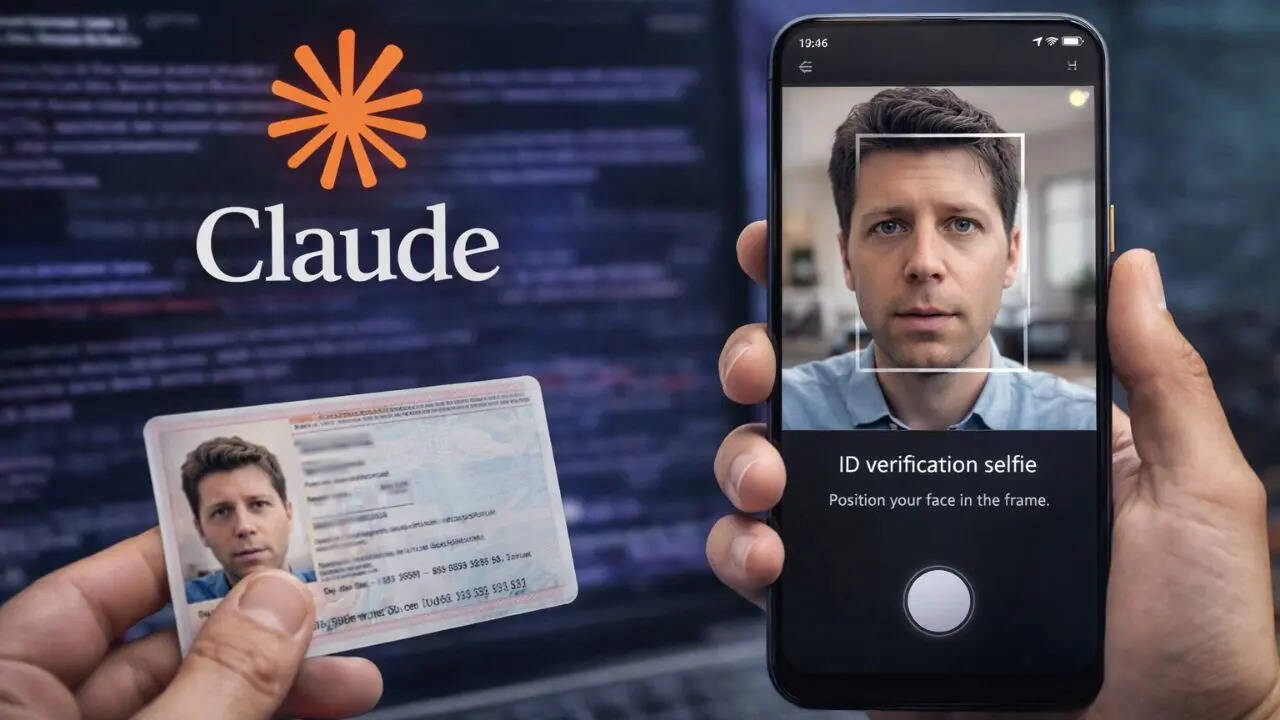

For a company that has long championed privacy as a core differentiator, Anthropic is now navigating tricky waters. Its AI chatbot, Claudehas built a loyal user base partly because of its perceived safety and minimal data intrusion. But a recent move—quietly testing identity verification—has sparked a wave of curiosity and concern.
The change isn’t universal yet, but it signals a potential shift in how AI platforms may operate going forward.
Credits: Times Now
What’s Changing Behind the Scenes
Anthropic has begun introducing identity verification checks in what it calls “select scenarios.” That phrase, however, leaves a lot open to interpretation—and that ambiguity is exactly what’s making users uneasy.
In some cases, users may now be asked to verify their identity by uploading a government-issued ID such as a passport or driver’s licence. Others might be required to complete a live selfie check to confirm authenticity. The process closely resembles Know Your Customer (KYC) protocols typically used by banks and financial institutions.
What’s unclear is when and why these checks are triggered. Is it tied to suspicious activity? Accessing premium features? Regional regulations? For now, Anthropic hasn’t provided detailed answers, which has only added to the speculation.
Why an AI Chatbot Needs Your ID
From Anthropic’s perspective, the rationale is straightforward: trust and safety. Verifying users can help prevent misuse of AI systems—whether that’s fraud, impersonation, or generating harmful content at scale.
As AI tools become more powerful and widely adopted, companies are under increasing pressure to ensure accountability. Identity verification could act as a deterrent against bad actors who exploit anonymity.
But here’s the tension: AI platforms have traditionally thrived on low friction and easy access. Adding ID checks introduces a level of seriousness—and inconvenience—that feels more aligned with banking apps than conversational AI tools.
How Your Data Is Being Handled
To manage this process, Anthropic has partnered with Personaa third-party identity verification provider. According to the company, all sensitive data is processed through Persona’s systems rather than being stored directly by Anthropic.
The assurances don’t stop there. Anthropic claims that:
- User data is encrypted
- It won’t be used to train AI models
- It won’t be sold or shared for advertising purposes
On paper, that sounds reassuring. But handing over government IDs and biometric data—even with strong safeguards—is a big ask. Trust, in this case, hinges not just on Anthropic, but also on its partners and their security practices.
The Privacy Backlash Begins
Unsurprisingly, the rollout has triggered criticism, particularly from users who chose Claude specifically for its privacy-first positioning. For them, this feels like a shift in philosophy.
There’s also the question of necessity. Unlike financial services, there’s no clear global regulation mandating strict identity checks for AI chatbots—at least not yet. That makes this move feel proactive, but also somewhat opaque.
Some concerns are philosophical: Should interacting with an AI require revealing your real-world identity at all?
Others are more practical: What happens if that data is compromised?
Lessons From Past Data Breaches
Skepticism around data security isn’t hypothetical—it’s rooted in real incidents. The Discord data breach 2025for example, exposed sensitive identity documents, serving as a stark reminder that no system is completely immune.
Even companies with strong security frameworks can face vulnerabilities. And when the data involved includes passports and facial recognition, the stakes are significantly higher.
This is why even well-intentioned moves toward safety can feel risky from a user perspective.

Credits: Digit
A Glimpse Into the Future of AI?
Anthropic’s experiment may be an early signal of where the AI industry is headed. As governments and regulators catch up with the rapid evolution of AI, identity verification could become more common—especially for accessing advanced capabilities.
The bigger question is whether users will accept this trade-off.
Convenience and privacy have always been key to the adoption of digital tools. Introducing friction in the form of ID checks risks pushing some users away, even as it aims to create a safer ecosystem.
For now, the rollout remains limited. But the conversation it has sparked is much larger—about trust, control, and what we’re willing to give up in exchange for safer AI.

Comments are closed.