
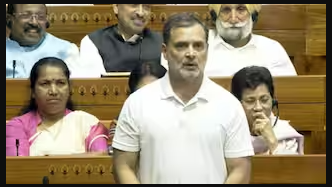
Rahul Gandhi Accuses Modi of “Hiding behind India’s Women,” Opposition Demand De-Linking Women’s Quota from Delimitation

Rohit Kumar
NEW DELHI, Apr 17: The Leader of the Opposition in the Lok Sabha Rahul Gandhi on Friday targeted the Narendra Modi government at the Center for “hiding behind India’s women” calling the linking of the women’s reservation bill with the delimitation of constituencies excise as an “anti-national act” attempting to alter the country’s electoral map.
Speaking on the second day of the special session in the debate on women’s reservation bill and delimitation,” Gandhi said, “The first truth is that this is not a women’s bill. This has nothing to do with the empowerment of women. This is an attempt to change the electoral map of India. Actually, it is a shameful act.”
It is a “panic reaction”, he also declared, “so that Prime Minister Modi can show he is pro-women,” particularly before voting for Bengal and Tamil Nadu Assembly elections next week, in which women voters will likely play a key role. He said the government had deliberately linked the women’s bill with the delimitation to try and disadvantage states that have better controlled population growth.
“But this is not a ‘women’s bill’… it has nothing to do with women’s empowerment,” Gandhi countered, “Women’s Reservation Bill was passed in 2023 with everyone’s support. What is happening now is an attempt to change India’s electoral map.” “Bring back the old bill and we will support it…” Gandhi said snapping back at accusations by the BJP members who have accused the opposition of politicizing the issue of women’s empowerment.
He also said the government was against sharing power with marginalized groups, specifically OBCs. “They are scared of erosion of their strength,” he said, referring to a vote bank of so-called upper classes, “…trying to rejig the Indian political map.” “What the government is doing is nothing short of anti-national… the government is telling southern, north-eastern, and smaller states ‘for us to remain in power, we are going to take away representation from you’. But we won’t allow you to do it.”
The opposition has been vocal about ‘links’ between the women’s reservation bill and those proposing delimitation. “The manner in which the government was implementing a quota for women – 33 per cent reservation in parliament and state assemblies – is really a bid to change India’s electoral map,” Gandhi warned parliament. The government, however, has said delimitation and expansion of the Lok Sabha are needed to operationalize the women’s quota before the 2029 Lok Sabha election, and called any party trying to block its move ‘against women’s empowerment.’
Hitting out at the NDA government further, Rahul claimed the Women’s Reservation Bill was an attempt to bypass the caste census and that the government was trying to take away power from the OBC communities.
“It is a historical fact that how Indian society treated Dalits and OBCs and their women…What is being attempted here is a bypass of the caste census. Here, they are trying to avoid giving power and representation to my OBC brothers and sisters and taking power from them,” he added.
On the delimitation issue, Gandhi said, “What you (BJP) are doing, because you are scared of what is happening in the politics of the country, you are scared of the erosion of your strength, and you are trying to rejig the Indian political map. You did it in Assam, J&K, and now imagining you can do it in India. You need a constitutional amendment to do that.”
Attacking the BJP, he said, “Manuvad over Samvidhaan…Amit Shah ji says that the caste census has begun. He repeated twice, trying to be clever, saying that houses don’t have caste. The point is whether or not the caste census is going to be used in representation in Parliament & State Assemblies. And now, what you are trying to do is that caste census has nothing to do with representation for the next 15 years…”
The delimitation process – i..e., the redrawing of parliamentary and assembly constituencies – will use demographic data from the 2011 census and the opposition has argued this disadvantages southern states that have controlled population growth.
Assigning seats on this score will give northern, Hindi-speaking states – which have not been as effective and a majority of which are BJP strongholds, such as Uttar Pradesh, which sends the most MPs to the Lok Sabha – more seats. Political leaders from southern states, including Tamil Nadu Chief Minister MK Stalin, have spoken out against this.
They have also argued the exercise makes it less important for the BJP – ahead of the 2029 election, in which it will seek an unprecedented fourth straight term – to focus on southern states for that win. The BJP has, historically, struggled for traction in the southern states.
The government, however, has insisted no state will be disadvantaged due to delimitation. The PM offered a “guarantee” in parliament yesterday. “I give my guarantee… no injustice will be done to any state, from east to west, north to south,” he said.
The stand-off was best explained Thursday by Congress MP Shashi Tharoor. “The government has a plan to re-delimit constituencies and increase seats in areas where the ruling party is strong. And they are using women’s reservation as an excuse to bring about that change… by trying to amend constitutional amendments they already brought in 2023.”
The opposition has also criticized the move to expand the Lok Sabha to a staggering 850 seats, 15 of which will be allotted to union territories and the rest to states. Apart from concerns a majority of these will be assigned to Hindi-speaking states, the opposition has questioned the need to expand the House to reserve seats for women, rather than simply reserving them now.
Vote on the women’s quota amendment and related bills was scheduled for Friday evening. The BJP-led NDA anyway did not have the required numbers in Parliament to get the amendment passed on its own.
Amending the Constitution requires a special majority in both houses of Parliament — a majority of the total membership (more than 50%), and a two-thirds majority of members present and voting.
So, if all 540 members, that are there in the House currently, are present and voting, the two-thirds majority mark would be 360. While the NDA has the support of 293 members in the Lok Sabha, which is 54% of the house, the opposition bloc has 233, of which the Congress has 98. Seven MPs are independents, and four belong to the Andhra opposition party YSRCP of Jagan Mohan Reddy; plus one each to the AIMIM from Telangana and the SAD from Punjab. The AIMIM and the SAD have already opposed the bill.
Even if 90 MPs abstain, the two-thirds figure comes to 300, still not the NDA number. That means, for the bills to get approval from the Lok Sabha, at least two main opposition parties have to abstain. That would have to be either the Samajwadi Party (37 MPs) of UP, or the Trinamool Congress of Bengal (28 MPs), or the DMK (22 MPs) of Tamil Nadu. They have said they won’t. In case the bills do not get Lok Sabha nod, they will not be taken up in the Rajya Sabha. In the Upper House, too, the NDA has less than 60% of the House.
The Congress and several parties from South India, a region that includes Andhra, have said the states could end up losing seats, even though they were successful in controlling their population as per a national policy of family planning.
The Congress has underlined that PM Modi’s “guarantee” and home minister Amit Shah’s claim, that there will be a flat 50% increase in Lok Sabha seats from 543 to 816, has no value if not coded in law. The proportionate share for states will remain the same, Shah has said. But this is not written in the bills, analysts have noted too.
The delimitation done by a commission appointed by the central government, can reduce the share of the southern states from 24% to 20% in the Lok Sabha, if it’s done as per the 2011 Census now or later, DMK from Tamil Nadu has pointed out for instance.

Comments are closed.