
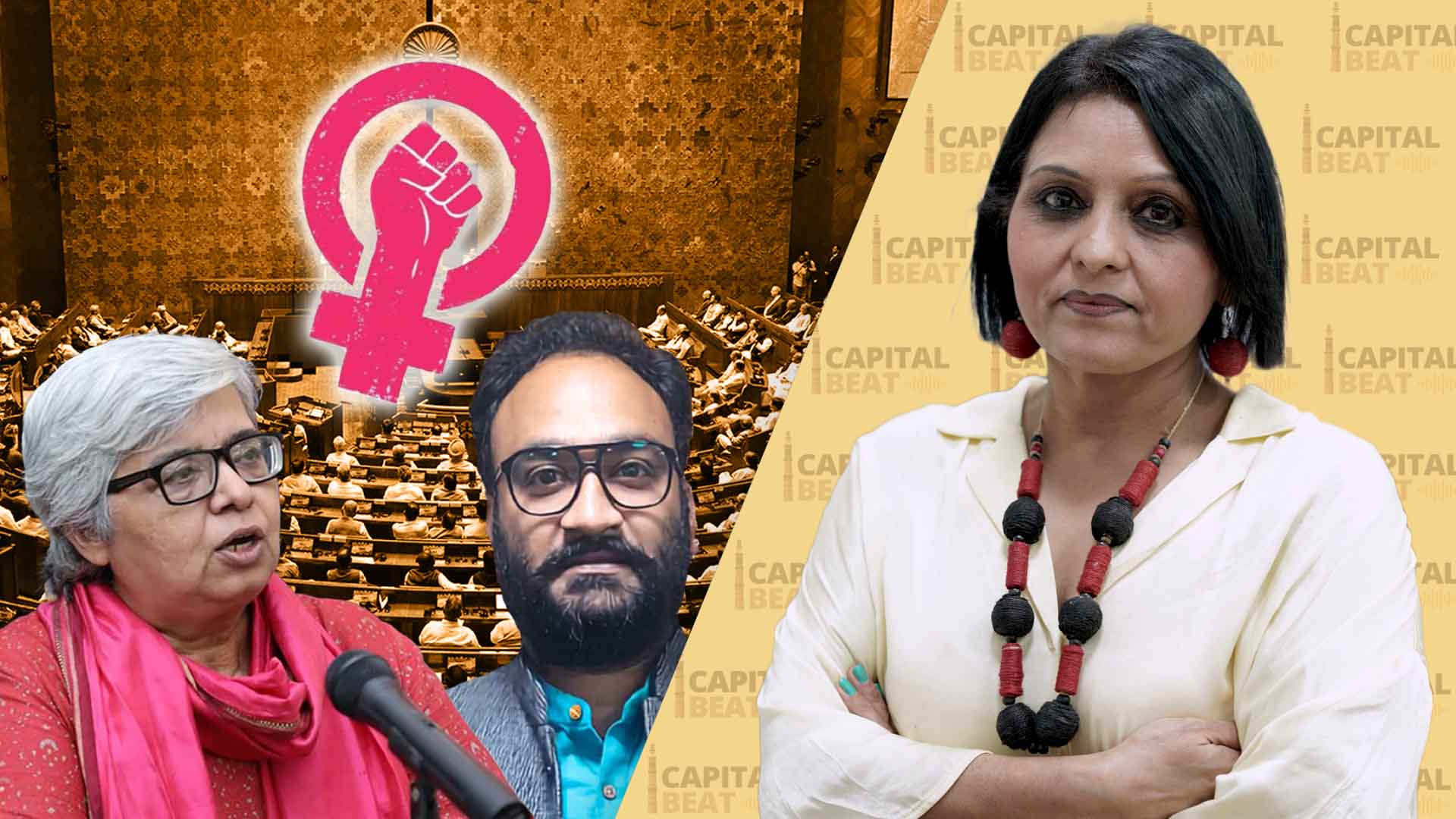

In the latest Capital Beat episode, Puneet Nicholas Yadav, Political Editor at The Federaland social activist Shabnam Hashmi discussed the defeat of a Constitution Amendment Bill linked to the implementation of the Women’s Reservation Act. The bill failed to secure the required two-thirds majority in the Lok Sabha, with 298 members voting in favour and 230 against, raising questions about its implications for women’s reservation, delimitation, and electoral strategy.
The discussion clarified that the defeat of the amendment does not nullify the Women’s Reservation Act passed in 2023. The legislation remains part of the Constitution, even as the proposed changes tied to its implementation have been rejected.
The panel also examined the legislative package introduced during the special session, which included three interlinked bills. With the Constitution Amendment Bill failing, the other two bills—dependent on its provisions—also stand defeated.
What the amendment bill aimed to change
Puneet Nicholas Yadav outlined the intent behind the amendment, stating that it involved three key components. “The first intention or intent behind this bill… was to go in for an increase in the number of seats in the Lok Sabha… to increase that to 850,” he said.
He added that the second objective was to conduct a delimitation exercise, described as “readjustment of the boundaries of constituencies,” followed by the implementation of women’s reservation.
Also Read: Will women’s quota stall if Centre’s amendment Bill falls in Parliament?
Yadav clarified that the government presented the bill as a measure to expedite women’s reservation, but its structural provisions went beyond that. “The government is of course trying to explain it the other way around… that the only intention was to expedite the implementation of women’s reservation bill,” he noted.
Why the bill failed to pass
The failure of the bill was attributed to the government lacking the required numbers. In a House strength of 540 members, the two-thirds majority threshold stood at 360.
“The government right from the beginning had only 293 members of its own… it was always very clear that the government does not have the numbers to push through a constitution amendment without the opposition backing it,” Yadav stated.
He emphasized that Opposition parties raised “grave concerns” during the debate, leading to their collective decision to vote against the amendment.
Status of women’s reservation after the vote
Despite the defeat, the Women’s Reservation Act remains legally intact. “Please get this straight. Women’s reservation… has not fallen,” Yadav said.
He explained that the Act, passed in 2023, is already part of the Constitution and continues to exist independently of the failed amendment. However, its implementation remains contingent on processes such as delimitation and fresh elections.
A key development discussed was the government’s notification bringing the Act into effect. “They issued a gazette notification saying that as of April 16 women’s reservation… has come into effect,” Yadav noted.
Implementation challenges and timelines
The notification enables the reservation of one-third seats for women in legislatures, but immediate implementation is not feasible. “You cannot naturally do that without going for a fresh election,” Yadav said.
He also pointed out that delimitation remains a prerequisite under the 2023 law. Without completing this process, the reservation cannot be operationalized in existing assemblies.
Another concern highlighted was the duration of the reservation policy. “They have cut short the life of the women’s reservation… out of those 15 years 3 years will pass now without its implementation,” Yadav stated.
Fate of the other two bills
The panel confirmed that the failure of the Constitution Amendment Bill has rendered the other two bills ineffective. These statutory bills were linked to the amendment’s provisions.
“Because the provisions made in those two bills are interlinked… those two bills can also not be passed,” Yadav said.
As a result, the entire legislative package introduced during the special session stands defeated.
Opposition stance and concerns
Shabnam Hashmi reiterated that opposition to the amendment was not opposition to women’s reservation itself. “Nobody is against the women’s reservation bill but delimitation is something which should be decoupled from this,” she stated.
She described the legislative exercise as pre-planned. “It was an extremely well planned choreographed theatrics which happened in the parliament,” Hashmi said.
Hashmi also warned of potential political messaging around the bill’s defeat. “They knew it very well that they cannot get it passed because they don’t have the two third majority,” she added.
Political messaging and electoral implications
The discussion highlighted how the outcome could influence political narratives. Yadav noted that the government may frame the defeat as obstruction by the opposition.
“They are going to play the matter… by saying… we wanted to bring women’s reservation early and… the opposition did not allow us,” he said.
Hashmi also pointed to the potential use of this narrative in elections. “They would be going from house to house telling people that opposition stop your reservation,” she said.
Delimitation debate remains unresolved
Both panelists indicated that the issue of delimitation remains central to future developments. Yadav described it as an ongoing concern despite the bill’s defeat.
“The threat of delimitation remains very alive,” he said, noting that the 2023 Act already includes provisions for it.
He warned that future delimitation exercises could reshape constituencies. “The opposition has a lot of trouble at hand… whatever delimitation exercise happens… one doesn’t know what form it will take,” he stated.
Challenges ahead for stakeholders
Yadav outlined the need for sustained political engagement on the issue. “They need to build… a very formidable campaign… and build a people’s movement,” he said, referring to opposition efforts.
Hashmi emphasized the role of public awareness. “The most important task… is to expose what has happened just now,” she stated.
She also highlighted concerns about misinformation. “That narrative has to be stopped… that is the major challenge,” Hashmi added.
The content above has been transcribed from video using a fine-tuned AI model. To ensure accuracy, quality, and editorial integrity, we employ a Human-In-The-Loop (HITL) process. While AI assists in creating the initial draft, our experienced editorial team carefully reviews, edits, and refines the content before publication. At The Federal, we combine the efficiency of AI with the expertise of human editors to deliver reliable and insightful journalism.

Comments are closed.