
US microbiologist behind Singapore’s sewage-to-tap water wins prestigious Lee Kuan Yew Water Prize

Joan Bray Rose, 72, of Michigan State University, was announced the 11th laureate of the biennial award by Singapore’s national water agency PUB at a press conference on April 16. She will receive a gold medallion, a certificate and S$300,000 (US$236,000) at the opening of Singapore International Water Week on June 16 from Deputy Prime Minister and Minister for Trade and Industry Gan Kim Yong.
Rose’s foundational contribution to water science is a framework known as quantitative microbial risk assessment, or QMRA, a mathematical method for calculating the likelihood that a given water supply will cause infection based on microbe concentration, exposure pathways and pathogen potency. Before QMRA, water safety tests typically returned results only after contaminated water had already been consumed.
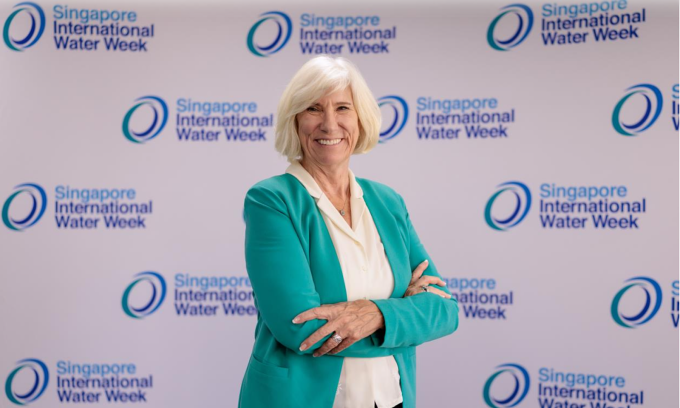
Professor Joan Bray Rose, Homer Nowlin Chair in Water Research and Director of the Water Alliance at Michigan State University and Lee Kuan Yew Water Prize 2026 Laureate. Photo courtesy of Media OutReach Newswire via VNA |
“By enabling the mathematical quantification of infection risks, Professor Rose has provided the world a global approach for defining, managing and regulating water safety,” PUB chief executive Ong Tze-Ch’in told reporters, The Straits Times reported.
The urgency of that work had become starkly visible a few years earlier. In 1993, a Cryptosporidium outbreak in the American city of Milwaukee, Wisconsin, driven by inadequately filtered drinking water drawn from Lake Michigan, killed at least 69 people and sickened more than 400,000, according to the U.S. Centers for Disease Control and Prevention.
It remains the largest documented waterborne disease outbreak in U.S. history. Rose had already been warning since 1988 that the chlorine-resistant parasite was widespread in treated drinking water supplies and that conventional testing was not catching it in time, according to the Stockholm Water Prize Foundation, which honored her in 2016.
Five years after Milwaukee, in 1998, Rose joined a U.S. study trip that set Singapore’s NEWater project in motion. With few natural water sources and a historical dependence on water imported from Malaysia, the city-state was weighing whether it could reclaim used water and return it safely to taps, an approach that required airtight risk science before it could win public and regulatory trust.
Rose served on the NEWater Expert Panel from 1998 to 2002 as Singapore evaluated the treatment process, and later chaired PUB’s External Audit Panel from 2003 to 2019, according to Singapore International Water Week, a platform to share and co-create innovative water solutions.
NEWater now meets up to 40% of Singapore’s water demand and is projected to cover 55% by 2060, according to PUB. It is one of the most-studied water reuse systems in the world and a reference case for water-stressed cities everywhere.
Singapore named Rose an honorary citizen in 2015 for her contributions to the country’s water security. She is now the Homer Nowlin Chair in Water Research and director of the Water Alliance at Michigan State University, has authored more than 300 scientific publications, and has won two of water science’s most prominent global honors: the 2016 Stockholm Water Prize, often called the Nobel of water, and the International Water Association’s 2024 Global Water Award.
Rose, in a statement released by Singapore International Water Week, said the Lee Kuan Yew Water Prize reflects collective progress in microbial risk science and pointed to emerging contaminants that will test the next generation of water systems. Those include per- and polyfluoroalkyl substances (PFAS), the so-called forever chemicals that resist breakdown in the environment, along with microplastics and antibiotic-resistant bacteria.
“Safe water is one of the world’s most fundamental yet unevenly distributed resources critical to sustaining human life,” she said in the statement.
The previous Lee Kuan Yew Water Prize went in 2024 to Dutch microbiologist Gertjan Medema, a longtime collaborator of Rose’s who pioneered the use of wastewater surveillance to track the spread of the coronavirus during the Covid-19 pandemic. According to Michigan State University, Medema was nominated for that prize by Rose herself.
Singapore International Water Week 2026 is expected to gather 2,500 specialists from governments, utilities and industry, and more than 25,000 trade visitors, at the Sands Expo and Convention Centre from June 15 to 18.
Comments are closed.