
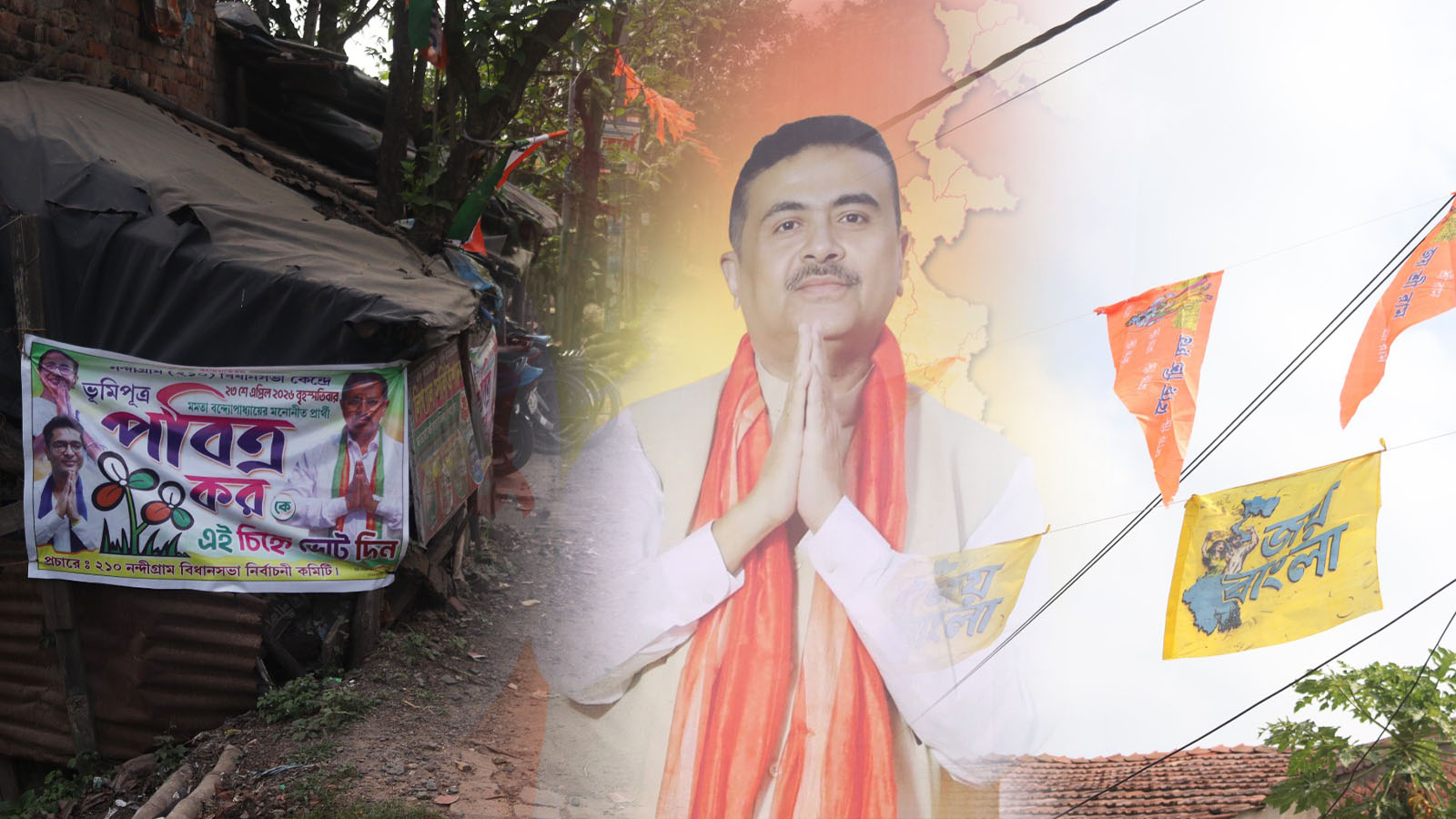

In a marked contrast to what prevailed two decades ago in Nandigram, a sea of saffron flags bearing images of Lord Ram and Hanuman, interspersed with yellow flags carrying “Joy Bangla” in blue, blankets the landscape from Tengua More in the north to Tekhali Bridge in the southeast.
Also read: Bengal elections: Peace came to Jangalmahal, but prosperity didn’t follow | Ground Report
This canvas is not coincidental but part of a larger process that has unfolded in Nandigram, located in poll-bound West Bengal’s Purba Medinipur district, after Opposition leader Suvendu Adhikari defeated Chief Minister Mamata Banerjee here five years ago in an epic electoral battle. Since then, it has emerged as a prototype of the assertive Hindutva model that the BJP envisages for the state.
Hindu gods, call for Hindu unity
Banners featuring Adhikari and Prime Minister Narendra Modi, alongside images of Hindu gods Ram and Hanuman, calling for “Hindu aikya” (unity) and urging people to celebrate Ram Navami, dot the rural landscape even weeks after the festival, reinforcing a persistent political overtone in religious messaging and vice versa.
The dominant socio-political milieu of Nandigram stands in sharp contrast to the political identity forged during the historic land rights movement of 2007, which reshaped the state’s politics.
Posters canvassing support for BJP candidate Suvendu Adhikari in Nandigram constituency in Purba Medinipur district of West Bengal, ahead of the 2026 Assembly elections. Photo: Abhishek Sharma
“If the Nandigram movement once stood as a symbol of communal unity, this election has turned into a contest of divisions,” said Sheikh Saddam Hossain, secretary of the Communist Party of India’s (CPI) Nandigram-1 local committee.
He said the Trinamool Congress (TMC) is seeking votes in the name of Lord Jagannath, while the BJP is in the name of Ram.
We have lived together here for years. This kind of division is not good.
The Jagannath temple built by the state government last year for Rs 250 crore in Digha, a coastal town in the same district located around 80 kilometres from Nandigram, is recurring in the TMC campaign discourse as part of the party’s competitive Hindu assertion, but with a localised flavour invoking deities that Bengalis relate to more than Ram.
The Adhikari factor in Nandigram
Alongside its Bengali-Hindu identity pitch, the TMC’s poll planks here include the alleged hegemony of the Adhikari family and Suvendu’s failure to deliver development in Nandigram, a constituency which he won in 2016 and 2021, on the tickets of the TMC and the BJP, respectively. Suvendu is also contesting against Mamata in Bhabanipur in Kolkata, aiming to repeat his 2021 feat in Nandigram.
Suvendu’s father, Sisir Adhikari, a former Union minister, shifted to the BJP in 2021 after long stints with the Congress and later the TMC, during which he served for nearly two decades as both an MLA and an MP.
Other members of the family have also held elected office, with Suvendu’s brothers Dibyendu and Soumendu representing Tamluk and Kanthi Lok Sabha seats, respectively. Dibyendu is now in the fray as the BJP’s candidate from Egra Assembly constituency.
Also read: Bengal elections could be decided by 65-70 constituencies with razor-thin margins
However, there are also people who aim to end the Adhikari family’s dominance in the region. One of them is Pabitra Kar, who the TMC has fielded against Suvendu in Nandigram, once the BJP leader’s trusted aide who returned to the ruling party only recently to take on his former mentor.
A Ram Navami poster mentioning BJP leaders such as Prime Minister Narendra Modi and West Bengal Opposition leader Suvendu Adhikari (left) in Nandigram and the town’s bus stand area which is decked up with banners and festoons of the rival TMC and BJP for the 2026 elections. Photo: Abhishek Sharma
“I quit the BJP to join the TMC to resist the hegemony of the Adhikari family in the district,” Kar said. Posters campaigning for him also call him a “bhumiputra” (son of the soil) in an apparent bid to put him ahead of the Adhikaris in local politics.
Calling the BJP leader a self-seeker who has failed to deliver development in the constituency, the TMC leader also promised a bridge over the local Haldi River, a cold storage facility for fishermen, a stadium and a medical college in Nandigram, along with upgrading the local agricultural market.
Suvendu calls himself ‘saviour’ of Sanatanis
Adhikari, a key face of Nandigram’s anti-land acquisition movement and now the BJP’s most prominent leader in the state, has in his campaign speeches and outreach repeatedly emphasised Hindu consolidation, positioning himself as a saviour of “Sanatanis”.
Claiming that while he gets just two votes in a polling booth set up in a madrasa, the TMC candidate gets 800, he said that in a booth in a high school, where most voters are Hindus, he gets 400 of the 700 votes polled, while the TMC gets 250 and others 50.
“If I don’t get a single vote in booths set up in madrasas, then those of you with a tilak on your forehead, tulsi around your neck, and our mothers and sisters wearing sindoor should ensure the TMC scores zero in your booth. Hindus must unite,” he said, amidst chanting of “Jai Sri Ram” from the crowd.
“I have been protecting the Sanatanis of Nandigram over the past five years,” Suvendu said, while campaigning at Tengua, adding that he has stepped in to support Hindus whenever they were attacked across the state.”
Also read: West Bengal voter roll revision: Yogendra Yadav flags ‘targeted deletions’
Clearly, the central axis of politics here appears to have shifted from land and livelihood to identity and consolidation.
The growing prominence of religious symbolism is particularly significant in a constituency where Muslims make up around a quarter of the population and have historically lived alongside Hindus with relatively little friction.
Nandigram has a 34.04 per cent Muslim population as per the 2011 census.
Some residents say the current atmosphere feels different.
“Earlier, festivals were shared. Now it feels like everything is being divided,” said a resident who did not want to be named, citing concerns about speaking openly during an election.
Concerns over this shift are also reflected in the revision of electoral rolls. Data from the special intensive revision exercise has raised sharp questions about whether minorities are being disproportionately affected.
A study of supplementary voter lists shows that although Muslims constitute roughly a quarter of the electorate, they account for an overwhelming 95 to 96 per cent of those deleted, around 2,700 out of 2,826 names, pointing to a stark demographic skew in the exercise.
A section of residents said the strategy could cut both ways for the BJP. While it may energise and consolidate one segment of voters, there are signs of unease among others.
Local Hindus, Muslims express concern
At a tea stall near Tekhali Bridge, Hindu and Muslim men sat together discussing the election over tea, expressing concern about the direction of the campaign.
“We have lived together here for years. This kind of division is not good,” said Samir Maiti, a local resident, as others nodded in agreement.
Several people The Federal spoke to in Nandigram echoed similar sentiments, suggesting that while the rhetoric may be sharp, everyday social interactions have not completely broken down.
The electoral battle in Nandigram is further complicated by personal equations and local dynamics.
Also read: Polls a week away, 12,000 Murshidabad voters remain in a limbo | Ground report
Kar, who hails from Nandigram Block II —considered a BJP stronghold with a predominantly Hindu population— is seen as a local candidate with deep roots in the area.
His candidature introduces an element of insider-versus-insider contest, adding to the already high stakes.
TMC has its task cut out, feel experts
Political observers say the TMC faces an uphill battle in Nandigram, given Adhikari’s organisational influence and the BJP’s entrenched support base. But they caution that local loyalties and the electorate’s response to polarisation could still shape the outcome in unpredictable ways.
Despite the charged political environment, Nandigram remains largely agrarian, and everyday issues continue to matter to voters.
Also read: BJP’s Suvendu Adhikari accuses TMC of imposing ‘Arabic culture’ in Bengal
But many say these concerns are being overshadowed by the larger ideological battle playing out in the constituency.
“Leaders are hardly talking about development or livelihood issues,” said Sheikh Imantullah, who runs a shop at Nandigram bus stand.

Comments are closed.