
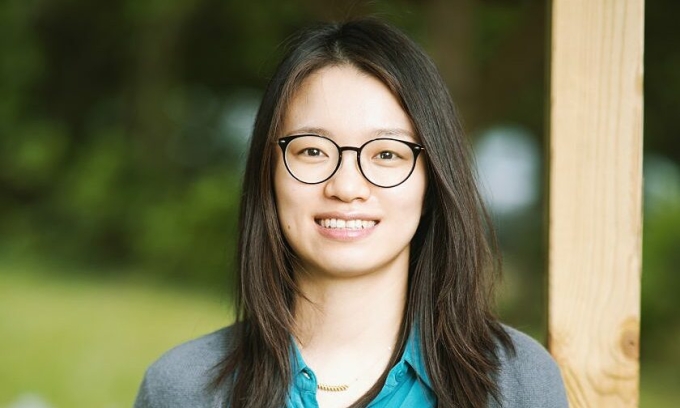
Chinese math prodigy Wang Hong, 2026 Fields Medal frontrunner, sweeps two top prizes in one week

The Breakthrough Prize Foundation announced on April 18 that Wang had won its 2026 New Horizons in Mathematics Prize, a US$100,000 award given each year to outstanding early-career researchers. The prize, widely known as the “Oscars of Science,” was presented at a gala in Los Angeles.
Wang was cited for her work in harmonic analysis, partial differential equations and geometric measure theory, covering the local smoothing conjecture, the Furstenberg set conjecture and the Kakeya conjecture, according to the foundation.
Four days earlier, on April 14, the Clay Mathematics Institute had named Wang one of four recipients of a 2026 Clay Research Award, alongside Tuomas Orponen of the University of Jyväskylä in Finland, Pablo Shmerkin of the University of British Columbia, and Joshua Zahl, now a chair professor at China’s Nankai University. The institute honored the four for their proofs of both the Furstenberg set conjecture in the plane and the Kakeya conjecture in three dimensions.
Wang’s biggest breakthrough came with Zahl in February 2025, when the pair posted a 127-page paper to the arXiv preprint server resolving the three-dimensional case of the Kakeya conjecture, a problem first posed by Japanese mathematician Soichi Kakeya in 1917 that had stumped mathematicians for more than a century.
The question sounds deceptively simple: what is the smallest region in which a needle can be rotated through every possible direction? Answering it rigorously in three dimensions required a decade of incremental progress across geometric measure theory and harmonic analysis.
Chinese mathematician Hong Wang. Photo courtesy of IHES |
Terence Tao, the 2006 Fields Medalist often described as the “Mozart of math,” called the result “spectacular progress in geometric measure theory” on his blog the day after the paper appeared.
According to the South China Morning Postthe breakthrough could have practical implications for imaging, data processing, cryptography and wireless communication, fields that rely on the mathematics of how wave packets interact.
Before this month’s double prize, Wang had already been collecting major honors at an unusual pace. She received the Maryam Mirzakhani New Frontiers Prize in 2022, the Salem and Ostrowski prizes in 2025, and the 2025 Gold Medal of Mathematics from the International Consortium of Chinese Mathematicians, informally known as the “Chinese Fields Medal.”
Earlier this year she was also named the 2026 recipient of the Sadosky Research Prize in Analysis from the Association for Women in Mathematics.
Her biography has the cadence of a prodigy’s. Born in Guilin, in southern China’s Guangxi region, to two secondary-school teachers, Wang skipped two grades in primary school, according to her publicly available biography. In 2007, at 16, she scored 653 out of 750 on China’s national college entrance exam and won early admission to Peking University’s School of Earth and Space Sciences, transferring to the School of Mathematical Sciences a year later out of what she has described as a love of the subject.
She went on to earn an engineering degree from France’s École Polytechnique and a master’s from Paris-Sud University in 2014, then a doctorate at the Massachusetts Institute of Technology in 2019 under Larry Guth, a leading figure in geometric analysis.
Wang is currently a professor at NYU’s Courant Institute of Mathematical Sciences and a permanent professor at France’s Institut des Hautes Études Scientifiques, or IHES, a position she took up in September 2025.
The Breakthrough Prize was founded in 2012 by a group of tech backers including Sergey Brin, Mark Zuckerberg, Priscilla Chan, Yuri and Julia Milner, and Anne Wojcicki, with the goal of elevating scientists into public recognition and inspiring younger researchers. The Clay Research Award has been given annually since 1999, a year after the Clay Mathematics Institute was established by American businessman Landon T. Clay and his wife Lavinia.
The 2026 Fields Medal, often called the “Nobel Prize of mathematics,” will be awarded at the International Congress of Mathematicians in Philadelphia from July 23 to 30.
In the medal’s 90-year history, only two women have won it: Maryam Mirzakhani of Iran in 2014 and Maryna Viazovska of Ukraine in 2022.
If Wang makes the shortlist this year, she will also become the third Fields Medalist of Chinese descent, after Shing-Tung Yau in 1982 and Terence Tao in 2006.
Comments are closed.