
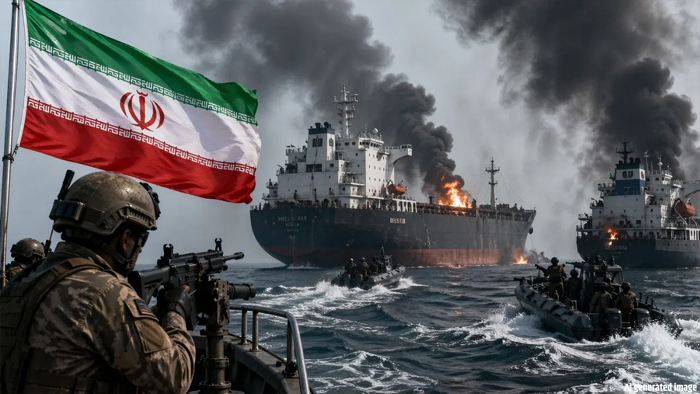

Desk: Iran’s Islamic Revolutionary Guard Corps (IRGC) launched a major military operation in the Strait of Hormuz, firing on two commercial vessels and seizing them. News of this heavy firing and the hijacking of the vessels sent shockwaves through the global commodity market. As a result, crude oil prices in the international market have suddenly surpassed the crucial $100 per barrel mark.
According to the report, this is the first such horrific incident since the war began where Iranian forces have directly used heavy weapons to intercept merchant ships. The Iranian military detected a total of three ships on its radar. Iran’s state news agency, Tasnim, reported that the IRGC has declared any external interference in the security and order of the Gulf region as its “red line.”
The ships attacked include the Panama-flagged “MSC Francesca,” which has been seized by Iranian forces. However, the Montenegrin government has expressed relief and clarified that its four crew members on board are completely safe. Meanwhile, a Liberian-flagged Greek ship, the “Epaminondas,” was hit by rockets and indiscriminate gunfire. The ship’s control room was severely damaged in the attack, and it is currently under Iranian control. A third ship, the “Euphoria,” was also fired upon, but it managed to escape and safely enter the United Arab Emirates (UAE).
Iran’s counterattack on Trump’s “economic blockade”
is crucial to understanding this entire maritime turmoil from a geopolitical perspective. Recently, US President Donald Trump stated in a statement that Iran fears “economic blockade” more than military bombardment. Diplomatic analysts believe Iran’s aggressive move in the Strait of Hormuz is a direct and aggressive response to this same US strategy. Iran has sent a clear message to the world that if any attempt is made to harm its economy, it will also disrupt the global energy supply chain.
Currently, on the one hand, the US has adopted a diplomatic strategy to surround Iran from all sides, while on the other, all avenues for peace or dialogue appear closed. Experts believe that until a concrete ceasefire agreement is reached in this entire region, this dangerous “hide and seek” and violence on vital sea routes for global trade are likely to continue. For the common man and the market, this means that until there is peace at sea, the threat of inflationary shocks from the crude oil crisis will remain constant.

Comments are closed.