
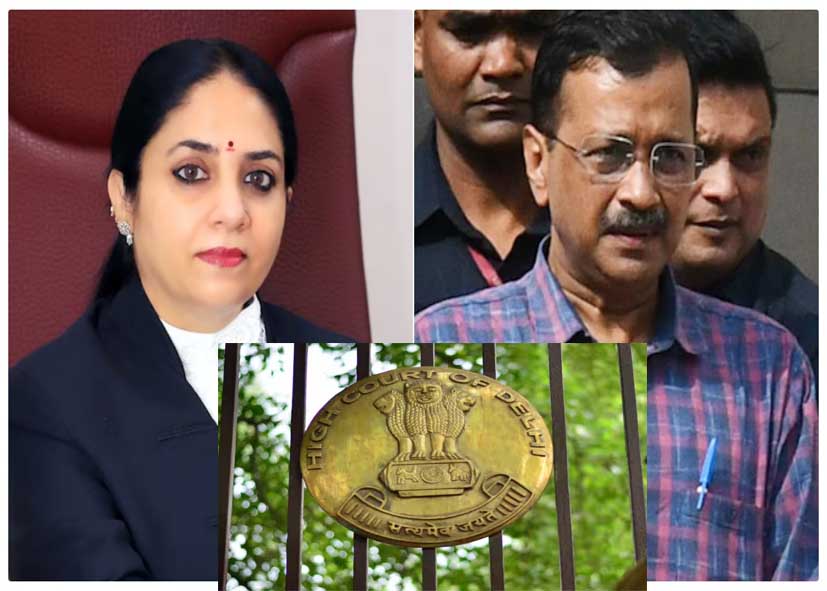
High Court is strict on the video controversy related to Arvind Kejriwal, said- who uploaded the video, the video should be deleted

The troubles of former Delhi Chief Minister Arvind Kejriwal are not decreasing. During the hearing on a Public Interest Litigation (PIL) in the Delhi High Court, the court has taken a strict stance regarding a video related to Arvind Kejriwal, some Aam Aadmi Party leaders, Congress leader Digvijaya Singh and journalist Ravish Kumar. During the hearing, the court directed to delete the video in question from the internet. Along with this, the court also raised the question as to who was the first to upload this video. Earlier, the recusal petition of Justice Swarana Kanta Sharma had been rejected by the court, after which this matter came into further discussion.
The court has made strict remarks regarding the recording of video conferencing and its dissemination on social media. The court said that such recordings violate rules and cannot be allowed to be circulated on social media. This comment was made by a bench of Justice V Kameshwar Rao and Justice Manmeet Pritam Singh Arora during the hearing of the petition filed by advocate Vaibhav Singh. The court has issued notice to Arvind Kejriwal, Aam Aadmi Party (AAP) leaders, Congress Digvijay Singh and journalist Ravish Kumar in this case. The next hearing of the case will now be on July 6. Earlier this case was before Justice D.K. Upadhyay and Justice Tejas Karia, but Justice Tejas Karia recused, following which it was transferred to the new bench.
Political agenda behind the video
The petitioner’s counsel told the court that recording of any judicial proceeding can neither be done nor published without permission. He claimed that the April 13 hearing was not only recorded but also shared on social media. The lawyer said it was shared by many people, including Aam Aadmi Party (AAP) leaders, and clarified that “sharing is the same as uploading.”
During the hearing, Digvijaya Singh’s alleged post was also mentioned and read out in the court. The petitioner side alleged that only those parts were made public which furthered the political agenda, while the entire proceedings were ignored. He called it an attempt to “scandalize” the court proceedings and said there was a suspicion of a wider conspiracy behind it.
What answer did Meta and Google give?
Lawyers on behalf of Meta Platforms and Google also appeared in the hearing. The court asked him whether it could be found out who first uploaded the disputed video. Meta told the court that there is no direct mechanism to accurately identify the “first uploader” of a video. The company said that even though URLs and information about associated accounts may be available, it is not technically possible to determine the initial uploader.
Despite repeated questions by the court, Meta said that it was not possible to identify the initial uploader. However, the company also said that some technical logs such as IP logs and other system data are available, through which tracing can be done to some extent. According to Meta, when an account is created, information such as email ID or mobile number is entered, and based on that, IP and other log data can help in investigation. It was also clarified during the hearing that Google also took a similar position on technical limitations and data availability.
Google said- deleted URLs
In the hearing, it was told by Google that 13 URLs given by the Registrar General have already been removed. Meta Platforms said that whenever any illegal or objectionable content is reported, action is taken in coordination with the concerned agencies. The court asked whether if the order is passed, would it be possible to remove all related videos and links, especially those that exist on various social media platforms. The court also clarified that the petition is not limited to just a few links but seeks to remove all the videos that are related to the case.
In the hearing, the court raised the question that when a case of illegal content comes to light, why do these platforms have to wait for instructions, and why do they not take action on their own. The court said it was keeping in mind the “larger interest of the institution”. It was told by Google that as soon as the URLs are received from the Ministry, they are removed. Meta Platforms said that it is not possible to delete a video immediately without any process and the platform itself cannot “judge” the content. On this, the court made it clear that in the next hearing the platforms should come with detailed instructions and also provide information as to who was the first to upload the disputed video. The court made a strict comment and said that any material which violates the law cannot be allowed to be broadcast or circulated.
Follow the LALLURAM.COM MP channel on WhatsApp

Comments are closed.