
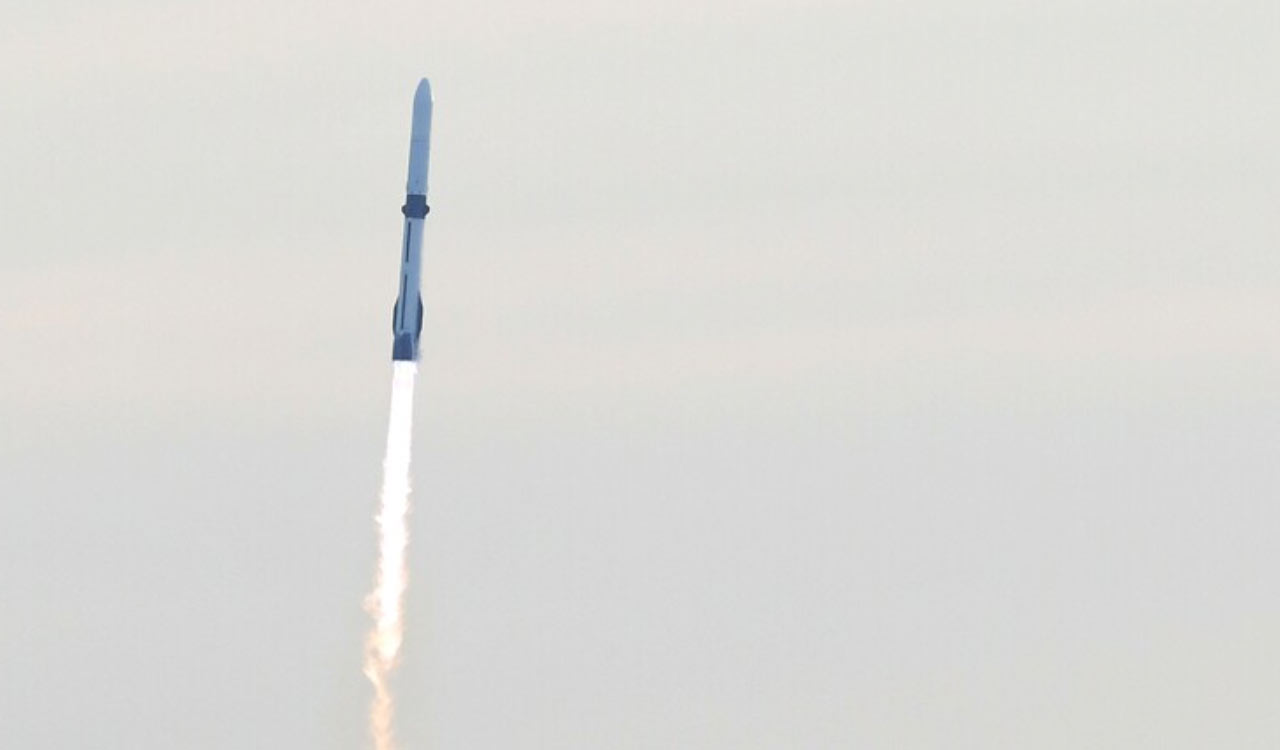

Pakistan has successfully launched its third indigenous electro-optical satellite, EO-3, from China’s Taiyuan Satellite Launch Centre. The satellite is expected to revolutionise urban planning, disaster management, food security, and environmental protection.
Published Date – 26 April 2026, 12:30 AM
Islamabad: Pakistan on Saturday successfully launched an indigenous electro-optical satellite, with the Foreign Office terming it a “significant milestone” that will enhance capabilities in remote sensing.
The satellite was launched from China’s Taiyuan Satellite Launch Centre, the Foreign Office (FO) said in a statement.
“The Pakistan Space and Upper Atmosphere Research Commission (Suparco) has successfully launched its indigenous electro-optical satellite (EO-3) from the Taiyuan Satellite Launch Centre, marking another significant milestone in the nation’s space capabilities,” FO stated on X.
“Beyond its core imaging mission, EO-3 carries advanced experimental payloads aimed at validating next-generation space technologies. These include a multi-geometry imaging module for enhanced imaging accuracy, an advanced energy storage system, and an onboard AI-powered data processing unit to enable real-time analysis and intelligent decision support,” it said.
The addition of EO-3 to Pakistan’s Earth Observation satellite fleet “significantly enhances national capabilities in remote sensing.”
“The integrated system will improve data continuity, imaging reliability, and analytical precision, supporting applications across Pakistan’s socio-economic sectors,” the FO said.
Separately, the army said the satellite would provide imaging data to “revolutionise urban planning, disaster management, food security and environment protection.”
President Asif Ali Zardari, who on Saturday left for China on a visit, termed the launch, in a statement, as a “historic milestone.”
The first indigenous Electro-Optical (EO-1) satellite was launched from the Jiuquan Satellite Launch Centre in northern China in January 2025.
Earlier in February, the second indigenous Earth Observation Satellite, EO-2, was successfully launched from China’s Yangjiang Seashore Launch Centre.

Comments are closed.