
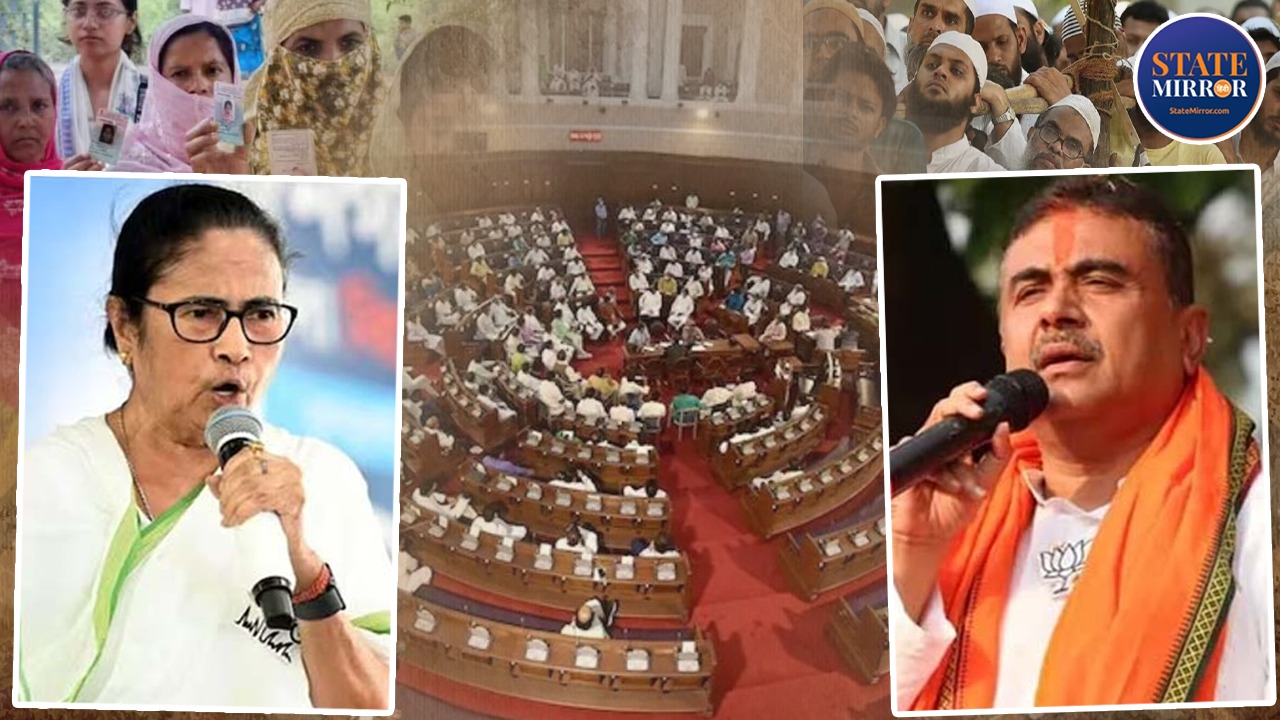
Bengal Election Phase 2: How the seats of these 5 districts are ‘kingmakers’, will Muslims decide the vote game?

West Bengal Assembly Elections 2026 In the second phase (Phase 2), voting is taking place in a total of 6 districts (North 24 Parganas, South 24 Parganas, Howrah, Hooghly, Nadia and Kolkata). This phase is crucial because it brings together urban, industrial and minority-dominated areas. Out of these 142 seats, Trinamool Congress had won 123 seats in the 2021 elections. Whereas Bharatiya Janata Party got 18 seats and Indian Secular Front got 1 seat. This is the reason why Phase-2 is being considered as the real battle zone of power, where Muslim vote bank is playing the role of “kingmaker” especially in 5 districts. Know where and what is the political equation.
1. Why is North 24 Parganas the biggest swing district?
There are a total of 33 assembly seats in North 24 Parganas. This is the most populous district of Bengal. The Muslim population here is on average 25–26%, but in Basirhat belt it reaches 45–50%. Barrackpore, Dumdum, Rajarhat, Bagda, Bangaon, Habra and Ashoknagar are the major seats. Whereas Basirhat North-South, Sandeshkhali, Meenakha, Hingalganj, Harua, Deganga and Baduria are Muslim dominated seats, where 40% percent vote share directly affects the election. TMC performed strongly here in 2021, but BJP challenged on urban seats. The victory margin in many seats was limited to 2-5 thousand votes. This is the reason why this district is considered as “Mini Bengal” and the biggest kingmaker, where the balance of Muslim votes and urban Hindu votes decides the result.
2. How does the vote bank decide the result in Nadia?
Nadia district has 17 assembly seats and the Muslim population is around 26–27%, rising to 35–50% in the border areas. Krishnanagar, Ranaghat, Chakdah, Kalyani and Nabadwip are major seats, while Karimpur, Tehatta, Chapra, Kaliganj and Nakashipada are Muslim dominated seats. Due to its connection with the Bangladesh border, this district is affected by issues like identity, security and migration. In 2021, TMC won most of the seats, but BJP made inroads in urban areas. Farming, border employment and migration are big issues here. Muslim vote is decisive in many seats, but the scattering of Hindu votes changes the equation. For this reason Nadia is considered a “sensitive kingmaker zone”.
3. How is urban vote and Muslim factor a gamechanger in Howrah?
Howrah district has 16 assembly seats and is an entirely urban-industrial area. The Muslim population is around 26%, which reaches 30–40% in many seats. Howrah North, South, Shibpur, Bali, Domjur and Uluberia are the major seats, while Uluberia, Amta, Bagnan and Panchala are Muslim dominated seats. The center of politics here is employment, transport and industrial decline. TMC took the lead in 2021, but BJP strengthened its hold among the urban middle class. Muslim vote is not in majority here, but being between 30–45% it becomes decisive in close contests. That’s why Howrah is called a “sliding kingmaker”, where even small vote swings change the outcome.
4. Less Muslims in Hooghly, why is vote effective?
Hooghly has 18 assembly seats and the Muslim population is around 15–16%, but in some seats it impacts up to 20–35%. Chunchura, Shrirampur, Dankuni, Arambagh and Tarakeshwar are the major seats, while Jangipada, Khanakul, Dhanekhali and Arambagh are Muslim dominated seats. This area was once the stronghold of the Left, then TMC emerged and now BJP has given a strong challenge. Unemployment, closed factories and industrial investment are the main issues here. Here the Muslim vote does not directly constitute a majority, but decides the margin of victory in a close contest. Therefore Hooghly plays the role of “indirect kingmaker”.
5. Why is South 24 Parganas the strongest fort of TMC?
South 24 Parganas has 31 assembly seats and the Muslim population is around 35–36%, while in many areas it goes up to 50%+. Diamond Harbour, Kakdweep, Gosaba, Canning, Bhangar and Baruipur are the major seats. Bhangar, Canning East-West, Basanti, Jaynagar, Kultali, Mathurapur, Magra Haat and Falta are Muslim dominated seats where 45–60% vote plays a decisive role. Under the leadership of Mamata Banerjee, TMC had almost made a clean sweep here in 2021. Rural development, government schemes and Matua politics are important issues here. Muslim vote bank is a strong base of TMC, but if the opposition divides it then an upheaval is possible on many seats.
Why will these 5 districts decide the power of Bengal?
These five districts of Phase-2 together influence the election trends of 115 seats. Among these, there are about 30-35 seats where the Muslim vote directly decides victory or defeat, while in the remaining seats it plays the role of “silent kingmaker”. Where the Muslim vote is more than 35%, the election result is largely decided, and where it is 20–30%, it becomes a decisive factor. That is, the real fight in Phase-2 is not just between parties, but about micro management of vote bank and social equation and this will decide in whose hands the power of Bengal will go.
What is BJP’s strategy?
BJP’s strategy in Phase-2 is clear, consolidation of Hindu votes, making anti-incumbency an issue and strengthening booth level management. The party is highlighting CAA and identity politics in the border districts, while raising the issues of unemployment and corruption in urban areas. Capitalizing on the anger against Trinamool Congress, BJP is also targeting women and youth voters. Also, taking advantage of the division of opposition votes in the triangular contest is its big strategy.

Comments are closed.