
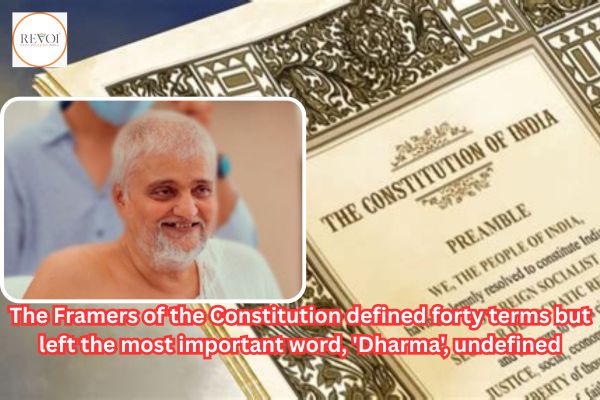

The Framers of the Constitution defined forty terms but left the most important word, ‘Dharma’, undefined.
Every constitution serves as a guiding principle for the delegation of power. It defines the terms under which authority may be exercised; simultaneously, through definition, it keeps that power within limits. That which remains undefined remains free. Over time, those who remain free are dominated by people who were never actually granted the authority to oversee them.
The first two articles of this series raised fundamental questions: Where is the instrument of transfer by which the Government of India acquired jurisdiction over the internal affairs of Indian religions? And how did that imperialist framework of control survive after independence—even when the British Crown itself had begun to abolish it? This third article concerns the definitional flaw at the heart of that legacy. In a sense, this silence within the constitutional text has turned the courts of the Indian Republic into ‘theologians’ or ‘self-proclaimed spiritual masters,’ who for the last 76 years have been delivering judgments on subjects that the Constitution itself never defined.
When the Law Forgets to Define
Before discussing the Indian constitutional text, consider briefly what happens elsewhere in the world when a law fails to define a common word. In the case of Nix v. Hedden (149 US 393), the United States Supreme Court faced a simple question regarding customs tariffs: Was an imported tomato a ‘fruit’ (duty-free) or a ‘vegetable’ (taxable)? Botanists gave correct testimony that the tomato is biologically a fruit. However, the Supreme Court unanimously ruled to the contrary. For the purposes of the tariff, tomatoes were vegetables because, in the “common language of the people,” they were served at lunch and not as dessert. Botanical truth lost to kitchen tradition—and it lost because the law had not taken the trouble to state what ‘fruit’ and ‘vegetable’ actually meant.
If the highest court of a great democracy can be compelled by the lack of a legal definition to declare a fruit a vegetable, imagine what happens when the Constitution itself leaves ‘Religion’—the very ‘conscience’ of a citizen—undefined, and not just a tomato under a tariff heading.
Asymmetry in the Text
The Constitution of India is not a “loose” document in that regard. Article 366 alone contains approximately thirty defined terms. In the complete text, nearly forty words are clearly defined—including ‘State’ (Article 12), ‘Law’ (Article 13), ‘Anglo-Indian’ (Article 366(2)), ‘Hindu’ (for the limited purpose of Article 25(2)(b)), ‘Goods,’ ‘Taxation,’ ‘Agricultural Income,’ ‘Corporation Tax,’ ‘Scheduled Castes,’ ‘Scheduled Tribes,’ and many others. The framers of the Constitution were very precise in this matter. Where a word had legal consequences, they provided its meaning.
Now consider a paradox that would make every constitutional lawyer in this country pause and think.
The term ‘Anglo-Indian’ is defined in Article 366(2) with extreme precision in 51 words: a person whose father or any of whose other male progenitors is or was of European descent but who is domiciled within the territory of India and is or was born within such territory of parents habitually resident therein and not established there for temporary purposes only. Paternal lineage, European descent, residence, place of birth—every element of the definition was placed with the care of a draftsman who understood that legal consequences depend on specific words. This term is used in only six articles—331, 333, 334, 336, 337, and 338—and it was for a community whose population, according to the 2011 census, was only a few hundred thousand. The 104th Constitutional Amendment of 2020 completely abolished reserved representation for Anglo-Indians in Parliament and State Legislative Assemblies. Yet, its definition remains as precisely present today as it was in 1950.
Other examples tell the same story. ‘Corporation Tax’ is defined in Article 366(6) with three technical sub-clauses and more than seventy words. ‘Agricultural Income’ is defined in Article 366(1) with a reference to the Income-tax Act. ‘Ruler’ was defined in Article 366(22)—a category that ended with the abolition of privy purses in 1971.
Now See What is Not Defined
‘Dharma’ — Undefined. This word and its related terms appear in Articles 5, 10, 25, 26, 27, 28, 29, 30, 44, 51A, and 325—occurring more than 20 times in a text that governs the spiritual lives of more than 1.4 billion people.
‘Religious Denomination’ — Undefined. This term appears in Article 26 and indirectly in Article 16(5), and it serves as the foundation for every religious rights dispute from 1950 to the present day.
The same Constitution that used 51 words to define a term for a community of a few hundred thousand—a term that is now largely legally inactive—did not even allocate a single clause to define the word that protects the faith and belief of a billion people.
The Demand of Articles 16(5) and 27
Two of the most fundamental clauses of the Constitution clarify the difference between ‘Religion’ and ‘Religious Denomination.’ Article 16(5) allows for the creation of a law where it is necessary for an office-holder of a religious institution to belong to a specific religion or denomination. Article 27 mandates that no person can be compelled to pay any tax, the proceeds of which are used for the promotion of any specific religion or denomination. In both—in the same breath and the same clause—the Constitution names two different categories. A text that uses this distinction in two fundamental rights should provide an explanation for it somewhere. The Constitution repeatedly mentions this distinction but explains it nowhere.
Ambedkar’s Recognition and His Retreat
The framers of the Constitution were not unaware of this problem. On December 2, 1948, Dr. BR Ambedkar told the Constituent Assembly that in India, religion covers every aspect of life from birth to death, and there is nothing to which religion is not linked. He proposed in principle that the definition of religion should be limited only to beliefs and essential religious rituals. KM Munshi also insisted during another debate that key terms should be broadly defined through an interpretation clause.
Nevertheless, no such definition was ever drafted. The Assembly left this question to the courts. The courts inherited a burden that the framers themselves found too heavy to carry.
The Judge as a Theologian, or a Spiritual Master?
Taking advantage of this silence of definition in the Constitution, the Supreme Court stepped in. In the case of Hindu Religious Endowments v. Shirur Mutt (1954), Justice BK Mukherjea defined ‘Religious Denomination.’ In this way, a secular judiciary—which was never elected based on religious qualifications, nor ever nominated by any Acharya, Jathedar, or Bhikkhu—assumed the power to define religious denominations. It began to decide for itself what is essential religion and what is non-essential, what is religion and what is superstition, and finally, it even gained the power to distinguish one faith from another.
A Mindset That Moved Forward
An irony is worth noting here. While passing the ‘Church of England Assembly (Powers) Act’ in 1919, the British Parliament deliberately avoided deciding what the ‘Church’ was, what its principles meant, or how its spiritual affairs should be governed. Parliament explicitly accepted that the Church should govern itself freely from controls. Western legislatures, meaning Parliaments, chose restraint over jurisdiction.
Whatever power the British Parliament was supposed to have in the subject of religion, based on that same logic, the power that came to the Indian Constituent Assembly should have been only as much as its predecessor legally possessed: that is, belonging to the Church, and nothing beyond. Yet, by keeping ‘Religion’ undefined, the Indian Republic has kept the door open to suppress every Indian religion—Hindu, Jain, Sikh, Buddhist—under a jurisdiction that was never granted to it, and that too through words that the Constitution never defined.
Conclusion
Two words that should have been defined with the greatest precision have been left in a state of total non-definition. The two categories that the Constitution itself considers distinct are never clearly distinguished. And a civilization whose religions are older than most modern nation-states today sees its justice being weighed in words that it never wrote itself and in a vocabulary it perhaps does not even recognize.
A Constitution that defines forty words and excludes the most important word is not a ‘secular’ Constitution; it is an ‘unfinished’ Constitution.
The framers of the Constitution left this question to the courts. The courts have handed this question back after 76 years. Now, as the nine-judge bench meets, the main issue is not Sabarimala, nor is it the principle of ‘Essential Religious Practice.’ It is that word (Religion) on which all of this rests, and the definition of which the Constitution has never provided.
Sabarimala Review Series
By Spiritual Sovereign Param Pujya Jainacharya Yugbhushansuriji,
79th Successor to Tirthankar Shri Mahavir Swami.

Comments are closed.