
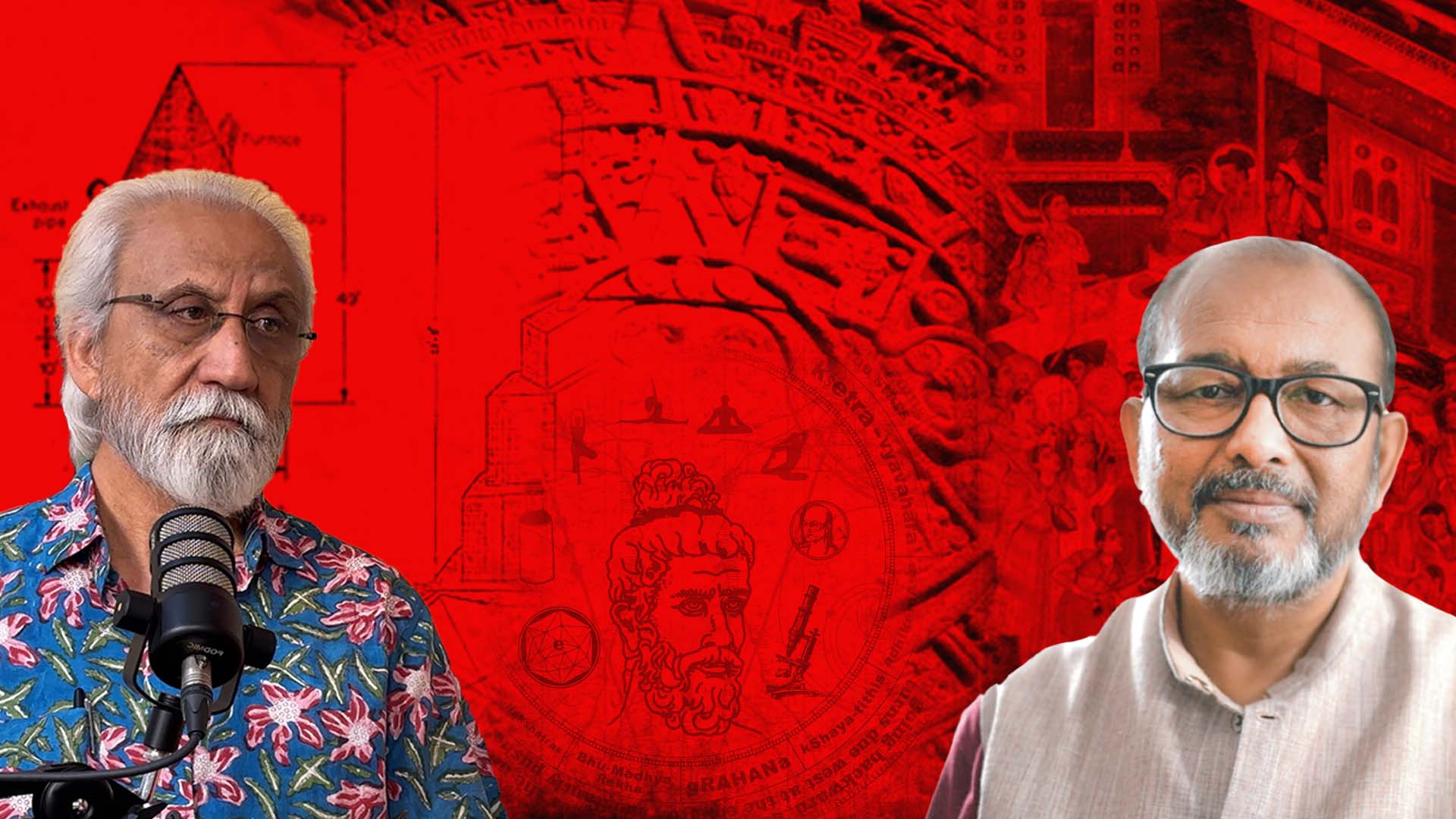

In this episode of Off The Beaten Track, Nilanjan Mukhopadhyay spoke to historian S Irfan Habib, a scholar of Indian scientific traditions, on the history of Indian science, scientific temper, and the politicisation of knowledge.
Habib said India’s scientific traditions were not “destroyed” by foreign invasions, and claims suggesting otherwise are politically motivated distortions of history. Challenging recent RSS assertions about ancient Indian science, Habib argued that knowledge systems evolve continuously and cannot simply be wiped out by rulers or invaders.
Edited excerpts from the interview:
How do you view RSS leader Dattatreya Hosabale’s claim that Indian scientific tradition was destroyed by centuries of invasions and is now being revived?
What Dattatreya Hosabale said is not new. Such claims have been made for centuries, especially by those who take pride in nativist interpretations of history.
I am not saying everything being claimed is entirely false. India certainly had rich philosophical and intellectual traditions. But when exaggerated claims are made about scientific achievements that did not actually exist, it becomes problematic.
Patanjali’s The Yoga Sutrasfor example, have immense philosophical and psychological value. They are important texts. But to describe them as an advanced scientific manual in the modern sense is misleading.
Also read: Shivaji not a communal ruler, RSS narrative ‘far from truth’: Scholar
And the idea that this knowledge was destroyed and is only now being revived is also misleading. These traditions have always existed. Scholars have studied them continuously. Ancient Indian philosophies and scientific traditions were never erased. Ideas cannot be destroyed in the way monuments can. They may be subdued, but they survive.
Was Indian scientific development uniquely disrupted by foreign invasions?
No. That argument oversimplifies history.
Every civilisation has contributed to human thought. India was not unique in this regard, nor was it uniquely victimised.
India had achievements, but it also had limitations. Scientific progress in ancient India did not simply stop because invaders arrived. In many areas, stagnation had already begun before Islamic invasions.
Knowledge systems also travel. Indian mathematical innovations such as zero, place value notation, and early algebra were transmitted to the Arab world, where scholars such as Al-Khwarizmi developed them further and passed them on to Europe.
So rather than destruction, what we see is transmission and transformation.
What were the real contributions of ancient Indian science?
India’s contribution to mathematics was substantial.
The concept of zero and place value notation are genuine historical achievements. These are well documented.
Also read: Hindutva is a political tool, not a devout faith: Author Ashutosh
But while these innovations were ground-breaking, they were not always advanced further within India itself. In many cases, later development occurred elsewhere.
This does not diminish India’s role, but it does mean we must avoid exaggerated claims.
Ancient India contributed significantly, but like all civilisations, it also had limits.
How do you assess Eurocentric histories of science?
Colonial and Eurocentric historians often reduced the history of science to Europe’s scientific revolution and industrial revolution.
This sidelined Indian, Arab, Persian, and other non-European contributions.
That was a form of imperial historiography.
Modern scholarship has corrected much of this, but political narratives today often distort history in another direction — replacing one bias with another.
Did religion and science coexist differently in India compared to Europe?
Yes, the situation was different.
Europe had institutional religious authorities like the Church, which often directly controlled intellectual life.
Also read: How RSS mobilised tribal communities through Vanvasi Kalyan Ashram
India did not have a comparable centralised authority. Religious traditions here were far more diverse and decentralised.
That reduced the kind of direct institutional conflict Europe witnessed.
However, this does not mean Indian traditions were purely scientific or beyond criticism. There were always differences, debates, and limitations.
How did figures like Sir Syed Ahmad Khan reconcile religion and science?
Sir Syed Ahmad Khan and Jamaluddin Afghani both argued that religious texts like the Quran were not scientific manuals.
They believed religion could inspire the pursuit of knowledge, but scientific inquiry had to be pursued independently.
This distinction between spiritual guidance and secular knowledge was extremely important.
It demonstrated that one could maintain faith while embracing scientific reasoning.
What happened to scientific temper in post-independence India?
Nehru’s idea of scientific temper was not limited to laboratories.
He meant rational thinking, questioning, and freedom from superstition for all citizens.
This was about building a society capable of reason.
Also read: Gita Press and RSS: Akshaya Mukul on how ideas shaped Hindu politics for a century
Today, that ideal is under threat when superstition is publicly endorsed by influential figures, including those in scientific institutions.
Private beliefs are one thing. But when public officials promote pseudoscience, it undermines scientific temper.
Has scientific temper declined since 2014?
Superstitious beliefs existed before 2014 as well.
But after 2014, there has been greater public normalisation of such rhetoric.
Statements that would earlier have been considered embarrassing are now made openly by people in powerful positions.
This weakens the culture of rational inquiry.
Was the COVID-19 pandemic a missed opportunity for promoting scientific thinking?
Yes.
At a time when public understanding of science was crucial, symbolic acts like clapping, banging utensils, or lighting candles were promoted instead.
Also read: How RSS emerged as a response to decline of Brahminical dominance 100 years ago
Such gestures may have had social or emotional value, but they did not strengthen scientific reasoning.
This was a missed opportunity to deepen scientific awareness.
Did India’s national movement embrace scientific rationalism?
Absolutely.
Figures like Jawaharlal Nehru, Rabindranath Tagore, Swami Vivekananda, BR Ambedkar, and Sir Syed Ahmad Khan emphasised reason, rationality, and intellectual strength.
Ambedkar challenged caste through rational and scientific principles.
Vivekananda spoke of mental discipline and pluralism.
Scientific temper was deeply embedded in many strands of India’s intellectual and nationalist traditions.
(The content above has been transcribed from video using a fine-tuned AI model. To ensure accuracy, quality, and editorial integrity, we employ a Human-In-The-Loop (HITL) process. While AI assists in creating the initial draft, our experienced editorial team carefully reviews, edits, and refines the content before publication. At The Federal, we combine the efficiency of AI with the expertise of human editors to deliver reliable and insightful journalism.)

Comments are closed.