
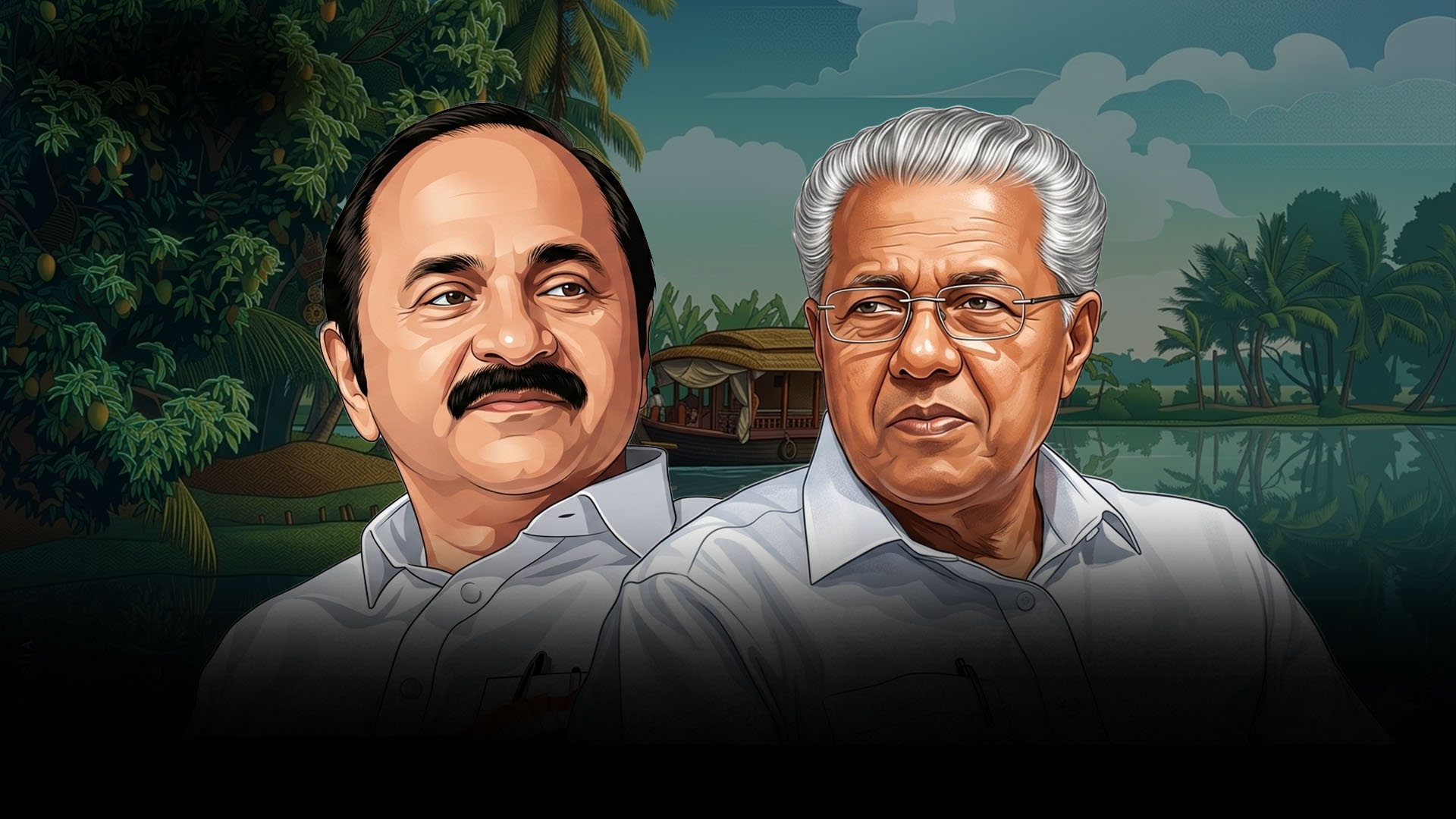

Exit polls for the Kerala Assembly election point to a narrow advantage for the United Democratic Front (UDF), but stop short of indicating a decisive wave—suggesting that the state’s political contest remains finely balanced. The projections hint at a possible return to Kerala’s long-standing pattern of alternating governments, even as the Left Democratic Front (LDF) attempts to retain power for a rare consecutive term.
The Federal spoke to MG Radhakrishnan and KJ Jacob, both senior journalists who have tracked Kerala politics for decades, to decode what the numbers may mean and the deeper trends shaping the verdict.
Radhakrishnan noted that most exit polls converge around a similar range, placing the UDF between 70 and 80 seats. This, he said, indicates an edge but not a sweeping mandate. The closeness of the contest underscores that while anti-incumbency may be at play, it has not translated into an overwhelming shift.
Jacob, however, expressed surprise at the absence of a clearer surge. Based on his ground assessment, he expected that if the UDF were to win, it would do so with a significantly larger margin. The lack of such a wave in exit polls, he suggested, leaves room for uncertainty in the final outcome.
Return to pattern
Kerala’s electoral history has largely been defined by a “revolving door” pattern, with power alternating between the UDF and LDF every five years. The 2021 election, which gave the LDF a second consecutive term under Pinarayi Vijayan, was widely seen as an exception.
According to Radhakrishnan, the current projections indicate a reversion to that traditional pattern. If the UDF does form the government, it would reinforce the idea that Kerala voters tend to reset political power cyclically.
At the same time, the relatively narrow margins suggest that the LDF has not collapsed electorally. Compared to recent Lok Sabha and local body elections—where the Left underperformed—the exit polls indicate some recovery, keeping the contest competitive.
Leadership factor
Leadership dynamics have played contrasting roles for the two fronts. The LDF has relied heavily on the leadership of Pinarayi Vijayan, whose governance record and political authority have provided a stable face to the alliance.
Radhakrishnan pointed out that while Vijayan’s leadership has drawn criticism, it has also helped prevent a complete erosion of support for the LDF. His presence, he argued, remains a key factor in keeping the contest close.
In contrast, the UDF faces what was described as a “problem of plenty.” Rather than lacking leadership, it has multiple contenders for the chief minister’s post, including V D Satheesan, K C Venugopal, and Ramesh Chennithala. This internal competition, while reflecting depth, could pose challenges in governance if the alliance comes to power.
Jacob, however, downplayed the importance of a chief ministerial face in this election. He argued that the campaign was overwhelmingly centred on Vijayan himself—either in support or opposition—making the UDF’s leadership question less decisive in influencing voter behaviour.
Minority shift
One of the most significant trends emerging from the discussion is the apparent consolidation of minority votes behind the UDF. Radhakrishnan highlighted that regions such as North Malabar, with a substantial Muslim population, appear to be tilting strongly towards the opposition alliance.
He noted that minorities—particularly Muslims, and to some extent Christians—constitute a decisive share of Kerala’s electorate. Their alignment with the UDF could therefore play a crucial role in shaping the final outcome.
This shift is partly attributed to political narratives around the LDF’s positioning vis-à-vis the BJP. Campaign messaging that questioned the Left’s ideological stance appears to have resonated with sections of minority voters.
Jacob, however, cautioned against oversimplifying this trend as mere “consolidation.” He argued that if minority voters are moving away from the LDF, it reflects shortcomings in the Left’s outreach rather than a uniform bloc voting pattern. Framing it otherwise, he warned, risks misreading the political signal and undermining the secular framework that Kerala politics has historically upheld.
Anti-incumbency
A decade in power has inevitably generated voter fatigue, a factor both analysts acknowledged. Kerala’s political culture, which typically resists prolonged incumbency, may be asserting itself once again.
Radhakrishnan observed that ten years in office is a considerable period in the state’s context, making some degree of anti-incumbency almost inevitable. This sentiment, combined with targeted campaign narratives, appears to have contributed to the UDF’s projected edge.
Jacob added that the election effectively became a referendum on the LDF government, with public discourse heavily focused on Vijayan’s leadership and governance record. In such a scenario, broader structural factors—rather than individual candidate choices—likely shaped voter preferences.
BJP factor
The Bharatiya Janata Party (BJP) remains a marginal but evolving player in Kerala politics. Despite aggressive campaigning and efforts to expand its base—particularly among Christian communities—both analysts expressed scepticism about its electoral breakthrough.
Jacob suggested that the BJP’s attempts to broaden its appeal may have created internal contradictions without yielding significant electoral gains. He indicated that the party’s vote share could stagnate or even decline compared to recent highs.
Radhakrishnan echoed this view, noting that while the BJP had previously increased its vote share to nearly 20 per cent, recent trends suggest a possible dip. He also pointed out that the party’s focused strategy—targeting select constituencies rather than the entire state—may not translate into actual seat wins.
Both analysts agreed that constituencies like Thiruvananthapuram and Palakkad, often seen as BJP strongholds, remain uncertain. Overall, Kerala continues to be a challenging terrain for the party in terms of converting votes into seats.
Succession debate
Beyond the immediate electoral outcome, the discussion also highlighted a critical long-term issue for the LDF: leadership succession. With Pinarayi Vijayan in his 80s, questions about the future leadership of the Communist Party of India (Marxist) are becoming increasingly urgent.
Radhakrishnan described this as a pivotal challenge, noting that Vijayan’s dominance has left a leadership vacuum that could become more apparent in the coming years. The absence of a clearly defined successor raises concerns about continuity and organisational stability.
Jacob agreed that succession planning is inevitable, regardless of the election result. He also pointed to a broader ideological concern, arguing that governance priorities may have begun to overshadow traditional Left principles—a shift that could require introspection within the party.
Uncertain finish
While exit polls provide an early indication, both analysts emphasised that the final outcome could still defy projections. The narrow margins leave open the possibility of either alliance emerging victorious once actual votes are counted.
The broader takeaway, however, is clear: Kerala’s electorate appears to be navigating between continuity and change without decisively committing to either. Whether this results in a return to the traditional power cycle or another exception like 2021 will only be known when the final results are declared.
The content above has been transcribed from video using a fine-tuned AI model. To ensure accuracy, quality, and editorial integrity, we employ a Human-In-The-Loop (HITL) process. While AI assists in creating the initial draft, our experienced editorial team carefully reviews, edits, and refines the content before publication. At The Federal, we combine the efficiency of AI with the expertise of human editors to deliver reliable and insightful journalism.

Comments are closed.