
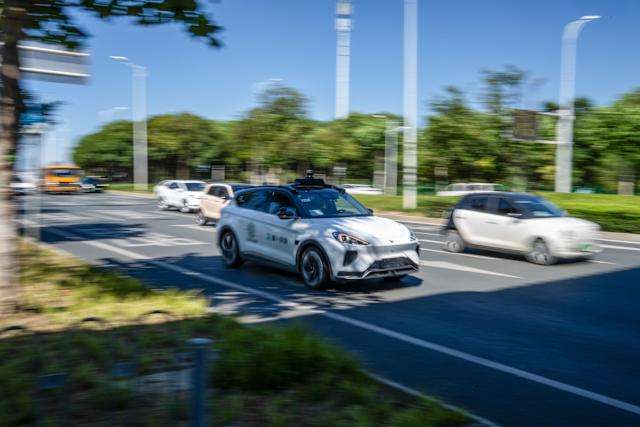

The global race for autonomous driving supremacy hit a major regulatory roadblock on April 29, 2026, as the Chinese government announced an immediate suspension of all new permits for self-driving vehicles. The decision follows a catastrophic system-wide outage involving Baidu’s “Apollo” fleet, which left hundreds of robotaxis stranded across several Tier-1 cities, including Beijing and Wuhan. The move marks a significant cooling in Beijing’s once-aggressive push to lead the world in autonomous transport, prioritizing systemic stability over rapid technological deployment.
The trigger for the regulatory freeze was a massive technical failure that occurred during peak morning hours on April 27. Baidu’s autonomous fleet, which operates under the “Apollo Go” brand, suffered a synchronized disconnection from its remote monitoring centers. Without a “heartbeat” signal from the central server, the vehicles’ safety protocols initiated an immediate emergency stop in the middle of active traffic lanes.
The result was near-instant gridlock in high-tech zones. In Wuhan, a city that has become a global testbed for robotaxis, more than 150 vehicles became motionless obstacles, requiring manual intervention to clear the roads. While no major injuries were reported, the event exposed a critical vulnerability: the “single point of failure” inherent in cloud-dependent transportation networks.
Regulatory Intervention: The Permit Freeze
In a swift response, the Ministry of Industry and Information Technology (MIIT) issued a notice to all autonomous vehicle (AV) developers including giants like Pony.ai, AutoX, and WeRide stating that all pending applications for expanded testing areas and new commercial permits are suspended indefinitely.
The MIIT’s directive demands a comprehensive “stress test” of the communication infrastructure used by these fleets. Regulators are no longer satisfied with individual vehicle safety; they are now demanding proof of “swarm resilience.” This means companies must demonstrate that their fleets can continue to operate safely even if the primary cloud connection is severed or compromised by a cyberattack.
The Resilience vs. Connectivity Debate
The Baidu outage has reignited a fierce debate within the engineering community regarding “Edge” vs. “Cloud” intelligence. Critics argue that Chinese AV development has leaned too heavily on high-speed 5G connectivity and V2X (Vehicle-to-Everything) infrastructure, assuming a constant link to a central brain.
Following the suspension, regulators are expected to mandate a “Hybrid Autonomy” standard. This would require vehicles to possess enough local “Edge” processing power to navigate to a safe parking spot autonomously without any external data link. For many developers, this shift could necessitate expensive hardware upgrades, potentially including the integration of more powerful onboard AI chips similar to those used by Tesla or the recently restricted high-end NVIDIA Blackwell units.
Impact on the “Robotaxi” Economic Model
The timing of the suspension is a major blow to Baidu’s financial outlook. The company had recently announced plans to achieve break-even for its Apollo Go division by the end of 2026. Those projections were based on a rapid expansion of the fleet and a reduction in “safety drivers” (remote monitors).
With new permits frozen, Baidu and its competitors are stuck with their current fleet sizes, preventing the “economies of scale” necessary to offset the high costs of R&D. Furthermore, the incident has dented public confidence. Viral videos of the “ghost fleet” stranded in Beijing have sparked a wave of skepticism on Chinese social media platform Weibo, with users questioning the safety of sharing the road with vehicles that can be “turned off” by a server glitch.
Geopolitical Ripple Effects
The suspension in China is being closely watched by Western regulators and competitors. In the United States, companies like Waymo and Zoox have faced their own share of scrutiny, but the scale of the Chinese “Apollo” failure is unprecedented.
Some analysts suggest that this regulatory pause gives U.S. firms a window to narrow the gap in commercial mileage. However, it also serves as a cautionary tale. As Western cities consider allowing robotaxis on their streets, the Chinese “gridlock event” provides a clear blueprint for the type of disaster recovery protocols that must be mandated from day one.
As of late April 2026, the streets of China’s major cities remain a laboratory for the future of transport, but the pace of experimentation has slowed to a crawl. The Baidu outage proved that while individual AI “drivers” might be safer than humans, the network that supports them is a new and dangerous variable.
The MIIT’s permit freeze signals the transition from the “innovation phase” to the “infrastructure phase” of autonomous driving. To get the green light again, companies will have to prove that their cars aren’t just smart, but independent. Until then, the dream of a fully autonomous urban landscape remains on hold, waiting for a system that is as resilient as it is intelligent.

Comments are closed.