
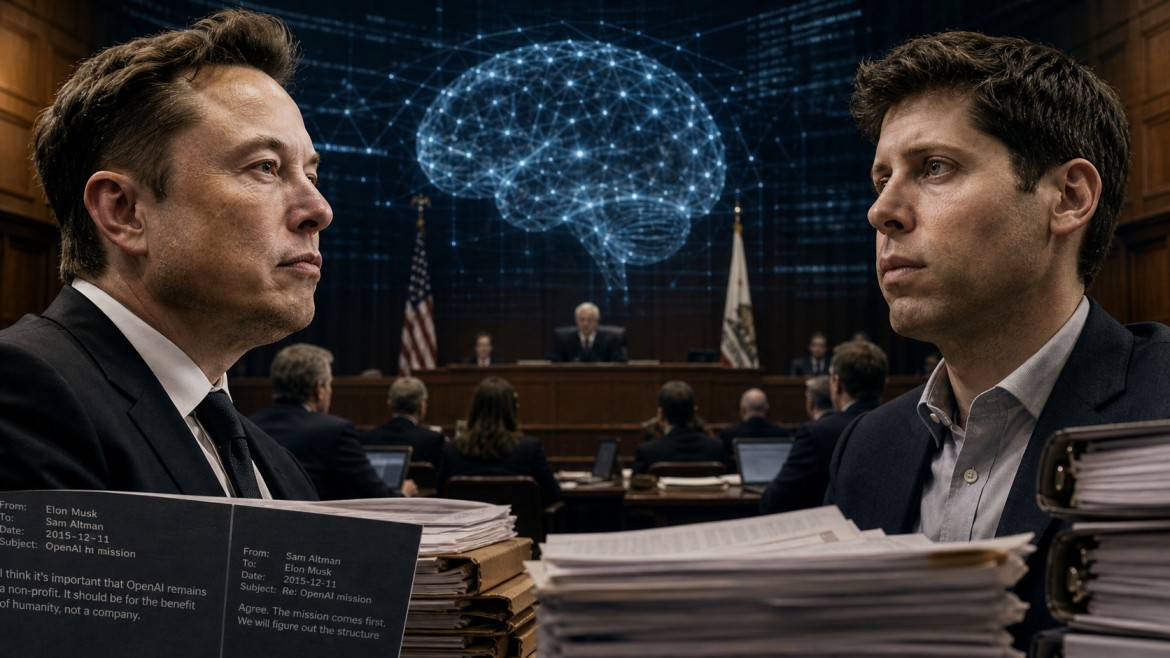

The courtroom is not where most people expected the story of artificial intelligence to unfold. Yet in a federal court in California, a dispute between Elon Musk and Sam Altman has turned into something more than a corporate fight. It has become a rare look at how one of the most influential AI labs in the world was built, who shaped it, and what they believed it was meant to become.
What has emerged so far is not a single narrative, but fragments. Emails from as early as 2015, internal documents, and hours of testimony are being presented piece by piece. Each fragment adds detail to a story that, until now, has mostly been told through public statements and carefully managed announcements. In court, that story is less polished. It is more direct, and at times, more conflicted.
At the centre of the dispute is a question that sounds simple but carries weight: did OpenAI depart from its original purpose?
Musk argues that it did. He claims the organisation, which he helped found, was meant to operate as a non-profit with a clear aim of developing artificial intelligence for the benefit of humanity. In his telling, the later move toward a for-profit structure changed that aim and redirected resources in ways he did not agree with. His lawsuit names not only Altman but also OpenAI president Greg Brockman and investor Microsoft.
OpenAI disputes this. Its legal team has argued that Musk was aware of plans to create a for-profit arm and that his claims reflect dissatisfaction after leaving the organisation. The case, now before a jury, is expected to run for weeks. What has already surfaced, however, offers insight into how early decisions were made and how tensions developed.
Early emails and the shape of a mission
The earliest documents presented in court go back to a time before OpenAI had a formal structure. Emails between Musk, Altman, and others show discussions about what kind of organisation they wanted to build. In several exchanges, Musk appears to take a leading role in defining the mission. He emphasised the need for a non-profit structure and raised concerns about concentration of power in artificial intelligence development.
These discussions were not abstract. They dealt with funding, governance, and control. Musk’s position, as reflected in the emails, was that the organisation should avoid traditional corporate incentives. The aim, he suggested, was to ensure that advanced AI systems would not be controlled by a small group of companies or individuals.
At the same time, other participants in those early discussions expressed concerns about how much influence Musk himself would have. Testimony and internal communication indicate that Brockman and Ilya Sutskever were wary of a structure that might give Musk too much control. This tension appears early in the record, suggesting that disagreements about governance were present from the start.
There are also references to external support. Altman, who at the time was closely associated with Y Combinatorappears in the emails as someone exploring how that network could support OpenAI in its early stages. The idea was not only financial backing but also access to talent and infrastructure.
Another detail that has drawn attention is the involvement of Jensen Huang. Documents suggest that Nvidia provided early computing resources to OpenAI, including access to high-demand hardware. In a field where computing power is a limiting factor, such support would have been valuable.
These early exchanges show a group trying to build something new while navigating familiar tensions. There was agreement on the importance of artificial intelligence. There was less agreement on how to structure an organisation that could develop it responsibly.
Testimony, tension, and the dispute over direction
If the documents provide background, the courtroom exchanges reveal how those early ideas are being interpreted today. Musk’s testimony has focused on his understanding of OpenAI’s mission at the time of its founding. He has said that his financial contributions, estimated at around $38 million, were made with the expectation that the organisation would remain aligned with its non-profit purpose.
“That was the entire basis for my charitable giving,” he told the court when discussing incorporation documents and the company’s charter.
Under cross-examination, Musk’s answers have often been brief. At times, he has said he does not know what is currently happening inside OpenAI. This has been a point of focus for the opposing legal team, which has questioned how closely he followed the company’s decisions after his departure.
OpenAI’s lawyers have also raised questions about Musk’s own ventures. His artificial intelligence company, xAIhas come up repeatedly in questioning. Musk acknowledged that xAI has, at least in part, used outputs from OpenAI’s systems to train its own models, a practice known as distillation. He described this as common within the industry.
The line of questioning has sought to draw contrasts between Musk’s stated views on non-profit AI development and his involvement in for-profit ventures. Musk has responded by arguing that his other companies, including Tesla and SpaceXpursue socially beneficial goals even as they operate as commercial entities.
The courtroom exchanges have not always been smooth. At one point, Judge Yvonne Gonzalez Rogers reminded Musk that he is not a lawyer after he challenged the phrasing of questions. The judge has also drawn boundaries around the scope of the case, making clear that it is not a forum for broad debates about existential risks from artificial intelligence.
The focus, she has said, is narrower: whether there was a breach of charitable trust.
That focus shapes how the evidence is being presented. Testimony from Jared Birchall has dealt with the specifics of Musk’s donations to OpenAI, including how funds were transferred and whether any restrictions were attached. Under questioning, Birchall indicated that he was not certain about the legal conditions tied to those funds once they were placed in donor-advised accounts.
This point may matter for the case. If the donations were unrestricted, OpenAI may have had more freedom in how it used them. If they were tied to a specific purpose, Musk’s claims could carry more weight.
There have also been disputes over what evidence should be considered by the jury. OpenAI’s legal team has sought to exclude parts of Birchall’s testimony related to a bid by Musk-linked investors to acquire OpenAI. The judge has not yet ruled on that request.
Throughout the proceedings, both sides have returned to the same underlying disagreement. Musk argues that OpenAI’s for-profit arm has become dominant, diverting resources and attention away from the non-profit mission. OpenAI maintains that its structure, which includes a non-profit parent overseeing a for-profit subsidiary, remains consistent with its goals.
The stakes are not limited to the parties in the courtroom. OpenAI has been considering plans for a public listing that could value the company at a high level. A ruling against it could complicate those plans. For Musk, the case also intersects with his own efforts in artificial intelligence through xAI.

Comments are closed.