
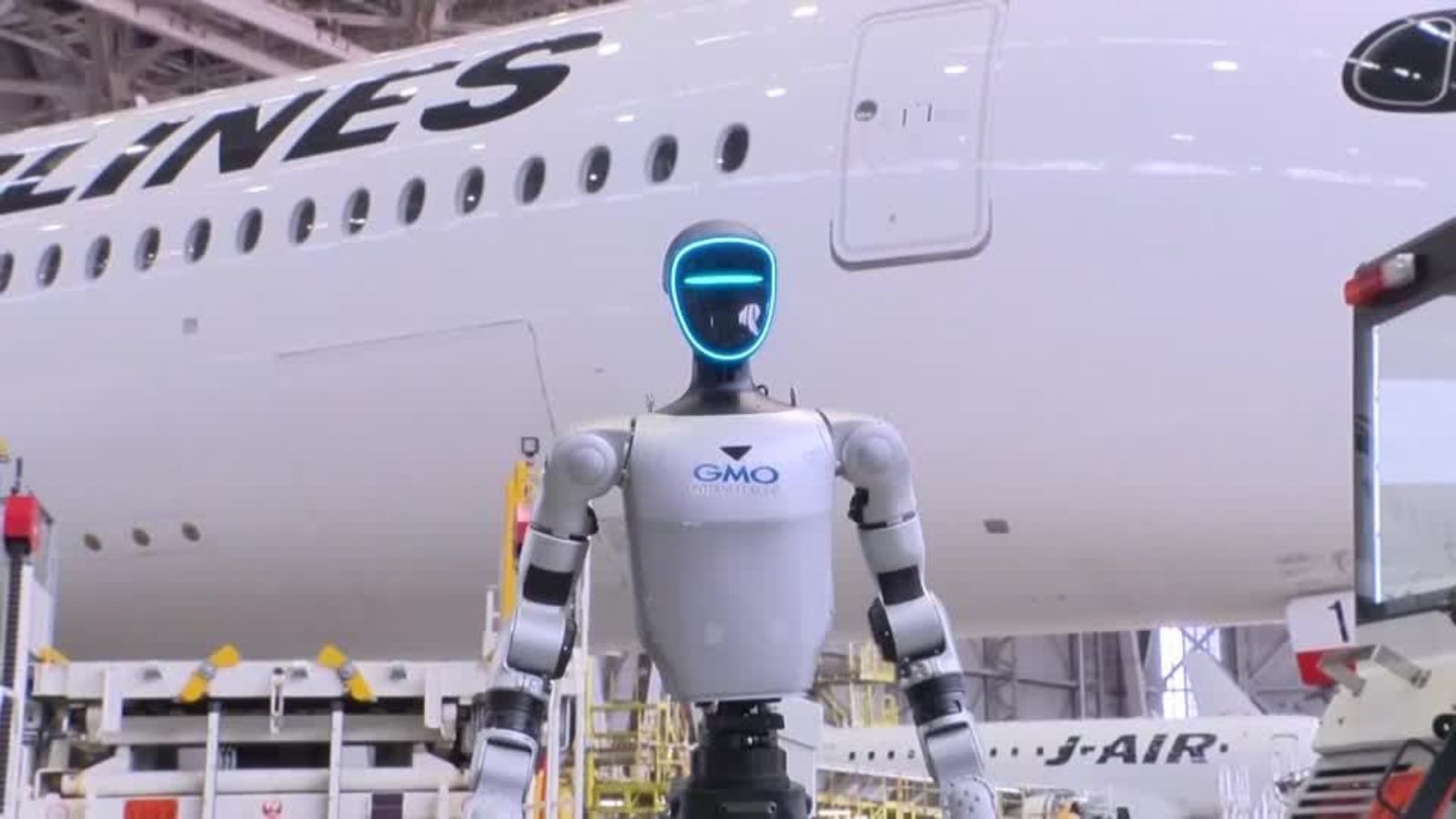

Japan Airlines has begun testing humanoid robots for ground operations at Haneda Airport, as the country’s aviation sector faces growing labour shortages. The airline is working with GMO AI & Robotics to test machines that can handle tasks such as baggage loading and cabin cleaning, with testing set to begin in May.
The move comes at a time when Japan is seeing a surge in tourism while its workforce continues to shrink due to an ageing population. According to the airline, the robots will be introduced gradually across the airport, with trials expected to run for two years.
In a demonstration, a humanoid robot developed by Unitree was seen moving cargo along a conveyor belt, greeting people, and interacting with staff. However, it remains unclear whether Unitree is directly involved in the airport trials or if the airline is evaluating multiple technologies. Japan Airlines told CNBC that “feasibility studies and risk assessments” are still ongoing.
Rising demand and demographic pressure
Japan’s aviation sector is under increasing strain as travel demand grows. Data from the Japan National Tourism Organisation showed international arrivals rose by 3.5 per cent in March compared to the previous year, adding pressure on airport operations.
At the same time, demographic changes are reshaping the labour market. The Organisation for Economic Co-operation and Development projects that Japan’s working-age population could fall by 31 per cent between 2023 and 2060. Analysts say this trend is pushing industries to adopt automation more quickly.
“Aging populations, labour shortages, and shifting worker preferences are opening the door for humanoids to take on essential – yet often undesirable – roles in manufacturing, logistics, agriculture, healthcare, and hospitality,” Barclays wrote in a January research note.
Research director Marc Einstein also expects robots to play a larger role in the workforce, especially as policies under Prime Minister Sanae Takaichi favour tighter immigration.
Technology advancing, but challenges remain
Humanoid robots have made rapid progress in recent years, with better movement and improved AI allowing them to perform tasks that were not possible before. Barclays has described physical robotics as the “next frontier” in artificial intelligence, estimating the sector could grow from a few billion dollars today to as much as $1.4 trillion by 2035.
Companies in China, including Unitree, Agibot, and Galbot, are pushing development forward, with some exploring public listings to fund expansion. Unitree recently gained approval to pursue an IPO aiming to raise significant capital.
Despite this momentum, experts caution that robots are not yet ready to fully replace human workers. They still struggle with delicate tasks and complex decision-making.
For now, Japan Airlines’ trial reflects a cautious step forward—testing whether humanoid robots can support airport operations while highlighting both the promise and limits of current technology.

Comments are closed.