
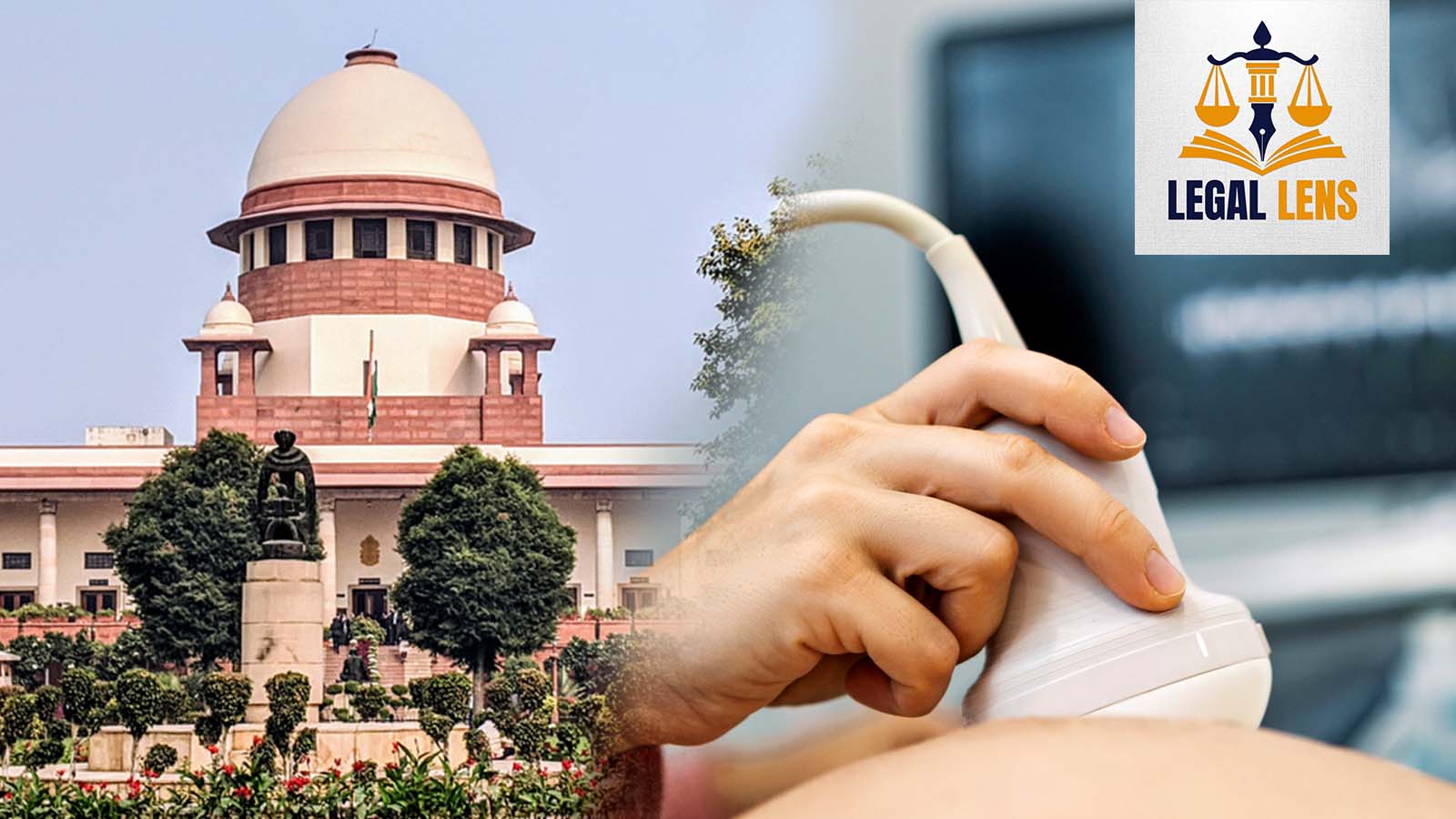

The Supreme Court on Thursday (April 30) refused the curative petition against its order permitting the medical termination of the pregnancy of a 15-year-old girl. The pregnancy was the result of a consensual relationship with a 17-year-old boy.
The petition was moved by the physicians of the All-India Institute of Medical Sciences (AIIMS), who argued that it was dangerous to terminate pregnancy at this stage as it could be harmful to both the girl and the foetus. A four-week wait, the doctors argued, will result in a normal delivery and both mother and child could be safe.
Also read: When Supreme Court had to remind India that women own their bodies
On April 24, a bench of Justice B V Nagarathna and Ujjal Bhuyan in their verdict had directed the AIIMS to let the girl opt for medical termination of pregnancy, notwithstanding the statutory bar on termination beyond 24 weeks. Her pregnancy has already crossed 30 weeks.
The bench of Chief Justice of India Surya Kant and Justice Joymalya Bagchi, in their April 30 order, repeatedly emphasised that the state should give ”primacy to the personal and bodily autonomy of the pregnant woman”.
The Supreme Court made it clear that the decision about continuing an unwanted pregnancy to its full term must be left to the woman concerned, whether minor or adult, as her right to her bodily integrity is paramount
In a nutshell, while the girl sought termination of pregnancy to avoid social stigma, the doctors were raising health concerns of the mother as well as the unborn child. The court, however, ordered that the decision be left to the girl and her parents after counselling.
The bigger and harder question, however, is what the case has done to the Indian abortion doctrine.
About the case
The case began on April 10 with the diagnosis of a 27-week live pregnancy of a woman anonymised as ‘S’. Several practitioners declined the abortion procedure given the gestational stage, as the Medical Termination of Pregnancy (MTP) Act, 1971, closes the statutory route at 24 weeks (bans abortion after 24 weeks except for defects in the foetus or threat to the mother’s life) except for foetal anomaly or maternal life.
On April 13, the mother filed a writ petition before the Delhi High Court. She invoked Sections 3(2)(b)(i), 3(3) and 5 of the MTP Act, 1971, Rule 3B(c) of the 2003 Rules, and the health ministry’s guidelines of August 14, 2017.
The high court directed the AIIMS to constitute a medical board and its report of April 18 found termination “not advisable”. It flagged risks of caesarean and instrumental delivery.
Also read: Court cannot compel any woman to continue with unwanted pregnancy: SC
It recommended prolongation of the pregnancy to 34 weeks “in the best interest of both mother and baby”. On the psychological side, it recorded “no major psychiatric disorder”, noting only “signs of emotional distress and adjustment difficulties related to the pregnancy”.
It found the minor physically fit for the procedure. It also asked the Court for “clear guidance” on management of the live foetus if termination were ordered.
Justice Purushaindra Kumar Kaurav, sitting singly, dismissed the writ on April 21 in a four-page oral order. The reasoning was almost wholly driven by the medical board. The constitutional autonomy argument was put aside. The order recorded that for “brevity and to avoid any delay”, the precedents relied on by the petitioner were “not being specifically dealt with”.
The doctrinal vacuum that SC filled
That was the doctrinal vacuum the Supreme Court filled three days later. Justices Nagarathna and Bhuyan, sitting on April 24 in S v. Union of India (SLP(C) 14454/2026), did three things on this record. The reasoning extends Indian abortion jurisprudence beyond the same Bench’s February 6 holding in A (Mother of X) v. State of Maharashtra (2026).
First, the Bench framed the constitutional override through Articles 226 and 32. Constitutional courts are approached, the Court held in Paragraph 11.3, when the statutory remedy is unavailable.
To then deny a constitutional remedy because the statute is silent, “cannot be the approach”. “A lack of remedy under a statute does not bar a constitutional remedy. The statute codifies a part of the constitutional remedy”, the Court held.
Also read: Tamil Nadu | Home births gaining ground despite govt’s warning on perils
Article 142, the classical source of relief beyond what statute permits, was the operative power for the April 24 directive to the AIIMS, even though the Bench did not name it. The Chief Justice’s bench confirmed as much on April 30 in oral observations, telling the additional solicitor general (ASG), Aishwarya Bhati, “We have exercised powers under Article 142.”
Secondly, the Bench rejected two assumptions on which late-term denials had typically rested. The first was that termination is conceivable only in the case of foetal abnormality. The Bench held that this subordinates the woman’s autonomy to “pathology of the foetus, which is not in the hands of the unintended mother”. In simpler words, the Bench said it is unfair to force a woman to carry a pregnancy she didn’t want simply because the law is focusing more on the health of the fetus than on the freedom of the woman. It said that her right to decide her own future should come first.
The Court’s formulation is unusually direct: “Rights are not functions of circumstance; they attach to humans for the reason that they are free moral agents.”
The second assumption, that delay extinguishes the right, was rejected by enumeration. The Bench listed the structural causes of late presentation: irregular menstrual cycles, want of reproductive awareness, financial constraint, healthcare access, and fear of disclosure due to coercion or abuse.
Thirdly, the Bench drew a line between clinical labels and lived experience. The Board’s finding of no psychiatric disorder did not negate the acute distress reflected in the minor’s two suicide attempts. The board’s biggest mistake was failing to consider the mental toll that being forced to continue the pregnancy would have on the woman. The HC made a mistake by treating the report as the final, absolute answer when the report didn’t look at the whole picture.
The April 30 hearing took these holdings into harder territory. ASG Bhati moved the AIIMS’s curative pleading viability, deformity, and the institutional concern over a live-born neonate. Earlier, the Nagarathna Bench had dismissed AIIMS’s review petition, deploring its refusal to comply with its earlier order to let her abort. The Bench, led by her, also issued a contempt notice to the AIIMS asking the doctors the reasons for non-compliance.
Justice Bagchi’s response is now the sharpest single statement on father of the country in this domain: “Who has stopped you? What is your father of the country approach? Give respect to your citizen.” (Parens patriae is a Latin phrase that literally means ‘parent of the nation’. In legal terms, it is a power that allows the state (the government or the court) to step in and act as a guardian for people who cannot look after themselves.)
Indian abortion jurisprudence has been caught since 2021 between two impulses. The father of the country impulse permits the State’s interest in potential life to override the woman’s choice. The autonomy impulse, anchored in Article 21, does not.
Also read: Why women in Kerala are risking their lives with dangerous home births
The Court has now ruled the former out for cases of this kind. AIIMS’s Dr Aparna Sharma offered the strongest counter on record. The dispute, she submitted, was not foetus versus child but child versus child, the unborn against the born. The reframing is doctrinally significant. It concedes the autonomy frame and tries to relocate the analytical centre to the unborn.
‘Quickening birth without court intervention’
The Bench engaged not the substance but the protocol. Justice Bagchi’s remark, that “quickening the birth without court intervention is a crime”, supplies the Article 142 invocation its sharpest justification. The constitutional jurisdiction is doing two things at once.
Medical opinion, the court held, cannot override the choice of the woman, if the pregnancy is not wanted by her.
It lifts the gestational ceiling, the legal time limit or the deadline. It immunises the procedure against criminal exposure under what is now the Bharatiya Nyaya Sanhita. The Chief Justice invited Parliament to remove the gestational limit for rape pregnancies of minors, and to compress child-rape trials. The invitation reads as recognition that the present design routes the most vulnerable petitioners through the most expensive forum.
A 2024 study by the Centre for Health Equity, Law and Policy at the Indian Law Society, Pune, examined 1,114 abortion judgments between 2019 and 2024. Eighty-five per cent ended in permission.
Also read: SC urges law review on abortion limits in rape cases amid minor’s pregnancy plea
Most need not have reached court at all. The judicial fix this case offers is therefore second- best by design.
What is durable here is the framing. S and A (Mother of X) 2026 now stand as paired authoritative restatements of constitutional autonomy over MTP Act ceilings. The same Bench has produced both within 11 weeks.
In a nutshell, through these judgments, the Supreme Court made it clear that the decision about continuing an unwanted pregnancy to its full term must be left to the woman concerned, whether minor or adult, as her right to her bodily integrity is paramount. Medical opinion, the court held, cannot override the choice of the woman, if the pregnancy is not wanted by her.
In the recent case, the medical opinion favoured continuance of pregnancy to the full term because the Board felt that termination at 30th week would result in the birth of a deformed child, and affect the reproductive capacity of the mother. The court asked the Board to counsel the girl and her parents about these likely consequences, but leave the decision to them.
The April 30 curative refusal makes that restatement institutionally settled. Amendment, if it comes, will travel on a separate, slower track.

Comments are closed.