
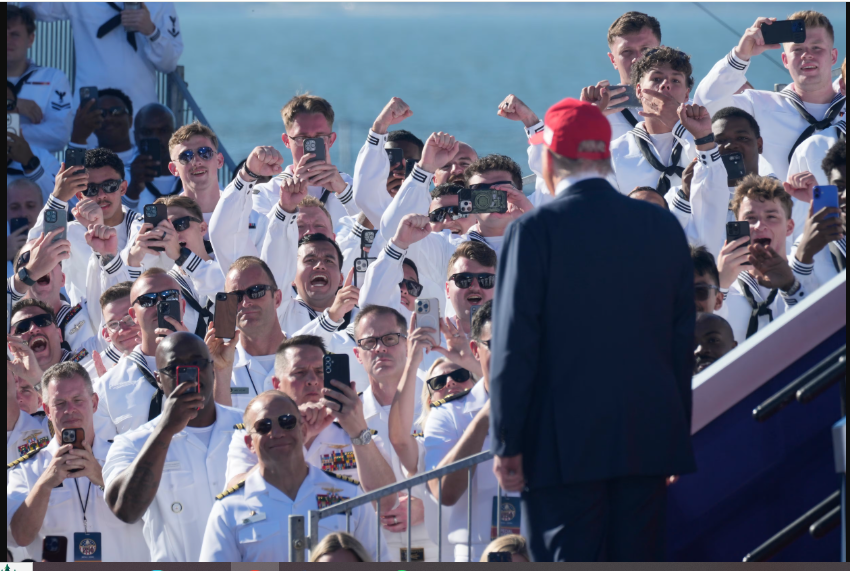

NEW DELHI, May 2: The United States President Donald Trump said the US Navy was acting like “pirates” in waters and boasted about how operations take place while seizing ships amid the blockade of Iranian ports.
“We … land on top of it and we took over the ship. We took over the cargo, took over the oil. It’s a very profitable business,” Trump said on Saturday while addressing a rally in Florida. As the crowd cheered, he said, “We’re like pirates. We’re sort of like pirates. But we’re not playing games.”
After American forces intercepted two tankers said to be transporting Iranian crude, Iran reacted strongly on Tuesday, branding the move “armed robbery on the high seas” and accusing Washington of violating international law.
Foreign Ministry spokesperson Esmaeil Baghaei said the operation effectively endorsed piracy. He described it as “the outright legalization of piracy and armed robbery on the high seas.” Writing on
Iran has blocked nearly all ships passing through the Strait of Hormuz apart from its own since the start of the war. Trump has imposed a separate blockade of Iranian ports. The US Central Command, responsible for US forces in the West Asia, said it has redirected 45 vessels to “ensure compliance” with its blockade as of Friday.
Pentagon chief Pete Hegseth told reporters in April that the blockade would last “as long as it takes,” while top US military officer General Dan Caine said it “applies to all ships, regardless of nationality, heading into or from Iranian ports.” Iran on its part has vowed to maintain its chokehold on the strait as long as Washington continues to blockade its ports.
Meanwhile, the representative of Iran’s Supreme Leader in India, Abdul Majeed Hakeem Ilahi on Saturday said Iran did not want the conflict, but was forced to respond amid continued attacks, even as negotiations were expected to continue. “Iran didn’t want this war, but Iran was forced by the war and several times Iran tried to avoid this war…I don’t know what is the condition of these people and these countries (US-Israel)…they want to impose on other countries what they want, and who gave them this authority?” he questioned.
He characterized the ongoing tensions between his country and the Israel-US alliance as a state of “no war, no peace” and called for an immediate halt to the conflict, he said the global stability hinges on those who initiated the war. He questioned why countries affected by the war and suffering from the energy crisis were not pressuring the US and Israel to stop the aggression. Recalling the negotiations Iran held in Oman, he said talks later moved to Geneva and made progress before being disrupted by sudden attacks.
Ilahi claimed that airstrikes and missile attacks led to the deaths of Iran’s supreme leader Ayatollah Ali Khamenei, ministers, commanders and civilians. “They killed a lot of civilians… They attacked a primary school, and they killed 175 innocent girls,” he said, claiming over 4,000 deaths, more than 40,000 injuries, and widespread damage to houses, hospitals, universities and public infrastructure.
Despite these losses, he said Iran resisted calls for “unconditional surrender” and stood firm and defended itself. “They wanted unconditional surrender. Which no one-no one can accept it. Iran said, ‘Okay, we are ready to be sacrificed,’ but we are not ready to submit ourselves,” he added.
He argued that they (US-Israel) proposed the current ceasefire only after realizing that they could not achieve any of their objectives after 40 days of conflict. The envoy further claimed that the ceasefire was not an actual ceasefire, but a “no war, no peace” situation.
Explaining the current situation in Iran, he said conditions remain stable and people were going about their daily lives. “They are working….(leading) their ordinary life. They are working-they’re going farming and they do everything….and they aren’t scared of anything. And they are ready to defend themselves,” he added.
Addressing the crisis in the Strait of Hormuz, he said the situation was stable before February 28 and all countries benefited from it. “(For) 10,000 years, the Strait of Hormuz was open…and Iran daily annually spent a lot for providing security in the Strait of Hormuz…so no one even complained anything about the Strait of Hormuz. Everyone was free…and even our enemies their warship was passing through the Strait of Hormuz,” he said.
(Rohit Kumar)

Comments are closed.