
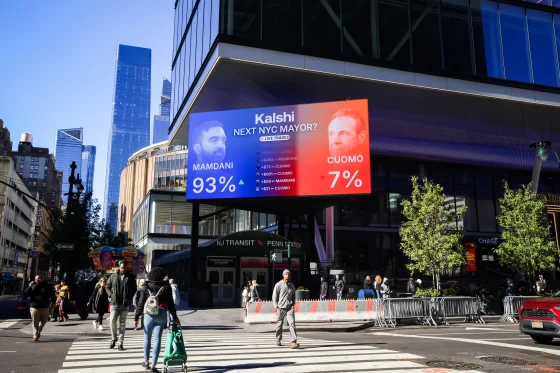

The Senate has recently voted to prohibit its members from gambling in the prediction market. This is an easy amendment to make on paper, but it is very difficult to implement in practice.
Last week, Bernie Moreno, a senator, proposed an amendment to the Senate ethics guidelines. These guidelines target prediction marketplaces like Polymarket or Kalshi, which allow placing bets on real-world events, including the election results, wars, or decision making. Over the last couple of years, the number of participants in such markets and their turnover grew significantly.
In a unanimous vote, the Senate decided to ban senators, as well as their staff and officials, from using these websites.
The rationale behind this move is obvious: politicians usually know some facts that others do not yet. This means that a member of the legislative body can easily earn money by placing a bet based on the insider information. In the financial sector, this would be called insider trading; today, the same applies to other markets as well.
As Moreno put it bluntly, “public office is not a source of extra revenue.”
Ethics vs. Law: Why the Senate is Limited
Recent instances forced the Senate’s hand. The first was a case involving a US soldier who used his access to classified information to make around $400,000 by trading on an online prediction market centered around the arrest of Venezuela’s president. The second involved a series of trades involving predictions about military actions in Iran, with some users appearing to cash in on these predictions.
The issue extended even closer to home, with a couple of political candidates getting in trouble for making bets on their own races. They were suspended, but their actions posed new challenges.
Support for the ban exists regardless of party affiliation. Representatives from both parties acknowledge that permitting the use of insider information by public servants would erode trust in the government’s institutions. Even the Senate’s leadership has urged other arms of government to consider implementing similar policies.
But there are some exceptions to the rule.
It is an ethics rule, not a criminal offense. Hence, it leaves no space for the imposition of criminal penalties, such as fines or imprisonment, for violations of the rule in question.
The problem is that although the Senate may determine the appropriate behavior of its representatives and punish them with various sanctions for violation of ethics rules, the Senate has no authority to use any other legal measures, such as the ones mentioned above.
Does it mean that a violation of the given rule entails nothing?
The Senate’s Move to Decouple Lawmaking from Prediction Markets
There is one important point worth mentioning: once a violation touches upon existing legislation, another story begins. Suppose a senator engages in insider trading or fraud, which is facilitated by the knowledge of certain information obtained from classified or confidential sources.
Then the case would be reported to law enforcement agencies, thus making it possible for the offender to face criminal charges.
Thus, the role of the rule in question is more preventive than punitive.
However, there is a more general concern. Prediction markets operate in a gray area between investment and gambling. These markets can offer valuable insights into public opinions, but they also encourage the exploitation of knowledge disparities. If the latter involves government decisions, the risks become quickly amplified.
The action taken by the Senate is an attempt to address this problem. The bill does not prohibit the use of prediction markets. It does not even regulate the prediction market websites. It addresses the conduct of the lawmakers.
According to critics, the proposed measure may be seen as being too narrowly focused. For example, a senator could circumvent the prohibition using other individuals, like relatives or close friends. Alternatively, one might argue that the real concern is not prediction markets per se, but rather the involvement of lawmakers in financial operations, like stock trading.
Advocates believe that the initiative is both realistic and necessary. It sets up an obvious moral boundary without waiting for a broader legislative solution.
In summary, the bill approved by the Senate clearly conveys the message that the combination of public office and personal betting should be avoided. What comes next is yet to be seen.

Comments are closed.