
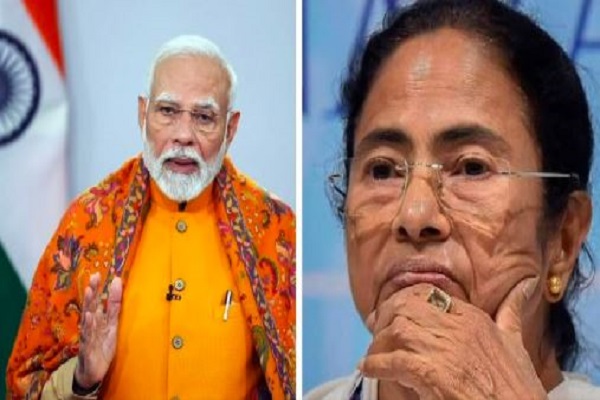
‘Lotus’ ready to bloom for the first time in West Bengal, Mamata Banerjee’s empire that lasted for one and a half decade collapses

Kolkata, 4 May. Results have started coming out in the counting of votes on Monday for 293 seats except one in the West Bengal Assembly and the trends till afternoon are indicating a historic change in the electoral history of this state of Eastern India. The way Bharatiya Janata Party (BJP) is moving towards a strong majority, it seems that the ‘lotus’ is ready to bloom for the first time in the state by destroying the empire of Mamata Banerjee led Trinamool Congress (TMC) that has been going on for one and a half decade.
Detailed description of vote counting of Bengal elections
According to the available data of 293 seats received from the Election Commission, BJP seems to be winning around 200 seats while 147 seats are required for a clear majority. In contrast, Trinamool Congress seems to be shrinking to about 90 seats. Till the last news was received, CPI (M) and Congress were fighting for one or two seats.
Re-polling on Falta seat will be held on May 21.
It is noteworthy that voting for the 294-seat state assembly was held in two phases on April 23 and 29. Of these, re-polling was conducted on May 2 at 15 booths in South 24 Parganas district, whereas after receiving complaints of rigging, the Election Commission has issued orders for re-voting on May 21 at all 285 polling stations of Falta Assembly, where counting of votes is on May 24. That is why counting of votes is taking place on 293 seats today.
‘Didi’s game’ backfiredBJP’s ‘M factor’ effective
If seen, this time the fight was not only about seats but also about strategy, promises and social equations. While BJP created a strong narrative through its promises, the ‘M Factor’ completely affected the electoral mathematics. BJP made illegal infiltration a big issue. The promise to expel Bangladeshi and Rohingya infiltrators proved effective, especially in the border areas. It was introduced by linking it to security and local rights.
Promises like giving financial assistance every month to women and unemployed youth also have a big impact.
Promises like providing financial assistance every month to women and unemployed youth had a big impact. Assurance was also given to implement the schemes of the Center in a better way, which strengthened the hold of the poor and middle class. BJP strongly raised the allegations of increasing violence and crime in the state. The promise of ‘strict law and order’ and implementing the UP model seemed to be influencing the urban and middle class.
The promise of ending ‘Syndicate Raj’ and bringing transparency was an important part of the BJP’s campaign. This message seemed direct to voters who had been angry with the system for a long time. The promise of restarting closed industries and bringing in new investments attracted the youth and the business class. The dream of ‘Sonar Bangla’ was linked with this.
Along with these promises, BJP also worked on these M factors which overturned the election results. About 30 percent of the Muslim population has traditionally been with TMC, but this time new equations were created. Humayun Kabir’s party AJUP tried to make a dent in this vote bank, while polarization also had an impact.
Women played a decisive role in this election
Women played a decisive role in this election. There was a tough contest between TMC’s plans and BJP’s issues of security and respect. The vote of lakhs of people working outside Bengal was important this time. Employment issues and the vision of ‘Sonar Bangla’ seemed to influence these voters. Matua vote was decisive in many areas including North 24 Parganas. The hopes of this community regarding the Citizenship Amendment Act (CAA) seemed to be going in favor of the BJP.
Mamata Banerjee’s personal image and militant politics were the biggest strengths of TMC. However, this time BJP avoided direct attack on him and adopted a different strategy. Prime Minister Narendra Modi’s rallies, road shows and focus on national issues gave new energy to BJP. His popularity helped in attracting new voters. Overall, the BJP took the lead in implementing its promises and social equations, while the TMC struggled to respond effectively to them. The effect of being in power for a long time also came in the form of anti-incumbency.

Comments are closed.