
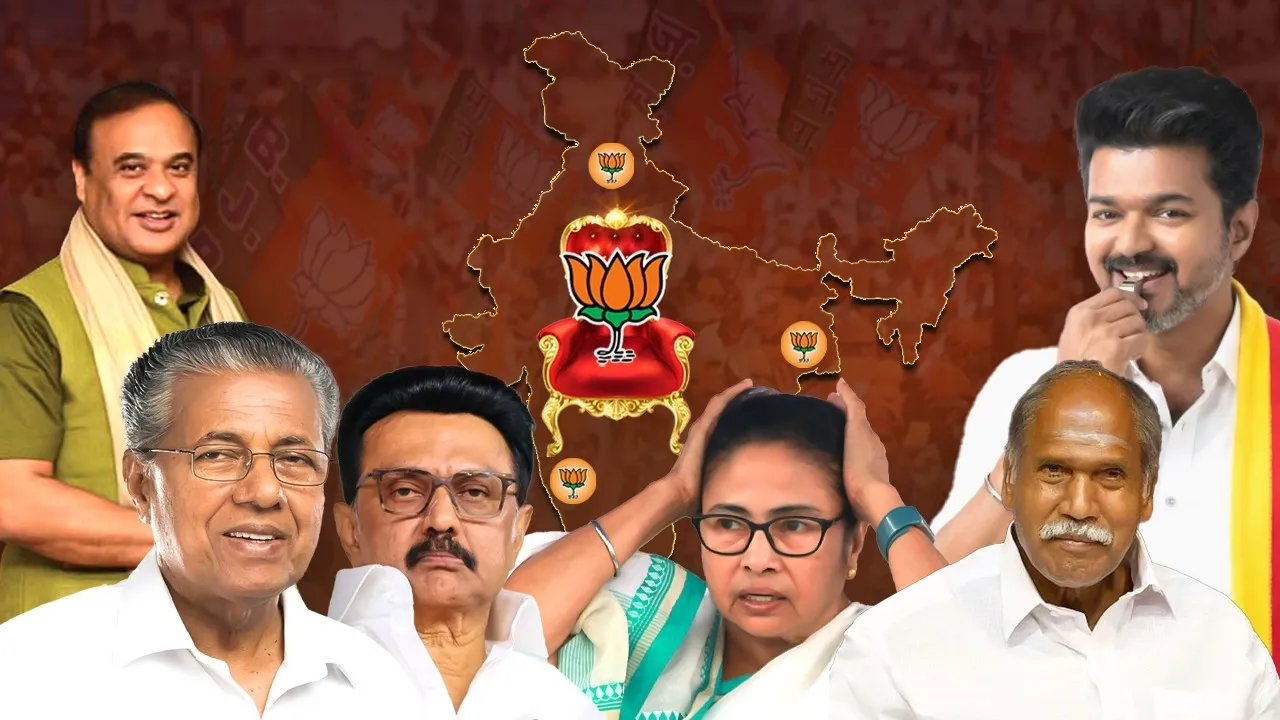
The MTA Speaks: 5-State Verdict Decoded; Strategies, Surprises And Power Shifts That Redefined Indian Politics

New Delhi: The Assembly election results from West Bengal, Tamil Nadu, Kerala, Assam and Puducherry have been declared, offering more than just outcomes that signal a shift in India’s political direction. These elections reflect evolving voter priorities, balancing national leadership, regional identity, and governance performance.
Veteran journalist Manoj Tibrewal Aakashin his popular show ‘The MTA Speaks‘analyzed the results in depth, highlighting the larger political trends emerging from across the five states.
Across 824 seats, the contest featured major national parties like the Bharatiya Janata Party (BJP) and the Congress, alongside powerful regional players. The results, however, have disrupted traditional political equations.
BJP surges in Bengal’s Muslim-Majority Seats: A Game-Changer in the 2026 Elections
A Shift in Political Center
The broader takeaway from these elections is clear: India’s political center is shifting, and voters are increasingly open to alternatives. Historically, major cities like Delhi, Mumbai, Kolkata and Chennai shaped national politics, with the Congress dominating for decades.
Over time, regional parties rose to prominence, but since 2014, under Narendra Modithe BJP has significantly expanded its footprint, altering the political landscape in key regions.
Bengal: A Major Political Earthquake
West Bengal witnessed perhaps the most dramatic shift. Once a stronghold of Mamata Banerjee and the Trinamool Congress, the state now appears to have opened up to the BJP in a big way.
This result reflects both anti-incumbency and growing acceptance of national leadership in state politics, signaling the emergence of a strong alternative force in Bengal.
Tamil Nadu: Breaking a Decades-Old Pattern
Tamil Nadu delivered a major surprise with actor-turned-politician Vijay making a strong debut through his party, Tamilaga Vettri Kazhagam (TVK).
The dominance of the DMK and AIADMK appears to be weakening, indicating that voters are willing to experiment with new leadership and narratives.
Kerala and Assam: Contrasting Trends
Kerala followed its traditional pattern of power shifts, with the Congress-led alliance gaining ground against the Left government led by Pinarayi Vijayan.
In contrast, Assam reinforced the BJP’s growing dominance, with the party maintaining a strong position under the leadership of Himanta Biswa Sarma.
Puducherry and the Bigger Picture
In Puducherry, the NDA’s performance highlights the growing influence of national politics even in smaller regions.
Taken together, these results point to four key trends: BJP’s continued expansion, Congress’s limited but notable recovery, challenges for regional parties, and the rise of new political faces.
National Impact and What Lies Ahead
The results are expected to influence the Rajya Sabha numbers, potentially easing the passage of key policies for the central government. They have also sent positive signals to markets, as political stability often boosts investor confidence.
Congress Returns to Power in Kerala, CM Race Heats Up Within UDF
While not a direct preview of the 2029 Lok Sabha elections, these outcomes offer strong signals of future trends. For the BJP, continued expansion could strengthen its national position. For the Congress and regional parties, the results serve as both an opportunity and a warning.
The Message for Future Elections
The biggest takeaway is that elections are no longer decided solely by traditional vote banks. Performance, leadership, and credibility are becoming decisive factors.
As India’s political landscape evolves, voters appear increasingly focused on governance and alternatives marking a significant shift in the world’s largest democracy.

Comments are closed.