
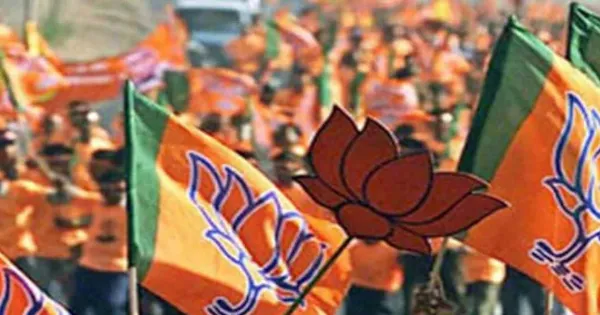

The 2026 assembly election results of five states are a detailed document of the political direction of the country and the changing psychology of the voter, which has set new paradigms for future politics.

Yogesh Kumar Goyal, senior journalist
The 2026 assembly election results of five states are not just an event of change of power or return of power in the history of Indian democracy, but it is a detailed document of the political direction of the country and the changing psychology of the voters, which has set new paradigms for future politics. These results have made it clear that the Indian voter is no longer just getting entangled in emotional slogans or traditional vote bank mathematics, but is giving his verdict on the accountability of governance, credibility of leadership and the solid ground of development.
If we closely analyze this political turmoil spread from the hills of the North-East to the coastal plains of the South, then it is clearly visible that the eastern expansion of ‘saffron’ politics is now at its peak, while in the South an interesting conflict has erupted between regional identity and a new political vision. These election results are a lesson for all those political pundits who used to make predictions only on the basis of old data, because this time the voters have initiated a ‘storm of change’ which has put a question mark on the political future of many stalwarts.
The explanation of this mandate of 2026 is incomplete without looking at the ‘great earthquake’ in the politics of West Bengal. The collapse of Trinamool Congress, which was in power in the state for almost one and a half decade, and BJP crossing 150 seats shows that the people of Bengal were fed up with the culture of ‘Syndicate Raj’ and ‘cut money’. This result of Bengal is not just an electoral victory, but an ideological revolution, where voters have accepted the coordination of ‘national development’ with ‘Bengali identity’.
The anger that incidents like Sandeshkhali had generated towards the government erupted like a volcano through EVMs. The way BJP polarized the Hindu votes here and also organized the Matua and Rajvanshi communities in its favor, it broke TMC’s impenetrable fort brick by brick.
In rural Bengal, central schemes like ‘Pradhan Mantri Awas Yojana’ and ‘Jal Jeevan Mission’ created a new ‘beneficiary class’, which found the transparency of direct benefit transfers superior to the corruption-ridden machinery of the state government. This election result also signals the end of the charisma of Mamata Banerjee, who was once considered unbeatable and now the politics of Bengal stands at a point where good governance and law and order are the only criteria of power.
If we turn to Assam, the situation here is completely different from Bengal, but equally impressive. The BJP’s ‘hat-trick’ under the leadership of Chief Minister Himanta Biswa Sarma has proved that when development is combined with cultural identity, it becomes an unbeatable formula.
BJP’s victory in Assam is not just a continuation of power, but an affirmation of the faith that the public has shown in Sarma’s effective and courageous leadership. The mandate of Assam gives the message that if the leadership has a vision and works aggressively on grassroots issues, then the people again provide it an opportunity to serve. Here the scattered strength of the opposition and the ideological emptiness of the Congress made the path of the BJP even easier.
In the political scenario of South India, Tamil Nadu has attracted the attention of the whole world this time. The rise of a new political sun in the form of Thalapathy Vijay shows that the people of Tamil Nadu now wanted freedom from the decades-old duality between DMK and AIADMK.
Vijay’s party ‘Tamilaga Vetri Kazhagam’ crossing the 100 seats mark is a political miracle, which reminds of the era of MGR when the confluence of cinema and politics became the key to power. Vijay presented himself not just as a film star, but as a ‘troubleshooter’ and ‘youth icon’. The courage he showed in defying coalition politics and entering the electoral fray like a ‘lone lion’ infused a new energy among the Tamil youth.
The election results of Kerala were no less interesting, where the traditional rule of ‘once here, once there’ ousted the LDF from power despite all the efforts of Pinarayi Vijayan. This stunning comeback of the UDF shows that the educated electorate of Kerala was in no mood to tolerate corruption and fiscal mismanagement. The damage done to LDF’s moral credibility by various scams could not be compensated even by its public welfare schemes.
Rahul Gandhi’s activism in Wayanad and promises of schemes like ‘NYAY’ created a positive atmosphere in favor of the Congress-led UDF. Most importantly, the discontent that arose among minority communities, especially Christians and Muslims, completely upset the balance of power. Even a small union territory like Puducherry has shown the importance of stability and coordination with the Center in politics. N Rangasamy’s easy-going image and his alliance with the BJP convinced voters that central and local governments needed to be on the same page for development.

Comments are closed.