
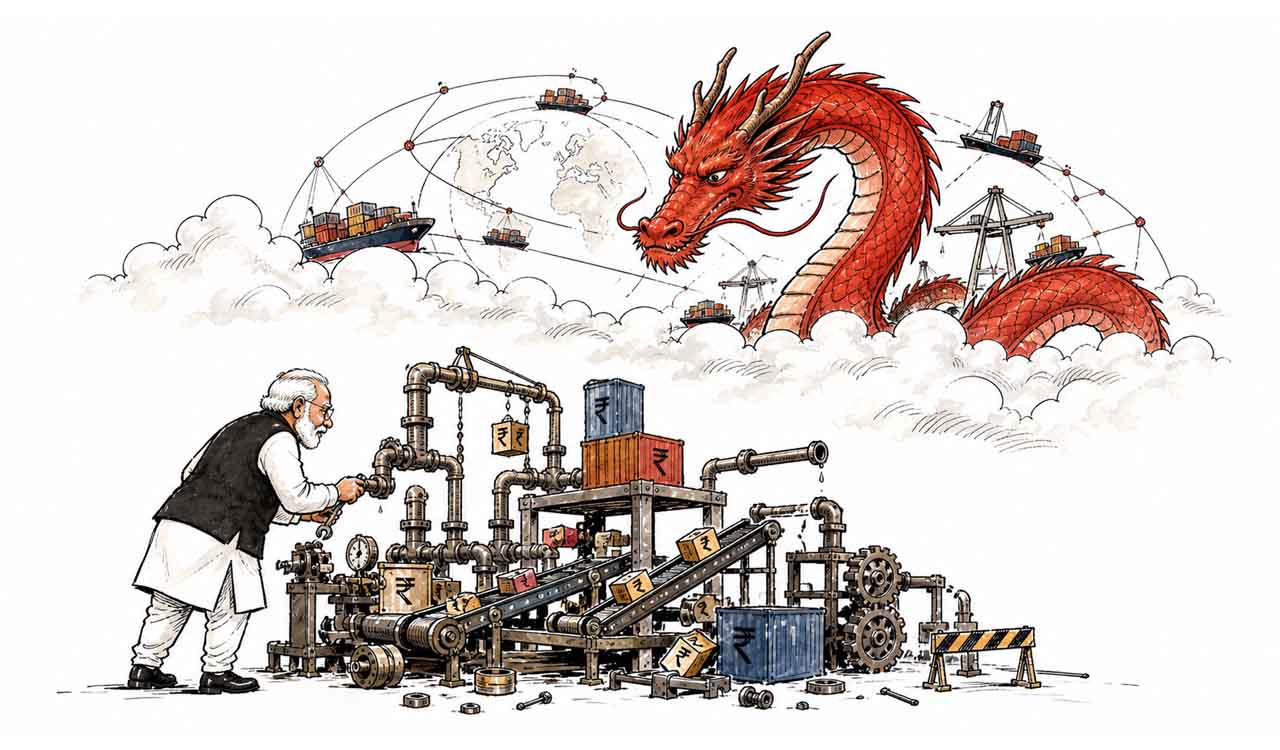

India is gaining from the China+1 shift but structural bottlenecks, weak supply chain, and policy gaps still hold it back
Updated On – 5 May 2026, 10:09 PM
Illustration: GuruG
Dr Jadhav Chakradhar, Dr Sabyasachi Tripathi
The ‘China+1’ strategy has become a defining feature of global trade in recent years. As multinational firms reassess their dependence on China, they are diversifying production across alternative locations. Rising labour costs in China, geopolitical tensions such as the US–China trade war, and supply chain disruptions during Covid-19 have accelerated this shift.
For India, this moment appears to offer a historic opportunity. Yet the reality is more complex: India is gaining, but not as much as it could.
At first glance, the optimism is justified. India has made visible progress in attracting global manufacturing. The government’s Production Linked Incentive (MORE) scheme has played a catalytic role, particularly in electronics. Mobile phone exports have surged from roughly $11 billion in FY23 to over $15 billion in FY24, indicating that global firms are beginning to shift parts of their supply chains toward India.
Electronics Sector
The experience of Apple Inc illustrates this shift. iPhones now account for nearly two-thirds of India’s mobile phone exports, and production has expanded rapidly over the past two years. Even more significant is the emergence of component exports: Apple’s suppliers in India are increasingly exporting intermediate goods, suggesting that the country is moving, albeit gradually, beyond simple assembly.
More broadly, India’s electronics sector has expanded dramatically over the past decade, with production rising several-fold and exports growing even faster. India is now the world’s second-largest mobile phone manufacturer. These trends indicate that India is, at least partially, integrating into global manufacturing networks.
But this is only part of the story. Despite rapid growth, India’s global position remains modest. Its share of smartphone exports remains 2–3%, far below China’s dominance and trailing competitors like Vietnam, which has steadily increased its share to 10–12%. In labour-intensive sectors, Bangladesh continues to dominate textiles, while Mexico has benefited from nearshoring due to its proximity to the United States.
Even in electronics, India’s strongest performing sector, the depth of integration remains limited. Domestic value addition is estimated at just 18–20%, compared to roughly 40% in China. This implies that India continues to rely heavily on imported components, capturing only a small portion of the value chain.
The key point is that China+1 is not an automatic windfall. It is a competitive race. Countries that are already embedded in global value chains have a clear advantage. The shift underway is not about building entirely new supply chains, but about relocating segments of existing ones. In this context, Vietnam’s success is not accidental; it reflects years of integration through trade agreements and export-oriented policies. India, by contrast, has historically been more inward-looking, limiting its participation in cross-border production networks.
Major Bottleneck
Structural constraints further weaken India’s position. Logistics remains a major bottleneck. While improvements have been made, costs are still significantly higher than in competing economies. Delays at ports, inefficiencies in transport, and fragmented supply chains raise operational costs for firms that operate on thin margins.
Labour presents another paradox. India has an abundant workforce, but skill availability remains uneven. Modern manufacturing requires precision, consistency, and technical capability, areas where gaps persist. The issue is not the quantity of labour, but its readiness for complex production processes.
Policy uncertainty adds another layer of friction. Frequent tariff changes and evolving compliance requirements create unpredictability for global firms. While some of these measures aim to promote domestic industry, they can inadvertently discourage integration into global value chains, which depend on seamless cross-border flows of inputs.
Vietnam, Bangladesh, and Mexico advanced rapidly in global supply chains through consistent policies and strong ecosystems; India must shift focus from protection toward competitiveness now
Perhaps the most critical limitation is the absence of a deep industrial ecosystem. China’s dominance is not simply about low costs; it reflects decades of coordinated investment in supplier networks, infrastructure, and logistics. Even today, China accounts for most of the global smartphone production. Replicating such an ecosystem is not a matter of short-term incentives, but of long-term institutional alignment.
None of this negates India’s progress. In fact, recent trends are encouraging. India’s role in global electronics manufacturing is expanding, and there are signs of deeper integration. A growing share of exports is now linked to global firms, and the country is increasingly seen as a viable alternative production base.
Beyond Schemes
But early gains should not be mistaken for structural transformation. The assumption that global firms will automatically shift to India as they diversify away from China is flawed. The evidence suggests otherwise. Countries like Vietnam, Bangladesh, and Mexico have moved quickly to position themselves within global supply chains, often with greater policy consistency and stronger ecosystem support. For India, the policy implication is clear: the focus must shift from protection to competitiveness.
Incentive schemes like PLI can attract investment, but they cannot substitute for deeper reforms. Reducing logistics costs, improving skill development, ensuring policy stability, and expanding trade integration are essential. India’s cautious approach to trade agreements has limited its access to global markets, particularly when compared to Vietnam’s aggressive strategy of signing multiple free trade agreements.
Equally important is coordination. Manufacturing competitiveness does not depend on a single policy lever; it requires alignment across infrastructure, labour markets, trade policy, and governance. Fragmented reforms will deliver incremental gains at best.
The China+1 moment represents a rare window of opportunity. Global supply chains are being reconfigured in real time. But such windows do not remain open indefinitely. As firms establish new production bases, the scope for late entrants narrows. In the end, China+1 is less a windfall than a test. It tests whether India can move from potential to performance, from promise to delivery. The country has secured a foothold, but not yet a leading position. India has a seat at the table. But it must still compete for it.
(Dr Jadhav Chakradhar is Assistant Professor of Economics, Centre for Economic and Social Studies (CESS), Hyderabad. Dr Sabyasachi Tripathi is Associate Professor at the Symbiosis School of Economics, Symbiosis International (Deemed University), Pune)

Comments are closed.