
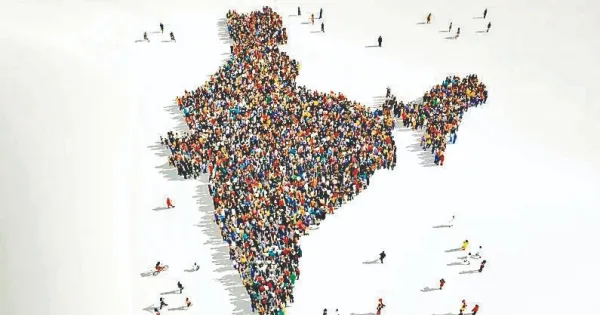

The census to be held in 2021 fell victim to the Covid tragedy. The question definitely arises as to why this necessary process was delayed so much after that.

Anil Trigunayat, Lucknow
The census has finally started in India, the world’s most populous country, after a delay of almost five years. The census to be held in the year 2021 fell victim to the Covid tragedy, but the common Indian definitely has a question that why did the heavy machinery of the central and state governments actually delay this essential process so much? When the census process was to be given a digital format, why was it not done two-three years ago? Perhaps even the concerned agency does not have a concrete answer to this.
Due to lack of timely census, there are many obstacles in the implementation of government schemes, allocation of resources and policy making. So, it can be assumed that for the last five years, the activities referred to by the Center and the State were based on memory or speculation? In those days, policy makers might have faced difficulty in planning, resources might have been allocated incorrectly, poor sections might have faced unequal resource distribution, problems might have arisen in delimitation of constituencies, health and emergency management might have also been affected.
Census is an important process of collecting information related to the population of a country. In this, detailed information is obtained about the number, age, gender, education, employment, place of residence etc. of the people of the country. Through this, the government comes to know how many people live in the country, what is their social and economic condition. On the basis of this information, the government makes plans like education, health, housing, employment and transportation. If proper census is not conducted, the government will not be able to know the real needs of the people. The benefits of the schemes will not reach the people properly.
Census also gives information about how fast the population is increasing or decreasing in an area. This helps in future planning. Helps in proper distribution of resources. The first modern census in India was conducted during the British colonial period from the year 1865 to 1872, but it was not conducted simultaneously in all areas of the country. The first non-synchronous census was conducted in the year 1872 during the reign of Lord Mayo (the then Viceroy). The first coordinated census of India was conducted in the year 1881 during the time of Lord Ripon. Since 1949, the census is conducted by the Registrar General and Census Commissioner of India under the Ministry of Home Affairs.
Census is a Union subject according to Article 246 of the Constitution of India. Listed at serial number 69 of the Seventh Schedule of the Constitution. Independent India conducted its first census in the year 1951. The seventh census was conducted in the year 2011. The census of year 2027 is the eighth census since independence. About seven thousand towns and about six lakh 40 thousand villages are included in the census conducted in 28 states and eight union territories of the country. A variety of factual information will be obtained officially through the process of collection, compilation, analysis and dissemination of demographic, social, cultural and economic data.
In this census, which will be conducted through digital medium for the first time in the country, about three crore personnel will ask 33 questions to the general public and collect data using digital tools like mobile applications on smartphones. Individuals will also have the option to conduct the census themselves through the online portal. The process of 16th census will be completed in two phases. In the first phase, data on the number of houses, their condition and available facilities will be collected, while in the second phase the actual population will be calculated. Lakhs of personnel have been deployed for this work.
The final figures will be declared on March 1, 2027. This census will not only give accurate population figures, but will also help in shaping the development plans, distribution of resources and policies of the Center and the State. In the first phase, there will be a survey of houses in both rural and urban areas, in which information about basic facilities like electricity, water, toilet will be collected. In the second phase, during the population census, details like name, age, gender, education, employment and migration of each person will be recorded. This work will be fast and error free through digital medium. Personnel will be given handheld devices, in which the location will be known with the help of GPS.
Talking about unofficial and informal census, its earliest reference in India is found in Kautilya’s Arthashastra (321-296 BC). Later, during the reign of Emperor Akbar, it is also mentioned in Abul Fazal’s work ‘Ain-e-Akbari’. Census was a regular process in the Maurya administration. Census was conducted by James Prinsep in Allahabad (Prayagraj) in 1824 and Banaras (Varanasi) in 1827-28. The first complete census of an Indian city was conducted in Dacca in the year 1830 by Henry Walter.
Although it is the 16th, but the official year of the eighth census of India after independence will be 2027. For this, the first phase of ground work will start from April 1, 2026 and will continue till September 2026. The final population census will be completed in February 2027. Government decisions and administrative machinery remained indifferent to the unprecedented delay in the census, although the Corona epidemic, logistics and political factors were also behind this delay. Well, albeit with great delay, by starting the census the Central Government has fulfilled the slogan of better late than never.

Comments are closed.