
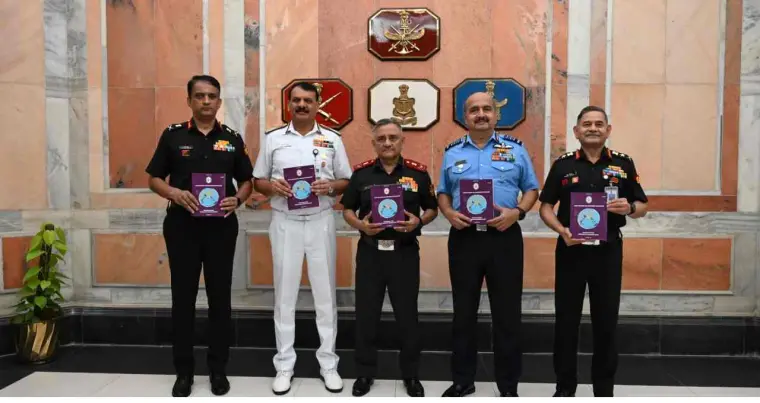

On the occasion of the first anniversary of Operation Sindoor Anniversary, Rajnath Singh released a documentary film at the two-day Joint Commanders Conference of top officers of the three services held in Jaipur.
New Delhi: Many important decisions and announcements related to the defense sector were made in the two-day Joint Commanders Conference held in Jaipur with the aim of strengthening India’s military preparedness and future war strategies. During the conference, India’s Defense Minister Rajnath Singh released a special documentary film based on ‘Operation Sindoor’, while Chief of Defense Staff Anil Chauhan released three new military doctrines for future wars.
The main objective of the conference was to establish better coordination between the three services—Army, Navy and Air Force—and strengthen military capabilities in line with modern technological challenges.
Release of film based on ‘Operation Sindoor’
The 28-minute documentary film released during the conference highlights India’s security challenges and military action against terrorism. The events from the 26/11 Mumbai terror attacks to the recent Pahalgam attacks were presented in a sequential manner in the film. Besides, it also depicts in detail the decisive action and strategic success taken by the Indian forces during ‘Operation Sindoor’.
The aim of the film is believed to be to highlight India’s military and political response to terrorism and regional security challenges internationally.
Emphasis on AI and cyber security in future wars
On the first day of the conference, there was a special discussion on the changing nature of modern warfare. Defense experts and military officials believe that future wars will not be limited to traditional borders but will also be fought in areas such as cyberspace, space and artificial intelligence. The conference stressed the need to strengthen artificial intelligence (AI), unmanned systems, cyber security and digital warfare capabilities.
Along with this, priority was also given to increasing self-reliance in indigenous technologies and defense production. The program also showcased several modern military technologies and defense systems developed in India.
Discussion on theater command and joint military structure
A major agenda of the conference was to increase jointness among the Indian forces and to move rapidly towards theater command. The theater command model aims to bring the three services into an integrated operational framework to ensure a coordinated and rapid response in war or emergency situations.
According to sources, CDS General Anil Chauhan has already submitted the report related to theaterisation to the Defense Minister. Now this proposal is awaiting the approval of the Cabinet Committee on Security.
Three new military principles released
During the conference, three new military doctrines were issued keeping in mind the future war requirements. The first principle is “Manned and Unmanned Teaming Joint Primer”. Its objective is to develop better coordination between human soldiers and AI based machines on the battlefield. Under this model, drones, robotic systems and other autonomous technologies will work together with soldiers, thereby reducing risk and increasing accuracy.
The second important document is the “Military Cyberspace Policy”, which has been prepared as a safeguard for future digital wars. This policy will provide strategic direction for defense against cyber attacks, military communications security and securing information systems. The third principle relates to the bilingual Joint Staff Service Duty Pamphlet, which aims to establish better communication and coordination at the administrative and operational levels between the three services.

Comments are closed.