


Demand grows for business-tech professionals
Students entering university today are expected to graduate into a labor market shaped by Vietnam’s target of having the digital economy contribute around 30% of GDP by 2030.
As digital platforms and data systems become central to business operations, companies are placing greater value on employees who can translate data into business decisions and commercial outcomes.
According to ITviec’s Vietnam IT Salary and Recruitment Report 2024-2025, positions such as business analyst, data analyst, and product owner remain among the most sought-after roles as companies accelerate digital transformation.
These positions sit at the intersection of business and technology, requiring professionals to understand technical systems while contributing to product development, strategy, and operational planning. Business analysts typically earn between VND20 million and 30 million (US$760-1,140) per month, while senior professionals may earn more than VND40 million. Product owners can earn between VND50 million and 70 million, depending on experience.
Students learn about fields supporting digital transformation. Photo courtesy of BUV |
Minh, 27, currently works as a business analyst at a digital bank in Ho Chi Minh City. Although he graduated in business administration, he said many strategic roles required stronger capabilities in data analysis and collaboration with technical teams.
“If you only understand business but not systems, it becomes very difficult to participate in important decisions,” he said.
After nearly two years of additional study in data analysis and programming fundamentals, Minh moved into a more strategic role in digital transformation projects. His monthly income now exceeds VND35 million.
At the same time, many engineers and technology specialists are pursuing further education in business and management to strengthen their market understanding and expand career opportunities.
Industry observers note that this transition often requires substantial retraining after employees have already entered the workforce, forcing them to balance professional responsibilities with new learning demands.
As artificial intelligence and automation continue to reshape industries, the need for hybrid skill sets is becoming more urgent. Repetitive and process-driven roles face increasing automation risk, while positions involving analysis, decision-making, and cross-functional collaboration are expected to remain in demand.
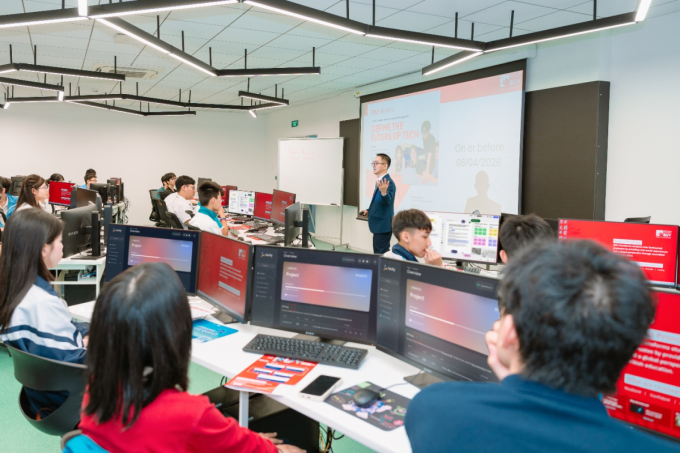 |
Small class sizes allow students to receive close guidance and regular feedback. Photo courtesy of BUV |
Universities adapt to changing workforce needs
In response, universities in several markets have begun introducing integrated programs that combine business and technology training.
Manchester Metropolitan University is among the institutions developing this model. Its business school holds Triple Crown accreditation from AACSB, AMBA, and EQUIS.
In Vietnam, the approach has been introduced through the Business Technology bachelor’s program at British University Vietnam, delivered in partnership with Manchester Metropolitan University.
One challenge commonly associated with interdisciplinary programs is the risk of broad but shallow learning. According to the university, the curriculum is structured to balance interdisciplinary training with academic depth, focusing on how businesses operate, how data is used to solve problems, and how technology supports business growth.
The program also aims to address the rapid pace of technological change by emphasizing adaptability and continuous learning rather than focusing solely on current technologies.
 |
BUV students attend internship interviews with partner companies. Photo courtesy of BUV |
To improve workplace readiness, students are assessed through projects and business case studies instead of relying entirely on written examinations. Through partnerships with businesses and industry networks, students are also exposed to professional environments during their studies.
Graduates receive degrees from both Manchester Metropolitan University and British University Vietnam. Students may also transfer abroad after two years or continue into postgraduate programs at overseas partner institutions.
Potential career paths include digital transformation consultant, business technology analyst, IT project manager, data strategist, and product innovation specialist across sectors such as banking, e-commerce, manufacturing, and technology.
With overseas study costs in the U.K. often exceeding $114,000 over three years, studying in Vietnam while earning an internationally recognized degree is increasingly being positioned as a lower-cost alternative. The program is currently offering scholarships for its first intake.
British University Vietnam (BUV) is the first university in Vietnam to receive a five-star rating from Quacquarelli Symonds and the first university in Vietnam and ASEAN to achieve global quality accreditation from the U.K.’s Quality Assurance Agency for Higher Education (QAA), one of the world’s most respected higher education accreditation bodies.
BUV’s academic programmes are systematically designed and continuously updated to reflect the latest industry trends, with a strong focus on combining theory and practice. The university says 100% of its students either secure employment or continue to higher education within three months of graduation.
More information about the program is available at BUV – Business Technology Program.
Comments are closed.