

101
A particularly sensitive front is the proposed implementation of the Uniform Civil Code within six months of assuming office,
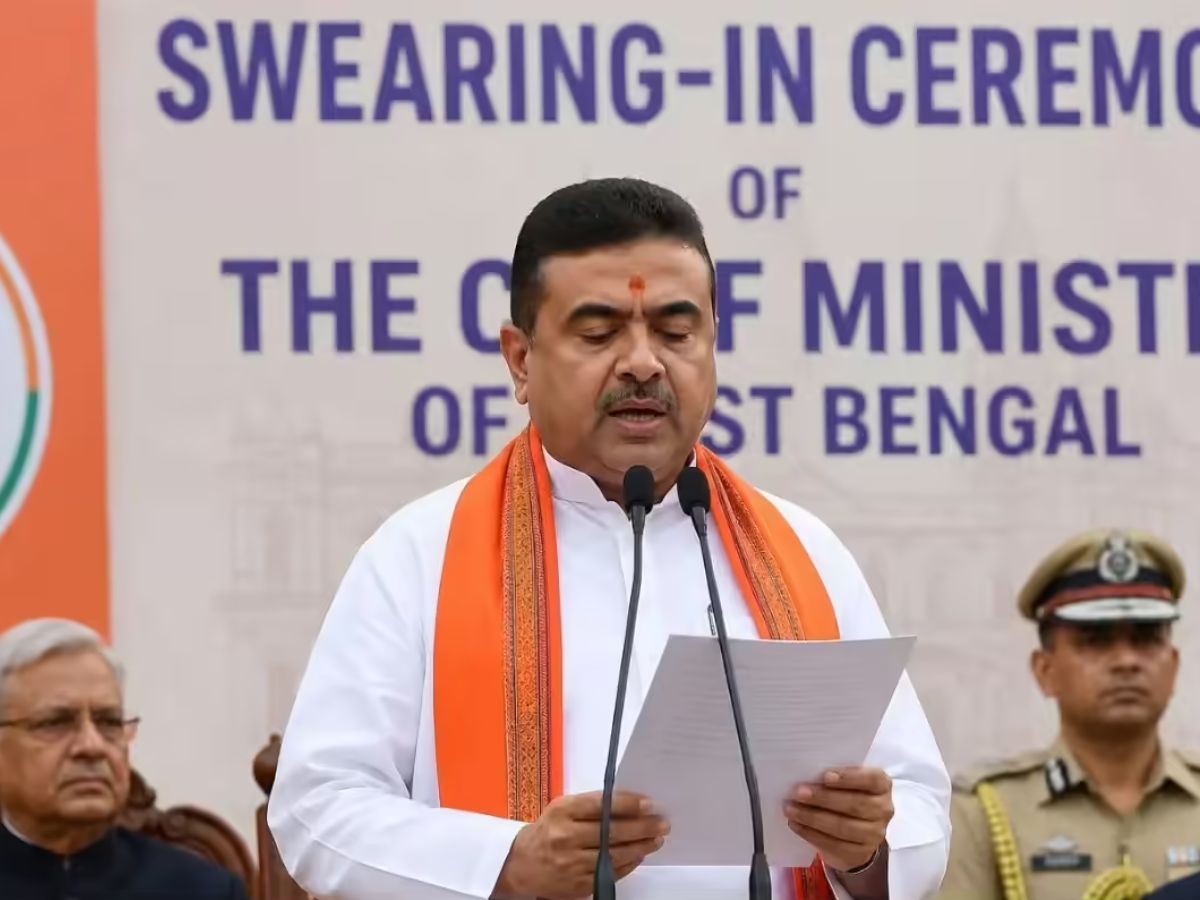
At precisely 11:32 a.m. on Saturday, Suvendu Adhikari – the Nandigram strongman, former Trinamool Congress Transport Minister turned BJP’s most combative face in Bengal – took the oath of office as the ninth Chief Minister of West Bengal and the BJP’s first Chief Minister at a teeming Brigade Parade Ground in central Kolkata, ending 14 years of Mamata Banerjee’s unbroken rule.
The ceremony, held on the very maidan where the Left Front once consolidated its dominance, marked what Prime Minister Narendra Modi, addressing BJP workers in New Delhi after the May 4 results, called a moment when “the lotus has bloomed in Bengal.”
With 207 seats in a 294-member Assembly, the BJP secured a mandate that ousted the Trinamool Congress and ended Mamata Banerjee’s rule in the State. The scale of the win – well beyond the majority mark of 148 – has given the incoming Government a clear legislative mandate. But translating an election campaign built on grievance, identity and national security into a governance programme for one of India’s most complex and politically charged States will be the defining challenge of Adhikari’s tenure.
The priorities of the new Government stem from border security and CAA implementation to industrial revival and accountability – that the party has set for itself through months of campaigning.
BORDER FIRST
If there was one issue that anchored the BJP’s campaign in the run-up to the April 23 and April 29 polls, it was the question of illegal infiltration across the Bangladesh border.
Alleged infiltration from Bangladesh remained one of the BJP’s key campaign themes, with Prime Minister Modi, Home Minister Amit Shah, and Adhikari himself repeatedly accusing the outgoing Trinamool Congress Government of facilitating cross-border movement and failing to curb smuggling.
The rhetoric to intensify detection, deportation, and documentation drives along the Bangladesh–West Bengal frontier reached a crescendo in the final days. Speaking at the BJP legislature party meeting in Kolkata on May 8, the day before his swearing in, Adhikari placed the issue at the very top of his Government’s agenda. “Infiltration has to be stopped,” he said, pledging that the new Government would fulfil all commitments made in its election manifesto. Shah, who addressed the same gathering, left little ambiguity about what he expected from the State. “Once the party forms Government in Bengal, infiltration and cow smuggling will be impossible,” Shah declared.
The incoming Government is expected to coordinate closely with the Border Security Force and the Centre to accelerate border fencing along the 2,200-kilometre India-Bangladesh frontier, large stretches of which remain unfenced or poorly patrolled.
Adhikari has advocated for increased surveillance at the border, organised protests near the border in the context of anti-Hindu violence in Bangladesh, and has linked concerns about demographic change to illegal immigration.
The new Government is also likely to push aggressively for the implementation of the Citizenship Amendment Act, which BJP leaders said would be fast-tracked under a BJP Government in Bengal, promising to speed up citizenship processing for persecuted Hindu refugees, particularly the Matua community.
IMPLEMENTING THE UNIFORM CIVIL CODE
A particularly sensitive front is the proposed implementation of the Uniform Civil Code within six months of assuming office, a promise that surfaced in the Sankalp Patra, the BJP’s manifesto. Shah repeatedly held that this would “ensure equal rights for women across communities” and “end the perception that some citizens are above the law.” Adhikari has used somewhat softer language, speaking of “a common civil code based on constitutional values” that would protect women’s rights and simplify inheritance and marriage-related disputes.
ACCOUNTABILITY AND THE SCAM QUESTION
The second plank of the BJP’s Government agenda draws directly from its campaign messaging on corruption. During the campaign, Amit Shah released chargesheets on alleged TMC scams and promised to recover stolen money with interest. The school recruitment scandal – in which thousands of Government teaching posts were allegedly sold through bribes, triggering prolonged agitation and court intervention – remained a raw wound throughout the campaign. The BJP had promised that a change of Government would mean full accountability.
Adhikari’s Government is expected to constitute a Special Investigation Team or expand the mandate of existing Central agency investigations into the recruitment scam, the Saradha chit fund case, and other myriad irregularities. Shah also hammered the law-and-order and women’s safety issues throughout the campaign, framing them as products of governance failure under the TMC.
WOMEN’S SAFETY: FROM CAMPAIGN PLANK TO POLICY
The August 2024 rape and murder of a trainee doctor at R. G. Kar Medical College in Kolkata was a watershed moment in Bengali public consciousness, and the BJP weaponised it with extraordinary effect. Modi, at a rally in Asansol, said that from the distressing incidents at RG Kar Medical College to the situation in Sandeshkhali, the TMC had consistently stood in support of perpetrators, adding: “The women of Bengal today find themselves unable to feel safe or secure. If there is any single party committed to granting women their rights, that party is the BJP.” The symbolism was made flesh on the campaign trail. At Panihati in North 24 Parganas, Modi pointed to the party’s candidate Ratna Debnath – the mother of the RG Kar rape-murder victim – saying: “This mother helped her daughter become a doctor. But that daughter was taken away from her by the TMC. We have made that mother a candidate.” That candidate, Ratna Debnath, won the Panihati seat. The new Government has signalled that fast-track courts for crimes against women, increased police accountability, and an overhaul of the State’s forensic infrastructure will be among its early legislative priorities.
JOBS, INDUSTRY AND THE RETURN OF INVESTMENT
Perhaps the most consequential long-term test for the Adhikari Government will be economic revival. Modi, at a rally in Durgapur during the campaign, recalled that Bengal was once the hub of Indian industrial development, noting that youth were leaving the State in search of employment while industries were shutting down, and pledging: “If BJP forms the Government in Bengal, it will turn the State into the top industrial region in the country.” He further alleged that TMC’s “goonda tax” had been a structural deterrent to investment. The BJP’s manifesto for West Bengal 2026 emphasised generating employment through industrial corridors, MSME support, and attracting private investment, and promised to boost manufacturing, IT hubs, and startup ecosystems to tackle unemployment in the State. The Government is expected to convene a Global Bengal Investment Summit within its first year, seeking to reverse the perception – prevalent among industrialists since the Tata Nano episode of 2008 – that Bengal is a hostile environment for capital. Modi, addressing party workers after the results were declared, promised jobs for the youth and increased safety for women, and said the first Cabinet meeting would implement Ayushman Bharat in the State – the Centre’s flagship health insurance scheme, which the Banerjee Government had refused to adopt for over five years, depriving an estimated seven crore eligible beneficiaries of coverage of up to Rs 5 lakh per family per year.
WOMEN, YOUTH, AND SOCIAL-ENGINEERING NARRATIVES
The Rs 3,000 monthly dole to women and youth is being positioned as the cornerstone of the BJP’s socialengineering push in Bengal. Shah justified it as a way to “empower women financially” and “break the cycle of single-party patronage.” Party spokespersons have also promised free bus travel for women in Governmentoperated buses, framing public transport safety and accessibility as part of women’s “freedom.”
Suvendu Adhikari amplified this in his speeches, saying that women will be “the eyes and ears of our Government,” with designated “women-grievance cells” in every district. The emphasis on youth, meanwhile, has been tied to the Rs 3,000 monthly support, skill-training centres, and promised IT-incubation hubs in tier-two towns. “We will not let Bengal’s talent be wasted,” Adhikari said. “We will create Bengal’s Silicon Valley here, not in Bangalore.”
THE IDENTITY QUESTION
Running beneath all of these policy planks is a more contested terrain: identity.
Shah, invoking the founding president of the Bharatiya Jana Sangh, said that the BJP’s victory in Bengal fulfilled a decades-long political aspiration: “Since 1950, we’ve embarked on this journey under the leadership of Syama Prasad Mookerjee. Today, in his own birthplace, in 2026, Syama Prasad Mookerjee’s Government is being formed.” Modi, in his victory address on May 4, invoked the spirit of Sri Aurobindo and Rabindranath Tagore, recounting that the Nobel laureate had wished for a country where one can hold one’s head high without fear, and said that their spirits will be at peace at last. The appropriation of Bengal’s intellectual and cultural heritage – a deliberate counter to TMC’s Bengali asmita campaign – will continue to shape how this Government communicates its identity.
During the campaign, the BJP conspicuously stopped criticising TMC’s welfare schemes such as Lakshmir Bhandar – which provides a monthly cash transfer to women – and instead promised higher payouts and faster delivery. The incoming Government is thus committed to continuing, and in some cases expanding, the welfare architecture it had spent years attacking in opposition.
THE ROAD AHEAD
The BJP built a granular organisational apparatus over five years in West Bengal, using the Panna Pramukh system with one dedicated worker per 30 to 60 voters, personally linked to 10 to 15 families for voter tracking. Winning the election was, in the party’s own assessment, the easier part. Governing West Bengal – with its traditions of labour militancy, its linguistic pride, its sharply polarised communal geography, and an entrenched bureaucracy shaped over decades by Left and then Trinamool patronage – is a different proposition altogether.
The Adhikari Government’s first 100 days will be closely watched: for the speed of Ayushman Bharat rollout, for any early moves on border security coordination, for the constitution of accountability mechanisms on the scam cases, and for whether the promised investment summits translate into factories on the ground. As one senior BJP functionary put it on the eve of the swearing-in ceremony: “Bengal does not forgive Governments that make promises they cannot keep. We know that better than anyone.” The real test of Sonar Bangla, the Golden Bengal that Modi and Shah conjured at rally after rally, begins today

Comments are closed.