
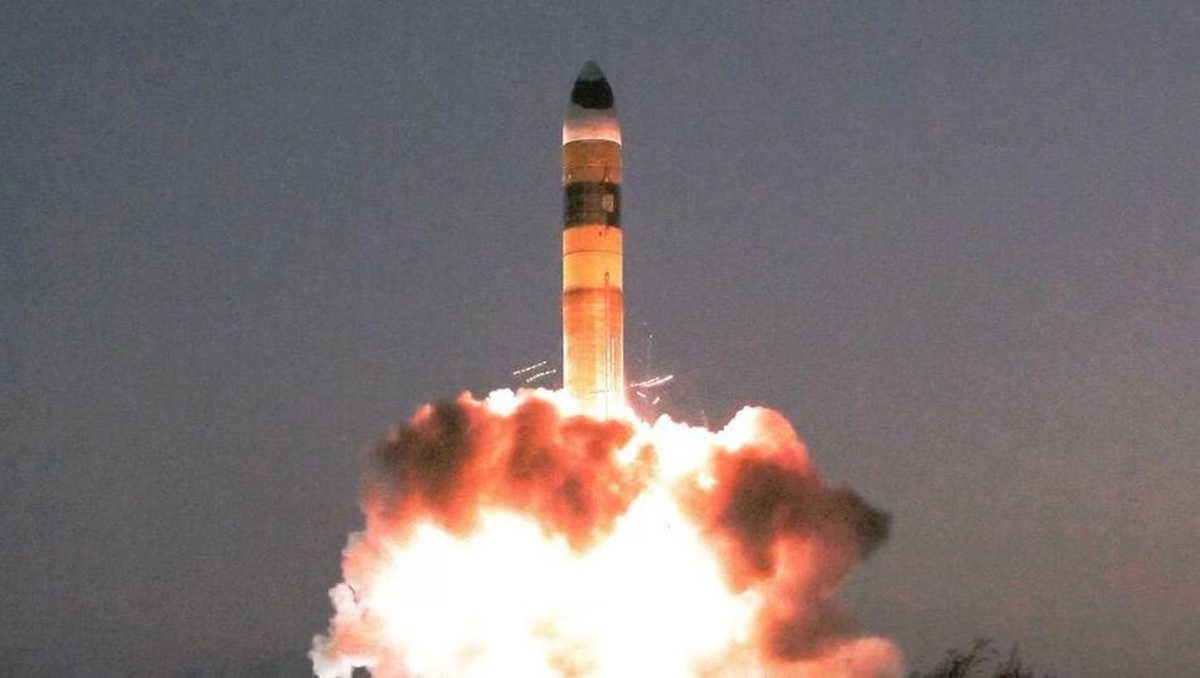
India Successfully Test Fires Agni 5 Missile With Mirv Technology With A Range Of Over 5000km

Taking its strategic and nuclear capability to new heights, India has successfully tested Agni-5 ballistic missile equipped with MIRV technology. According to the Defense Ministry, this test was conducted on May 8 from Dr. APJ Abdul Kalam Island in Odisha. With this success, India has become firmly included in the list of select countries which have Multiple Independently Targetable Re-Entry Vehicle (MIRV) technology.
The Defense Ministry said that during the test, the Agni-5 missile was launched with multiple payloads and successfully hit different targets in the Indian Ocean region. Tracking systems, radar and telemetry stations deployed on land and sea continuously monitored the missile’s movements throughout the mission. According to the ministry, all the objectives of the mission were completely successful.
MIRV technology is considered among the most advanced capabilities of modern nuclear missile systems. With its help, a single missile can attack many different targets simultaneously. Unlike normal ballistic missiles, MIRV missiles carry multiple nuclear warheads and each warhead can be directed towards a different target. Defense experts believe that this version of Agni-5 may be capable of carrying four to five warheads, although the government has not made its official number public.
After this achievement, Defense Minister Rajnath Singh congratulated DRDO and the Indian Armed Forces. He said that this success will further strengthen India’s security preparedness and increase its ability to deal with future challenges. India first tested the Agni-5 missile with MIRV technology in March 2024. That mission was named Mission Divyastra by Prime Minister Narendra Modi. Even at that time this test was considered a major leap in India’s defense technology.
Advanced Agni missile with MIRV (Multiple Independently Targeted Re-Entry Vehicle) system was successfully tested from Dr. APJ Abdul Kalam Island, Odisha on 08th May 2026.
The missile was flight tested with Multiple payloads, targeted to different targets spatially distributed… pic.twitter.com/W7ufT7pwbt
— DRDO (@DRDO_India) May 9, 2026
Agni-5 is among India’s longest-range indigenous ballistic missiles. Its range is said to be more than 5000 kilometers, making it capable of reaching large parts of Asia. The missile has a three-stage solid fuel engine, which gives it high speed and long range strike capability.
The Agni missile series developed by DRDO consists of several variants. The range of Agni-1 is about 700 kilometers, Agni-2 is 2000 kilometers, Agni-3 is 3000 kilometers and Agni-4 is about 4000 kilometers. Agni-5 is considered to be the most advanced missile of this series.
According to defense experts, completely indigenous technology has been used in the MIRV system of Agni-5. Indian avionics, high-accuracy sensors and modern navigation systems have been installed in it. The special thing is that the first MIRV test conducted in 2024 was led by a woman scientist of DRDO and a large number of women scientists played an important role in that mission.
India’s nuclear policy is based on the “No First Use” principle. This means that India will not launch a nuclear attack first, but if it is attacked, it will retaliate on a large scale. In India, the final decision on the use of nuclear weapons lies in the hands of the political leadership and the Prime Minister is the head of the Political Council of the Nuclear Command Authority.
India has the capability to launch nuclear attack through all three mediums, land, sea and air, which is called Nuclear Triad. Recently, the Indian Navy has also inducted its third nuclear powered ballistic missile submarine INS Aridman into service, further strengthening the maritime nuclear capability.
According to the Stockholm International Peace Research Institute (SIPRI) report, India had about 180 nuclear warheads by January 2025. In the same report, China is estimated to have about 600 nuclear warheads and Pakistan to have about 170 nuclear warheads.
Also read:
Terror attack alert in Delhi; Capital on high alert after Shahzad Bhatti module busted
Superstar Vijay becomes Chief Minister of Tamil Nadu, after 60 years the state gets its first non-Dravidian CM
The brutality of Islamic jihadists in Mali; 80 people feared dead
Himanta Biswa Sarma will become Chief Minister for the second consecutive time, date fixed

Comments are closed.