

StarDream Cruises, which operates three vessels, said its operating costs have risen, largely driven by higher global fuel prices, as reported by Channel News Asia.
Its president, Michael Goh, said the line’s Asia itineraries, including those stopping in Singapore, have remained broadly stable, though “selective adjustments” have been made across parts of its network as part of routine operational optimisation.
In March, StarDream Cruises announced a SGD15 (US$11.82) per-person fuel surcharge linked to rising costs stemming from the Middle East conflict.
These decisions “have been carefully managed and have not materially impacted the overall guest experience,” Goh said.
The company has also rolled out measures such as route and itinerary adjustments, speed management and energy efficiency initiatives across its fleet.
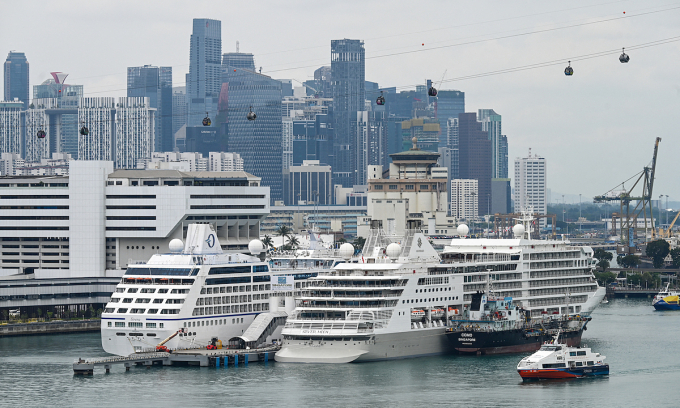
Cruise ships are docked at the Habourfront cruise centre in Singapore on February 24, 2026. Photo by AFP |
International cruise arrivals to Singapore rose 10% year-on-year in March, according to the Singapore Tourism Board.
The board’s director of cruises, Chitra Rajesh Kumar, identified Indonesia, mainland China and Malaysia as the three leading source markets.
“Correspondingly, cruise passengers from these markets also increased during this period,” she said.
The primary marine fuel used by cruise ships saw its global price spike from roughly $550 per tonne in February to a peak of around $1,060 per tonne in March, according to price-tracking platform Ship & Bunker. As of May 5, the price stood at $975 per tonne.
This is why some operators have revised their routes in response to the geopolitical situation and the energy crunch.
Oceania Cruises, which has 14 scheduled Singapore departures between 2026 and 2028, said it has rerouted its ship Oceania Vista, originally set to transit the Suez Canal on a voyage from Singapore to Southampton in the United Kingdom. The vessel will now sail via Cape Town, South Africa, and up the continent’s west coast.
“The safety and security of our guests and crew is our number one priority and given the current state of the conflict in the Gulf States, the most prudent course of action is to officially alter the itinerary at this time,” a spokesperson said.
Similar moves are being made elsewhere. Regent Seven Seas Cruises said its 20-night sailing from Bangkok earlier this month, which was originally due to end in Doha, Qatar, will now disembark in Mumbai, India.
StarDream Cruises said its operations remain centred on Southeast and East Asia, which Goh said helps “minimise exposure to affected regions.”
Despite the headwinds, cruise holiday demand has proven resilient, according to the Singapore Tourism Board.
“The cruise industry has demonstrated resilience, with cruise lines seeing steady bookings in the months ahead,” director Chitra said.
“This is supported by sustained global interest in cruising, the strength of regional source markets, and our excellent air connectivity.”
Goh said StarDream Cruises has not seen any meaningful drop in demand for its Asia sailings, with bookings continuing to benefit from strong regional interest and fly-cruise packages.
“Demand trends remain stable and encouraging, with more travellers also exploring cruising as a convenient and value-driven option, offering greater pricing certainty compared to land-based travel where costs can be more variable,” he said.
Singapore continues to see steady advance bookings, underpinned by broader industry growth projections that forecast global cruise passenger numbers reaching 42.1 million by 2029, up 13% from 2025, according to the Singapore Tourism Board.
Further growth is anticipated, as the country is set to invest more in cruise infrastructure to accommodate rising demand across Asia.
Authorities are assessing the viability of a new integrated cruise and ferry terminal at Straits View, located next to the Marina Bay Cruise Centre Singapore, as part of the broader Greater Southern Waterfront development, Travel Weekly Asia reported.
The proposed facility would feature three cruise berths and as many as 10 ferry berths, boosting passenger handling capacity to 1.5 times that of the existing Marina Bay Cruise Centre Singapore and double that of the current HarbourFront Passenger Terminal.
Cruise passengers in Southeast Asia delivered 2.4 times the economic value of the global average in 2024, with Singapore accounting for 48% of the region’s 3.9 million passenger visits, according to a recent report by consulting firm Tourism Economics.
Comments are closed.