


The project was presented at the School of Computing & Innovative Technologies Graduation Show 2026, where students showcased research and practical applications across a range of emerging technology fields.
As quantum computing is expected to contribute to advances in healthcare, manufacturing, and nuclear energy, predicting system lifespan and performance degradation remains a major challenge. Nga’s research proposes a unified hybrid modeling framework that incorporates key physical factors often absent from existing reliability models.
By combining principles from quantum physics and reliability engineering, the project seeks to improve analysis and forecasting capabilities while contributing to the development of predictive maintenance strategies for future quantum hardware.
Nguyen Dieu Nga presents her research on “A Unified Hybrid Framework for Degradation Modeling in Quantum Computing Systems.” Photo courtesy of BUV |
Titled “A Unified Hybrid Framework for Degradation Modeling in Quantum Computing Systems,” the project was developed under the supervision of Associate Professor Ali Al-Dulaimi, Head of the School of Computing & Innovative Technologies at BUV.
According to Al-Dulaimi, the research addresses maintenance-related challenges in quantum computing systems and could provide a basis for further research and future investment in the field.
Nga said her interest in artificial intelligence (AI) led her to explore the intersection of AI and quantum computing during her second year at university.
She said quantum computing has the potential to provide the computational power needed to solve increasingly complex problems, particularly in AI applications involving large-scale data processing and performance optimization.
The research is currently being submitted to Q1 academic journals, reflecting the potential for BUV students to contribute to international academic research.
Nga’s project was one of 28 featured at Graduation Show 2026, an event highlighting student research and applications in areas including operating systems, cybersecurity, AI, digital mapping, and Internet of Things (IoT) technologies.
More than a year-end showcase, the exhibition aimed to demonstrate how students apply academic knowledge to practical challenges while engaging with emerging technology trends.
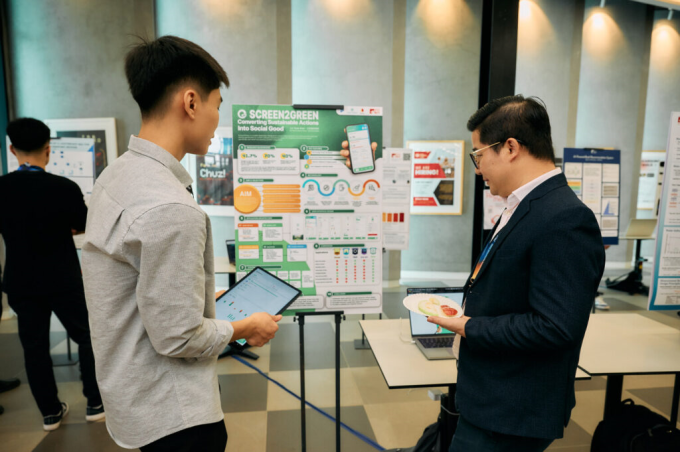 |
Participants at BUV’s Graduation Show 2026, where 28 projects were showcased. Photo courtesy of BUV |
The projects covered topics ranging from intrusion detection systems to AI-powered waste classification and IoT solutions for smart cities.
Beyond technical problem-solving, the projects also reflected students’ implementation skills, systems thinking, and practical orientation.
The event attracted representatives from technology companies operating in Vietnam.
Pham Quang Vinh, Senior Product Development Manager and IoT Engineer at One Mount Group, said the students demonstrated strong technical knowledge and creative approaches to problem-solving.
“The students here are highly talented, creative, and dynamic. They demonstrate deep expertise in their chosen areas, along with an innovative mindset in tackling challenges with long-term value,” he said.
The Graduation Show also provided students with opportunities to present their work directly to industry representatives, faculty members, and parents.
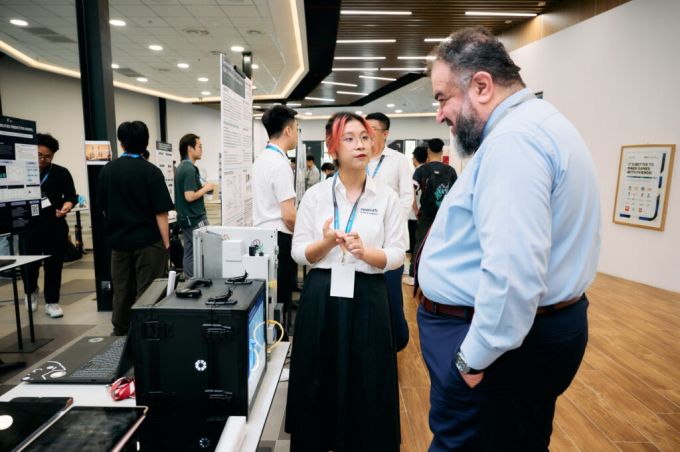 |
Phung Ngoc Diep presents a project developed from her internship at Bosch Rexroth. Photo courtesy of BUV |
Comments are closed.