
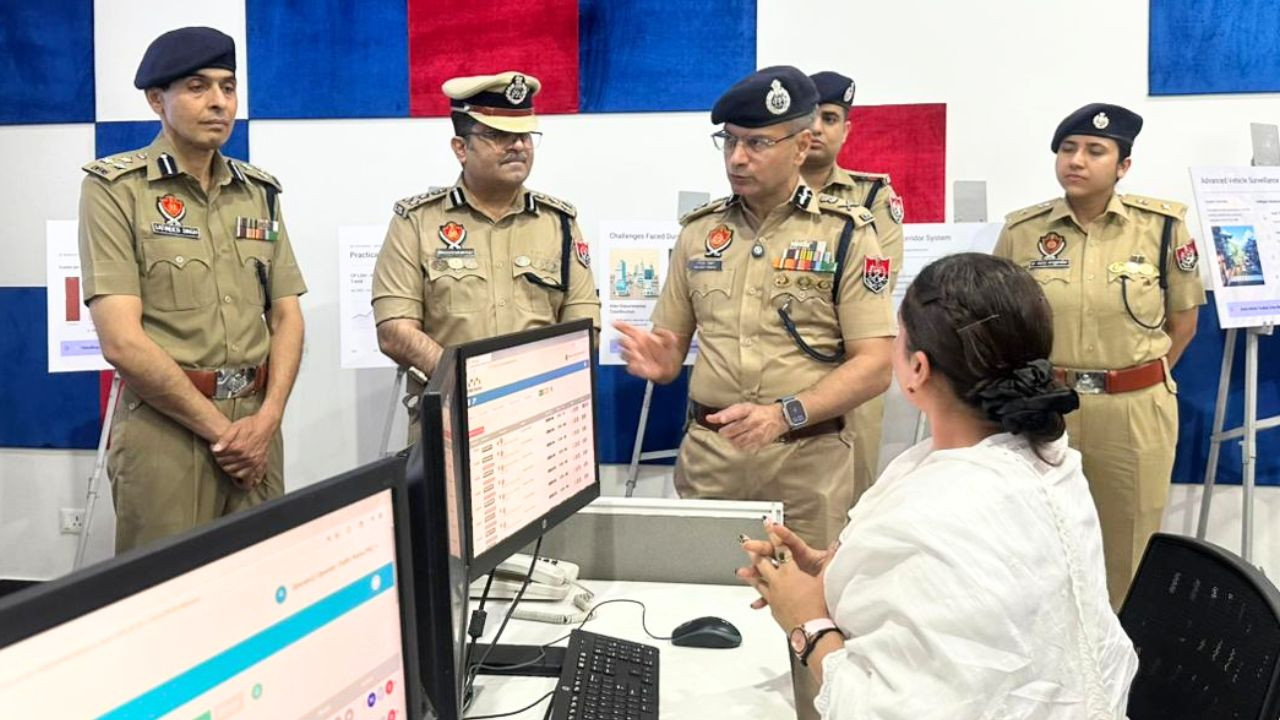
Hi-tech ICCC of Punjab Police; Now digital clampdown on criminals, know what is ICCC system?

Mohali: The state-of-the-art Integrated Command and Control Center (ICCC) launched by Punjab Police is setting new standards in modern policing across the country. From tracking the activities of criminals to arresting miscreants, Punjab Police is now achieving the goal of ‘Safe Punjab’ more effectively by combining Artificial Intelligence and human intelligence of its personnel.
Today, I visited #Ludhiana as part of my ground-zero tour, reviewing on-ground policing and reinforcing our focus on smart, technology-driven systems. Held a comprehensive meeting with field officers, emphasizing swift and citizen-centric resolution of public grievances.
The… pic.twitter.com/07IJBDDQbd
— DGP Punjab Police (@DGPPunjabPolice) May 5, 2026
What is ICCC system?
Recently, Punjab Director General of Police (DGP) Gaurav Yadav inaugurated the Integrated Command and Control Center (ICCC) in Ludhiana. Under this project, around 1,700 high-resolution cameras have been installed at 259 locations in the city, thereby further strengthening the surveillance system of the city, which is considered the ‘industrial hub’ of the country.
Jalandhar is also emerging as a big example of the success of ICCC project. This surveillance network of 1,007 high-resolution cameras installed across the city has played a vital role in solving many cases. The ICCC helped reconstruct the activities of the accused in the case of armed robbery of gold worth Rs 1 crore and Rs 2 lakh cash at a jewelery shop in Bhargava Camp. With the help of ICCC, the police synchronized the footage from 12 junctions and tracked the escape route of the accused through the streets of the city, traced their whereabouts and recovered the stolen property.
Big success of ICCC
ICCC also played a big role in linking digital evidence in the investigation of the grenade attack on the house of former minister and BJP leader Manoranjan Kalia. The investigators created a visual trail of the movements of the suspects from the crime scene to Jalandhar Railway Station. One of the accused was later identified based on the footage and arrested from Delhi after being tracked across four states through an online transaction of Rs 3,500 made during the absconding.
High-resolution tracking cameras also played an important role in establishing better coordination. In the Santokhpura firing case, some attackers had fired about 12 bullets at the house of a veterinary doctor. High-resolution cameras captured one accused filming the firing and the other firing. The movements of the accused were traced to key surveillance routes based on visual markers created in coordination with ICCC and local private CCTV cameras.
After investigation, two accused were arrested and two weapons were recovered. After Aam Aadmi Party leader Satwinderpal Singh ‘Lucky’ Oberoi was shot dead in Model Town, ICCC provided assistance in the investigation through recognition analysis.
In the CCTV footage, the attacker wearing a black hoodie and one of his associates were clearly seen on a black two-wheeler. Later this information was matched with the digital claims related to the gang, on the basis of which the names of the main accused appeared in the police report.
The high-level detection system was used in the investigation of the Western Union cash robbery incident that took place at a travel shop in Harnamdas Pura, where some masked miscreants committed the robbery of ₹1.08 lakh. Cameras recorded the movement of the accused, despite wearing masks, and operators tracked their movements across several streets before the crime.
Total 982 fixed cameras installed in Jalandhar
A total of 982 fixed cameras have been installed in Jalandhar for continuous surveillance and security, while 15 cameras are with pan-tilt-zoom technology, capable of active tracking. Facial recognition systems for biometric matching have been installed in transit hubs at a total of 10 locations, while Wi-Fi hotspots and additional sensors are available at 20 locations. ICCC operators can sift through thousands of hours of footage in a matter of seconds based on signals like ‘red shirt’, ‘white SUV’ or ‘vehicle speed’.
Statement of DGP Gaurav Yadav
In this regard, DGP Gaurav Yadav said, “Punjab Police has a zero tolerance policy against organized crime and gangsters. While on one hand the police force is carrying out successful operations against criminals and gangsters at the grassroots level, ICCC established in various districts of the state is helping in making this work more efficient. Punjab Police is able to reach the roots of crime and with the recent technological developments our objective is completely clear.”
Automated algorithms continuously scan over 1,000 camera feeds and identify suspicious activities. These include detection of unclaimed objects, analysis of crowd formation to identify illegal crowds, and issuing alerts when cameras are tampered with, which immediately triggers manual review.
Statement of Police Commissioner Dhanpreet Randhawa
Jalandhar Police Commissioner Dhanpreet Randhawa said, “The ICCC acts as the ‘brain’ of the city, transforming raw data into useful intelligence. Through a ‘single pane of glass’ dashboard, traffic density, crime hotspots and municipal corporation sensor data are linked into a unified GIS based interface. This has further accelerated coordination between police, traffic and municipal departments.”
He further said, “Artificial Intelligence has further improved policing, but its proper use is most important. Punjab Police makes effective use of ICCC to continuously monitor the miscreants. It is a great combination of Artificial and Human Intelligence. ICCC has given additional strength to many projects like ‘Gangster Te War’, ‘Operation Prahaar’.”
Inaugurated in Ludhiana
Under the recently inaugurated ICCC in Ludhiana, various units like Traffic, Police Control Room (PCR), Safe City and Wireless have been integrated under one roof, which has significantly increased coordination and coordination in police work and reduced the response time of PCR from 15 minutes to about 7–8 minutes.
Under the ICCC project, 1,700 high-resolution cameras have been installed at 259 locations in Ludhiana, further strengthening the city’s surveillance system. Along with this, Intelligent Traffic Management System (ITMS) has also been installed at 46 different locations.

Comments are closed.