
Helicopter saves 11 from Atlantic with 5 minutes of fuel left after Bahamas plane ditches off Florida

The Beechcraft 300 King Air twin-engine turboprop, on what should have been a 20-minute hop from Marsh Harbour to Freeport in the Bahamas, instead went down about 80 miles east of Melbourne, Florida, on May 12, the U.S. Coast Guard said. By the time rescuers reached them, the 11 Bahamian adults on board had been crammed into a single yellow raft for roughly five hours, with no idea anyone was looking for them and no sign of the plane or any wreckage.
“I have not known anyone to survive a ditching in the ocean,” Maj. Elizabeth Piowaty, the aircraft commander on the HC-130J Combat King II that first reached the scene, told reporters at Patrick Space Force Base on May 13. “From what I’ve seen, for all those people to survive is pretty miraculous,” The Guardian reported.
The operation began at about 11 a.m. on May 12, when an emergency locator transmitter on the downed aircraft alerted U.S. Coast Guard Southeast District watchstanders, the 920th Rescue Wing said in a statement. A 920th Rescue Wing HH-60W Jolly Green II helicopter was already airborne on a training mission and was redirected to the search. Piowaty’s HC-130J joined the effort and dropped a package of food, water and additional flotation to sustain the survivors until the helicopter could begin hoisting them, SCMP reported, citing the Coast Guard.
Using a winch and basket, the helicopter crew completed nine hoists in roughly an hour to pull all 11 survivors from the raft as a thunderstorm closed in. Lt. Col. Matt Johnson, who piloted the helicopter, told the press conference his aircraft had only about five minutes of fuel left when the last survivor came aboard, NBC News reported. He described that point as “bingo time,” military shorthand for the moment a crew has to break off and head back to base. The HH-60W can refuel in flight, Johnson said, but using that capability would have delayed getting survivors, some of whom needed urgent medical attention, to shore.
Capt. Rory Whipple, a combat rescue officer who was lowered to the raft, said the survivors “were in distress, physically, mentally, emotionally” after their hours in the open water.
“They didn’t even know that we were coming until we were directly overhead,” he said. “On someone’s worst day, we are at our best to bring everyone home.”
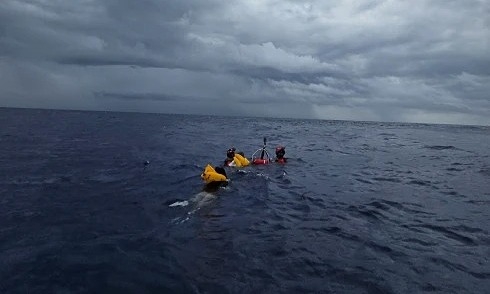
This photo provided by the U.S. Air Force shows rescue operations underway for survivors of a downed civilian aircraft off the coast of Melbourne, Fla., Tuesday, May 12, 2026. Photo courtesy of U.S. Air Force/DVIDS via AP |
The pilot, identified by CBS News as 43-year-old Bahamian aviator Ian Nixon, said the chartered flight lost one engine, then the second, then its radios and navigation before he was forced to ditch.
“Basically, lost my navigation, all radios. Flying over 25 years and I’ve never seen anything like that,” Nixon, a father of three with 25 years of flying experience, told CBS News after returning to Nassau. He had tried to reach Freeport and Miami radio for help but got no response, he said.
The survivors were flown to Melbourne Orlando International Airport and taken to Holmes Regional Medical Center, where three were treated for minor injuries and all 11 were listed in stable condition, according to CBS News.
A Coast Guard Air Station Clearwater C-27 Spartan crew and the Royal Bahamas Defence Force also assisted in the search, the 920th Rescue Wing said. The Bahamas Aircraft Accident Investigation Authority said in a statement that because the crash occurred outside Bahamian territorial waters, it would not lead the investigation but had notified relevant authorities.
The U.S. Federal Aviation Administration is investigating the cause of the engine failure.
Comments are closed.