
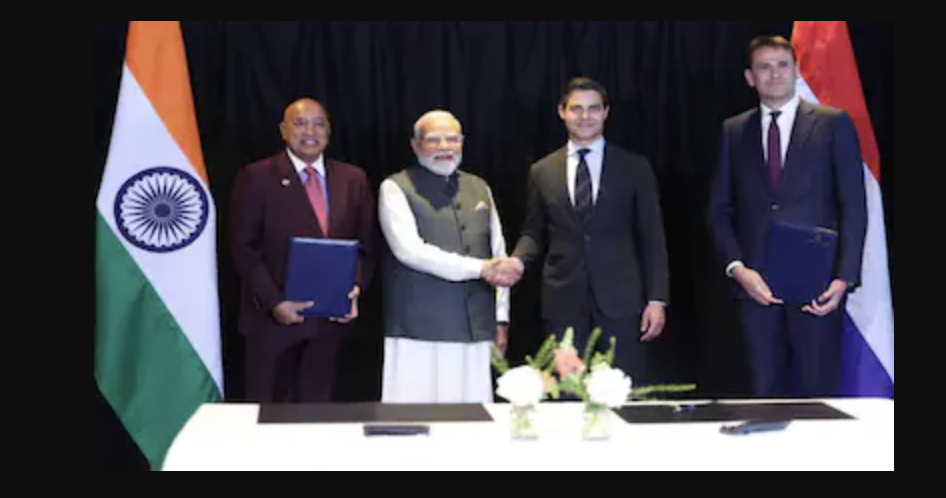

India’s semiconductor ambitions received a massive boost after Tata Electronics and Dutch chip-equipment giant ASML officially announced a strategic partnership to support India’s first commercial semiconductor fabrication facility. The partnership will focus on Tata Electronics’ upcoming 300 mm wafer fabrication plant in Dholera, Gujarat.
The announcement was made during Prime Minister Narendra Modi’s visit to the Netherlands, highlighting semiconductors as a major pillar of India-Europe technology cooperation.
Why ASML Is So Important
ASML is not just another semiconductor company.
The Dutch firm is widely considered:
- The world’s most critical chip-equipment manufacturer
- The only company capable of producing advanced EUV lithography machines used for cutting-edge semiconductor manufacturing.
Its lithography systems are used by:
- TSMC
- Samsung
- Intel
- Global semiconductor giants manufacturing advanced chips.
Without ASML’s systems:
- Modern AI chips
- Smartphone processors
- Advanced GPUs
- High-performance computing chips
…cannot be manufactured at scale.
That is why this partnership is considered one of India’s most strategically important semiconductor agreements so far.
Tata’s Dholera Fab Is A $11 Billion Project
According to reports:
- Tata Electronics is investing nearly $11 billion in the Dholera fab
- The plant will manufacture semiconductors for:
- Automotive systems
- Mobile devices
- AI hardware
- Consumer electronics.
The facility will use:
- 300 mm semiconductor wafers
- Advanced lithography infrastructure
- Cleanroom manufacturing environments.
This makes it:
- India’s first front-end semiconductor fabrication plant
- One of the country’s largest high-tech manufacturing investments ever.
ASML Will Bring More Than Machines
The partnership goes beyond simply supplying equipment.
According to the joint announcement:
- ASML will support fab establishment and production ramp-up
- Both companies will collaborate on:
- Talent development
- Lithography skill training
- Supply-chain resilience
- Semiconductor R&D infrastructure.
This is important because semiconductor fabs require:
- Extremely specialized engineering talent
- Precision manufacturing expertise
- Highly controlled supply chains.
India currently has limited experience in large-scale chip fabrication, making ASML’s involvement crucial.
India’s Semiconductor Push Is Accelerating Fast
The Tata-ASML partnership is part of India’s broader semiconductor mission.
India has already announced:
- Multi-billion-dollar semiconductor incentives
- Subsidies covering up to 50% project costs
- Multiple fab and OSAT projects nationwide.
Current major projects include:
- Tata’s Dholera fab in Gujarat
- Tata’s Assam OSAT facility
- Micron’s semiconductor plant
- Additional chip packaging and assembly units.
Reports suggest:
- Eight semiconductor-related projects are already underway in India.
India Wants To Reduce Dependence On China & Taiwan
The semiconductor industry has become strategically critical because chips power:
- Smartphones
- AI systems
- Electric vehicles
- Defense electronics
- Telecom networks
- Data centers
- Consumer electronics.
Currently:
- Taiwan dominates advanced chip manufacturing
- China controls large portions of electronics supply chains
- The US-China technology conflict has disrupted global semiconductor geopolitics.
India now wants to position itself as:
- A trusted alternative manufacturing base
- A “China+1” semiconductor destination
- A resilient global electronics hub.
Why This Partnership Is A Big Deal For India
This agreement is important because:
India is finally entering the most complex layer of electronics manufacturing.
Previously, India focused mainly on:
- Smartphone assembly
- Electronics manufacturing services
- Component assembly.
Now, the country is moving toward:
- Core semiconductor fabrication
- Advanced chip packaging
- High-tech supply chain integration.
And with ASML involved, India gains access to:
- World-class lithography expertise
- Advanced chipmaking infrastructure
- Semiconductor ecosystem development.
Bigger Picture: Semiconductors Are The New Oil
The Tata-ASML partnership reflects a global reality:
Semiconductors are now among the world’s most strategically important technologies.
Countries worldwide are racing to secure:
- Chip supply chains
- Domestic fabrication capacity
- AI hardware independence
- Advanced manufacturing leadership.
For India, the bigger takeaway is clear:
The country is no longer trying to become only an electronics assembly hub — it now wants to become a serious semiconductor manufacturing nation capable of participating in the global AI and advanced computing economy.

Comments are closed.