
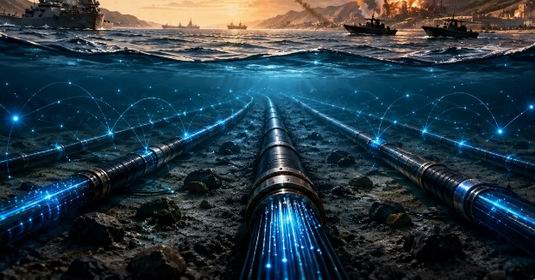
After LPG, oil, now there is a shadow crisis on the internet! Iran is preparing to use which new weapon in Hormuz?

New Delhi. After the recent war between America and Iran, fuel crisis has arisen in many countries of the world including India. Due to supply chain stalling, there is an outcry for everything from LPG to petrol diesel in import dependent countries. More than 2 months have passed since the war started, but the US and Iran are not ready to retreat, due to which the Strait of Hormuz is still closed. Meanwhile, Iran can now use a weapon that can bring the internet to a standstill in many countries. After blockading Hormuz, Iran has recently threatened to weaponize undersea internet cables.
According to reports, Iran may target the cables laid under the Strait of Hormuz, through which data is transferred between Gulf countries, Asia and Europe. At the same time, Iran is preparing to collect ‘toll tax’ on these cables from the world’s biggest tech companies. Ibrahim Zolfaghari, a media and military spokesman affiliated with the Iranian Revolutionary Guards (IRGC), recently threatened this in a post on social media. “We will impose tariffs on internet cables,” he said.
What is Iran’s plan?
According to this plan, Iran will charge huge fees from big companies like Google, Microsoft, Meta and Amazon for the use of these cables. The work of repair and maintenance of these undersea cables will be given exclusively to Iranian companies only. Iran says that if tech companies do not obey Iranian law, then internet traffic on this route can be stopped.
Internet Lifeline Below Hormuz
According to the information, many important cable systems are active under this sea route.
AAE-1 (Asia-Africa-Europe 1): This network connects Southeast Asia to Europe via Egypt.
FALCON Network: It connects India and Sri Lanka with Gulf countries, Sudan and Egypt.
Gulf Bridge International: It connects the entire Gulf region.
Why are these submarine cables so important?
According to the United Nations agency ‘International Telecommunication Union’ (ITU), 99 percent of the world’s international internet traffic runs through these submarine fiber-optic cables. These cables are the digital lifeline of countries like the UAE, Qatar, Bahrain, Kuwait and Saudi Arabia, which have invested billions of dollars in AI and cloud infrastructure in recent years. According to Geo Political analyst Masha Kotkin, if these cables are damaged, internet speed may reduce, online banking will come to a halt and billions of dollars of economic loss may occur globally.
Is there no other way?
Experts clearly say that there is no practical alternative to cables at present. According to telecom research firm ‘Telegraphy’, satellites can never handle data loads as heavy as subsea cables. Networks like Elon Musk’s ‘Starlink’ may be a limited solution, but they are not capable of handling the traffic of millions of users.
Devastation may begin again
After the American and Israeli attacks on Iran on February 28, a fierce war broke out in West Asia. There was a ceasefire between the two countries on April 8 but the situation is still not under control. US President Donald Trump on Sunday gave a stern warning to Iran, saying that the clock is ticking. If reports are to be believed, America may soon launch a major attack on Iran. In the coming days, a high-level meeting has also been called in the ‘Situation Room’ of the White House regarding this. There is talk that US President Donald Trump is furious over the lack of a deal and in view of this the fear of war has deepened.

Comments are closed.