
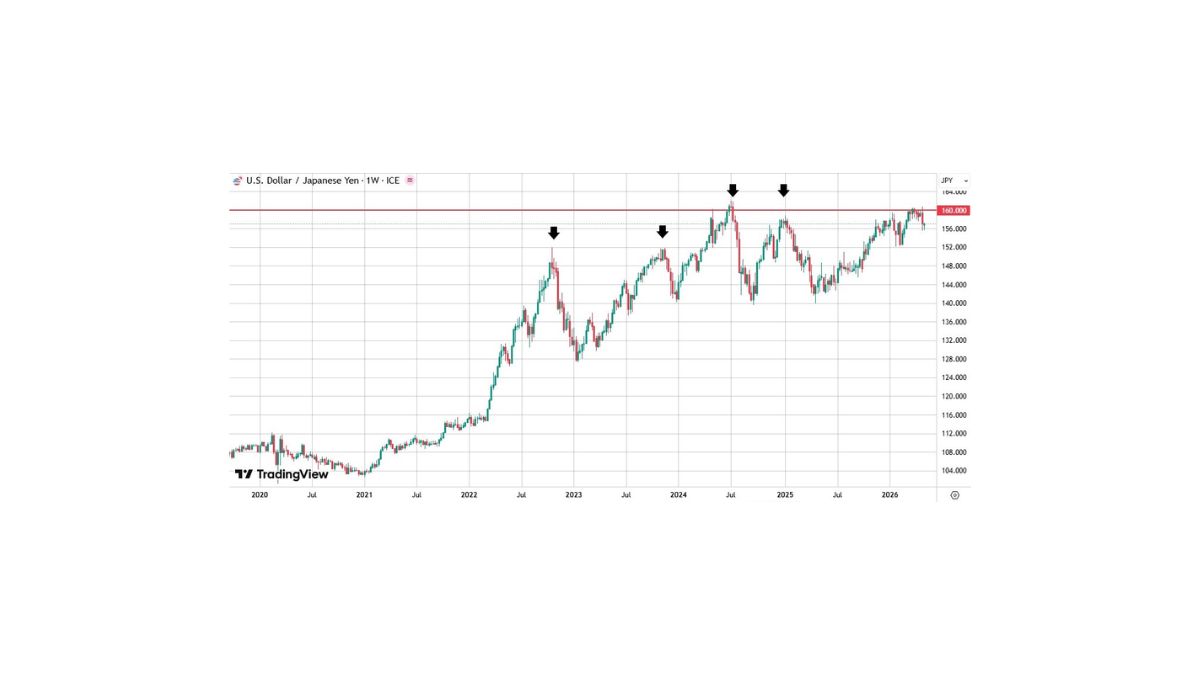

The Bank of Japan (BOJ) and the Japanese Ministry of Finance have engaged in several efforts to contain the depreciation of the yen through intervention in foreign exchange markets by selling dollars.
Over the past years, the psychological benchmark that has served as the point of reference for these interventions has changed and is currently represented by the 160 level in USD/JPY.
There have been multiple instances of interventions in foreign exchange markets conducted by Japanese institutions. Specifically, the BOJ intervened when USD/JPY traded within the range of 143 and 149. Most recently, in 2024, the stress threshold for intervention expanded to the 157–162 area. Since 2022, the market has tested the 160 level several times, despite significant intervention by Japanese authorities, estimated at more than $200 billion in total from 2022 to 2026.
All instances where the price tested the level at which the Japanese government has repeatedly attempted to intervene in order to influence USD/JPY.
Palliative measures like foreign exchange intervention can help slow the price momentum and cool off the trading environment. However, they do nothing to address or mitigate the fundamental issues that continue to exert downward pressure on the value of the yen.
The BOJ can try to pressure short sellers. However, if yen weakness is driven by higher U.S. rates, energy weighs on the trade balance, and fiscal concerns around JGBs — Japanese government bonds — then intervention will likely remain a temporary solution.
The recent rise in bond yields further complicates the situation. The BOJ has started to reduce its JGB purchases. According to current plans, monthly purchases of JGBs are expected to decline to approximately ¥2.1 trillion in Q1 of 2027. Although the BOJ has left open the option of engaging in additional JGB purchases in response to rapidly increasing long-term JGB yields, it would be a major challenge for the central bank, as this could result in yet another round of yen weakness.
Conversely, raising rates to support the yen could intensify fiscal pressure on government debt.
This is what creates the core dilemma: restrictions implemented to curb inflation could destabilize the bond market, resulting in potentially serious negative implications for the long-run sustainability of Japan’s sovereign debt obligations; whereas using expansionary fiscal policies could simply lead to a further decline in the value of the yen.
The failure of Japanese institutions to resolve the downward pressure on their currency represents a global concern.
If the exchange rate were to spiral out of control and the 160 threshold were to be decisively broken, the move could become explosive. The yen is at the heart of the operation of global financial systems. Large amounts of capital are tied to the so-called carry trade: a strategy that involves borrowing yen at very low interest rates and investing the proceeds into dollar-denominated assets that provide higher returns due to higher interest rates in the United States.
Should speculative sentiment begin to build and result in upward pressure on USD/JPYit could ultimately lead to forced intervention by the Japanese Ministry of Finance. A sudden revaluation of the yen could cause margin calls and prompt a rapid liquidation of all related carry trades along with other risk assets including equities.
A protracted closure of the Strait of Hormuz could serve as a catalyst for this crisis. This is because Japan relies heavily on oil imported from countries located in the Gulf region, making the country particularly vulnerable to fluctuations in oil price. Furthermore, Japan is experiencing the most severe energy shock in its history. Higher import costs due to a weaker yen will make these imports even more expensive. This will place an added burden on household incomes as well as businesses. Companies may opt to raise product prices in response to higher production costs. Without a long-lasting peace agreement in the Middle East, the yen is vulnerable to speculative pressure and will likely drag with it an economy that remains highly sensitive and heavily dependent on debt financing, such as Japan’s.

Comments are closed.