
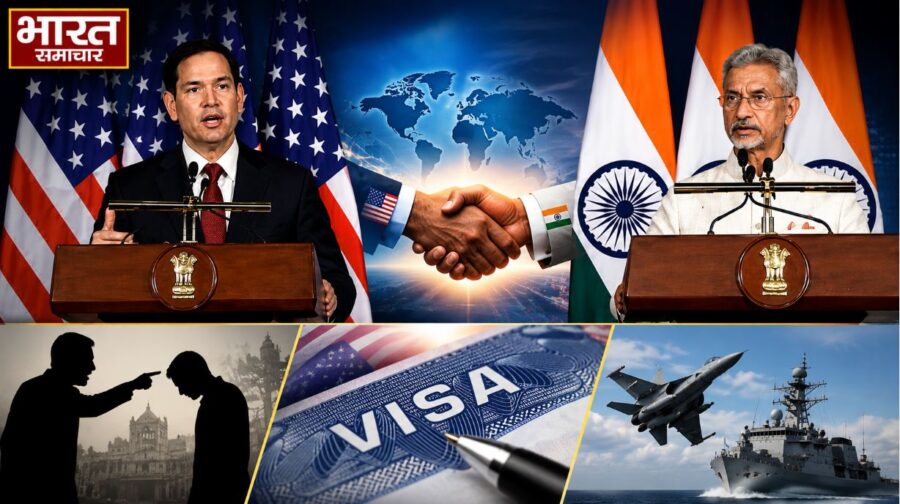
Rubio-Jaishankar’s joint talks, what happened from anti-India racism to visa crisis and defense agreements?

US Secretary of State Marco Rubio and Indian Foreign Minister S. Jaishankar addressed a joint press conference at the historic Hyderabad House in New Delhi on Sunday. The future blueprint of India-US strategic relations was presented in this press meeting organized after the high-level delegation level talks between the two leaders. Along with this, candid answers were also given on sensitive issues like changes in US visa policies, immigration crisis and increasing online racism against Indians in America.
In the press conference, US Secretary of State Marco Rubio made it clear that the relationship between the world’s two largest democracies has now gone far beyond the scope of traditional diplomacy. He said-
“A strategic partnership is something very different. It is formed when as two countries your national interests are completely aligned and you work together strategically to solve global problems.”
Rubio’s statement comes just a day after he met Prime Minister Narendra Modi during his four-day official visit to India. Many senior officials of both the countries including India’s Foreign Secretary Vikram Misri, Foreign Ministry spokesperson Randhir Jaiswal and US Ambassador to India Sergio Gore were present in this meeting.
America’s stance on changes in J1, F1 and H-1B visas
Marco Rubio clarified the situation on the changes made by America in J1, F1 and H-1B visa policies in the recent past and the confusion created among Indian professionals and students. He said that these reforms are not targeted at any one country, but are a part of the modernization of the US immigration system.
Praising the invaluable contribution of Indians to the American economy, Rubio said that Indian companies have invested more than $20 billion in the American market and America wants this investment to grow even further. Referring to America’s internal migration crisis, he said-
“The United States is currently facing a serious migration crisis. More than 20 million people have entered our country illegally over the past few years, forcing us to deal with this challenge. This has nothing to do with India. As a sovereign nation, whatever policies you make must be in your national interest.”
He assured that America is still the most welcoming country in the world, but due to this major policy reform, there may be some temporary problems in the transition period.
Strict tone on racist comments against Indian-Americans
In recent days, Rubio took a very strong stance on the question of racist and hateful comments being made targeting Indian-Americans online and on other forums in America. He said that such actions will be taken very seriously.
Citing the example of his own family (whose parents immigrated to the United States from Cuba in 1956), Rubio said, “The United States, like every country in the world, has some stupid people who say stupid things all the time. But the reality is that America is a very hospitable country and immigrants from all over the world have enriched our society and culture.”
Jaishankar’s statement on defence, interim trade agreement and ‘Make in India’
Indian Foreign Minister S. During the press conference, Jaishankar gave detailed information about the strengthening defense and economic pillars between the two countries. He announced that India and the US have recently renewed their 10-year ‘Major Defense Partnership Framework Agreement’ for a further period. Along with this, both the countries have also signed a comprehensive ‘Underwater Domain Awareness’ (UDA) roadmap.
Emphasizing on self-reliance in defense production, Jaishankar said, “We have deeply discussed the importance of taking into account India’s ‘Make in India’ approach and the strategic lessons learned from recent global conflicts while pursuing mutual cooperation in the defense sector.
Speaking on the trade front, the External Affairs Minister said both countries are committed to finalizing an ‘interim trade agreement’ as soon as possible. The agreement will lay the foundation for a larger and comprehensive bilateral trade deal in the future, which was first envisioned during Prime Minister Narendra Modi’s visit to the US in February 2025.

Comments are closed.